




Top 5 NPS Tools in India (2026): Which Platforms Actually Help CX Teams Take Action?

The best NPS tools in India help teams go beyond collecting scores by enabling multichannel feedback, multilingual AI analytics, and built-in closed-loop workflows. Execution-focused platforms like SurveySensum allow Indian CX teams to act faster and resolve issues at scale.
Request a Demo
If you’re evaluating NPS tools in India, you’re not just buying a survey platform.
You’re trying to answer this harder question:
→ How do we collect feedback across India’s real customer channels, analyze it in multiple languages, and act on it fast without blowing up budgets or timelines?
Because in India, CX isn’t linear. It’s fragmented, multilingual, WhatsApp-led, price-sensitive, and execution-heavy.
Let’s break this down properly.
The Reality of Running NPS in India
NPS in India doesn’t follow a straight path. It’s all about day-to-day execution. And here’s where execution begins to crack.
1. Customers Are Multichannel. Most Tools Aren’t.
Indian customers don’t wait for email surveys.
They:
- Reply on WhatsApp
- Respond after support calls
- Engage via SMS
- Sometimes ignore email completely
When tools are built around email-first workflows, teams start stitching together integrations just to reach customers where they already are.
That adds complexity, cost, and operational friction.
Instead of capturing feedback naturally, teams chase it.
2. Multilingual Feedback Breaks Traditional Analytics
Feedback in India rarely comes in clean, structured language.
You’ll see responses like:
“Product accha hai but delivery was late.”
This single sentence mixes English, Hindi, context, and intent.
But traditional keyword-based tagging only picks up isolated words, not context. It may tag “accha” as positive and miss the complaint hidden in “delivery was late
So, teams export responses to Excel, manually tag themes, and interpret sentiment at scale.
By the time they decode the insight, the detractor has already churned, and the issue has escalated.
Keyword tagging loses intent. Manual tagging loses time. In a high-volume Indian market, that delay directly impacts revenue.
3. Foreign Pricing Models Are Not Fit For Indian CX Reality
Many NPS platforms are priced for global markets, but Indian CX teams operate differently.
Teams here work with lean budgets, high response volumes, and strong ROI pressure. When pricing is module-heavy or usage-based, especially across channels like WhatsApp, costs quickly become unpredictable.
What Indian CX teams actually need is:
- Transparent pricing
- Easy cost forecasting
- Scalable plans without sudden spikes
- Pricing aligned with real operational usage
Because the goal isn’t just buying a platform. It’s making sure the cost of running NPS stays practical as execution scales.
4. Implementation Becomes the Hidden Bottleneck
Ask any CX leader in India: “How long did implementation actually take?”
Three months. Six months. Sometimes longer.
Heavy configuration, IT dependency, and slow onboarding kill momentum before teams even start using the system properly.
By the time rollout finishes, urgency is gone.
5. Support Speed Directly Impacts CX Execution
When something breaks at 11 AM IST, waiting a full day for support isn’t just inconvenient; it slows down resolution.
Indian CX teams need:
- Regional support coverage
- Faster troubleshooting
- Operational guidance, not just ticket responses
Because customer issues don’t pause while teams wait for help.
6. Closed-Loop Ticketing Should Be Built Inside the Platform
Feedback should not move outside the system to become action. When ticketing happens in emails, spreadsheets, or separate tools, ownership gets fragmented, and follow-ups slow down.
Indian CX teams need a built-in closed-loop ticketing system because it:
- Assigns ownership instantly
- Keeps follow-ups and history in one place
- Improves accountability across teams
- Helps teams track resolution without manual chasing
When ticketing lives inside the platform, feedback moves faster from insight to closure.
Now that the gaps are clear, the real question becomes simple: what should Indian CX teams actually expect from an NPS platform?
What Indian CX Teams Actually Need From an NPS Platform
At this point, the question shifts from “Which tool collects NPS?” to “Which tool helps teams close the loop faster?”
The answer usually comes down to a few non-negotiables:
- Multichannel reach (WhatsApp, SMS, calls, email)
- Context-aware multilingual AI text analytics
- Role-based hierarchical dashboards with access control
- Fast implementation and onboarding
- Transparent and affordable pricing
- Reliable customer support in local time zones
- Built-in closed-loop ticketing system
This is where tools start separating themselves.
So, before choosing a platform, let’s quickly compare how the top NPS tools actually fit Indian CX realities.
Quick Comparison: Which NPS Tool Fits Your CX Reality?
The real difference is not who can collect NPS scores – it’s who helps teams act faster, assign ownership clearly, and close issues across channels.
|
Tool |
Multichannel Engagement |
Multilingual Text Analytics |
Closed-Loop Execution |
Implementation |
AI Capabilities |
G2 Rating |
|
✔ WhatsApp, SMS, Email, Call, In-app |
✔ Context-aware AI (for many Indian languages) |
✔ Automated ownership & workflows |
✔ Fast onboarding |
✔ SensAI Copilot, AI text analytics, AI survey builder, AI summary |
⭐ 4.6/5 |
|
|
Qualtrics |
✔ Enterprise omnichannel |
✔ Advanced but complex |
◑ Requires configuration |
✖ Long setup cycle |
✔ Advanced analytics & predictive insights |
⭐ 4.4/5 |
|
Medallia |
✔ Strong enterprise coverage |
✔ AI-driven insights |
✔ Structured workflows |
✖ Heavy deployment |
✔ Experience AI & journey analytics |
⭐ 4.5/5 |
|
SurveyMonkey |
◑ Mostly email & links |
◑ Keyword-based analysis |
✖ No built-in action flow |
✔ Quick start |
◑ Basic AI features |
⭐ 4.4/5 |
|
Zoho Survey |
◑ Basic digital channels |
✖ Limited AI depth |
✖ No ownership tracking |
✔ Easy deployment |
◑ Basic automation |
⭐ 4.4/5 |
✔ Strong | ◑ Partial | ✖ Limited
That’s just a gist of each tool; now let’s dive in-depth to understand each tool better.
Top 5 NPS Tools in India (2026)
Now, let’s look at how these five platforms actually perform in real Indian CX environments
1. SurveySensum: Overall Best for Execution-First NPS Programs
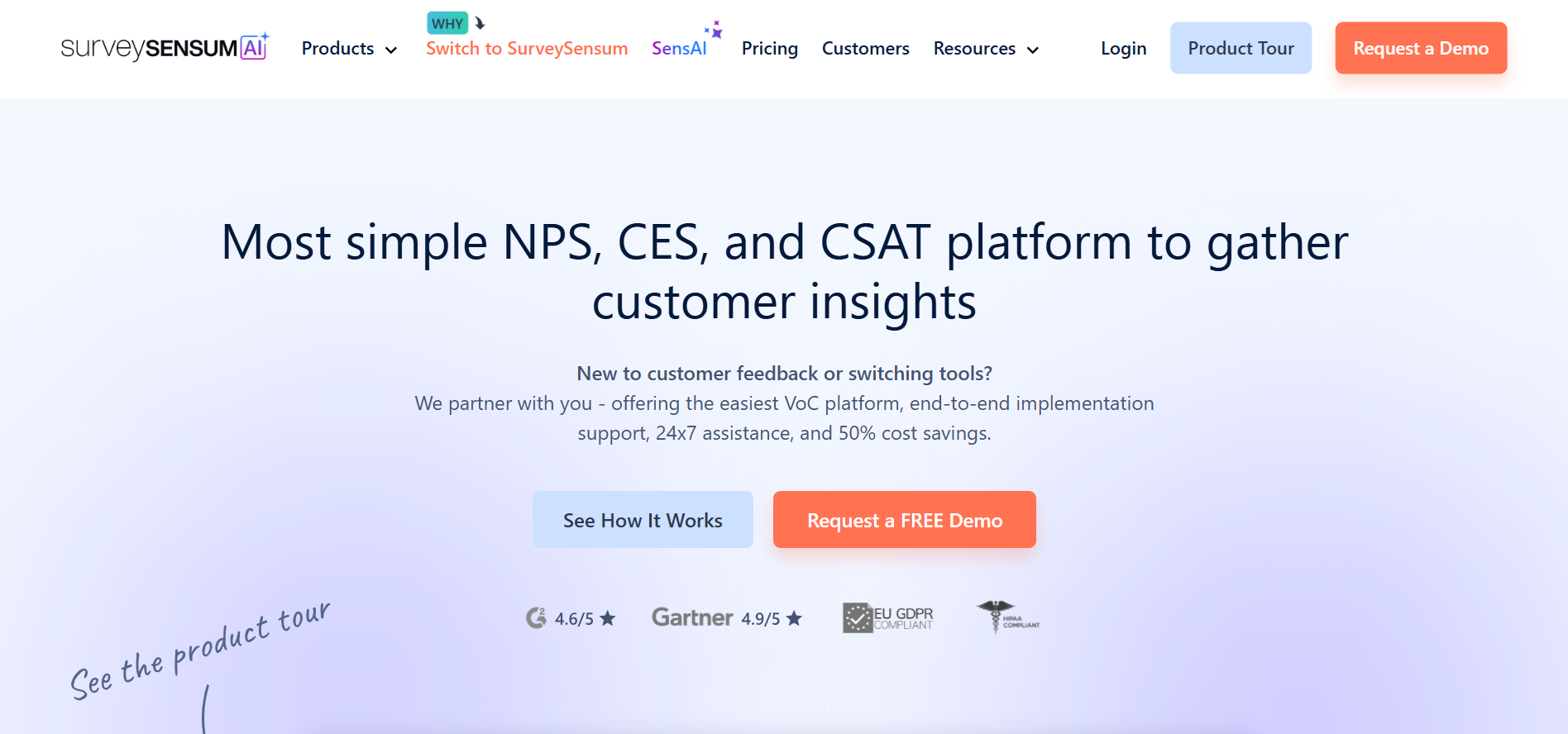
Best for: Indian enterprises that want NPS to directly drive action and closure.
SurveySensum is one of the top NPS tools in India, built for execution-first CX teams that want everything inbuilt – from feedback collection to ownership and closure.
Designed for real operational CX, it combines multichannel feedback, multilingual AI understanding, and built-in execution workflows so NPS drives action and outcomes, not just reporting.
Key Strengths
- Built-in closed-loop ticketing system with clear ownership, escalation logic, and resolution tracking.
- Multichannel NPS collection including WhatsApp-first workflows, email, SMS, and operational follow-ups.
- Contextual multilingual AI text analytics tool designed for Indian regional language feedback.
- AI Copilot lets you ask questions and instantly get insights and next actions without digging through dashboards.
- SensAI helps you analyse feedback, identify key drivers, and surface what needs attention automatically.
- AI survey builder that creates surveys quickly without heavy IT dependency.
- Role-based dashboards giving branch → regional → leadership visibility without data overload.
- Scalable enterprise setup with fast implementation, migration support, and structured onboarding.
- Region-aligned customer support with responsive assistance suited for Indian operational timelines.
Why choose this tool
If your goal is to turn NPS into an execution engine rather than a reporting layer, SurveySensum is the strongest fit.
Want to understand what execution-first NPS actually costs? View SurveySensum pricing built for growing CX teams in India.
Free Forever • No Feature Limitation • No Credit Card Required • Sign Up For Free 
2. Qualtrics: Best for Enterprise Governance and Analytics
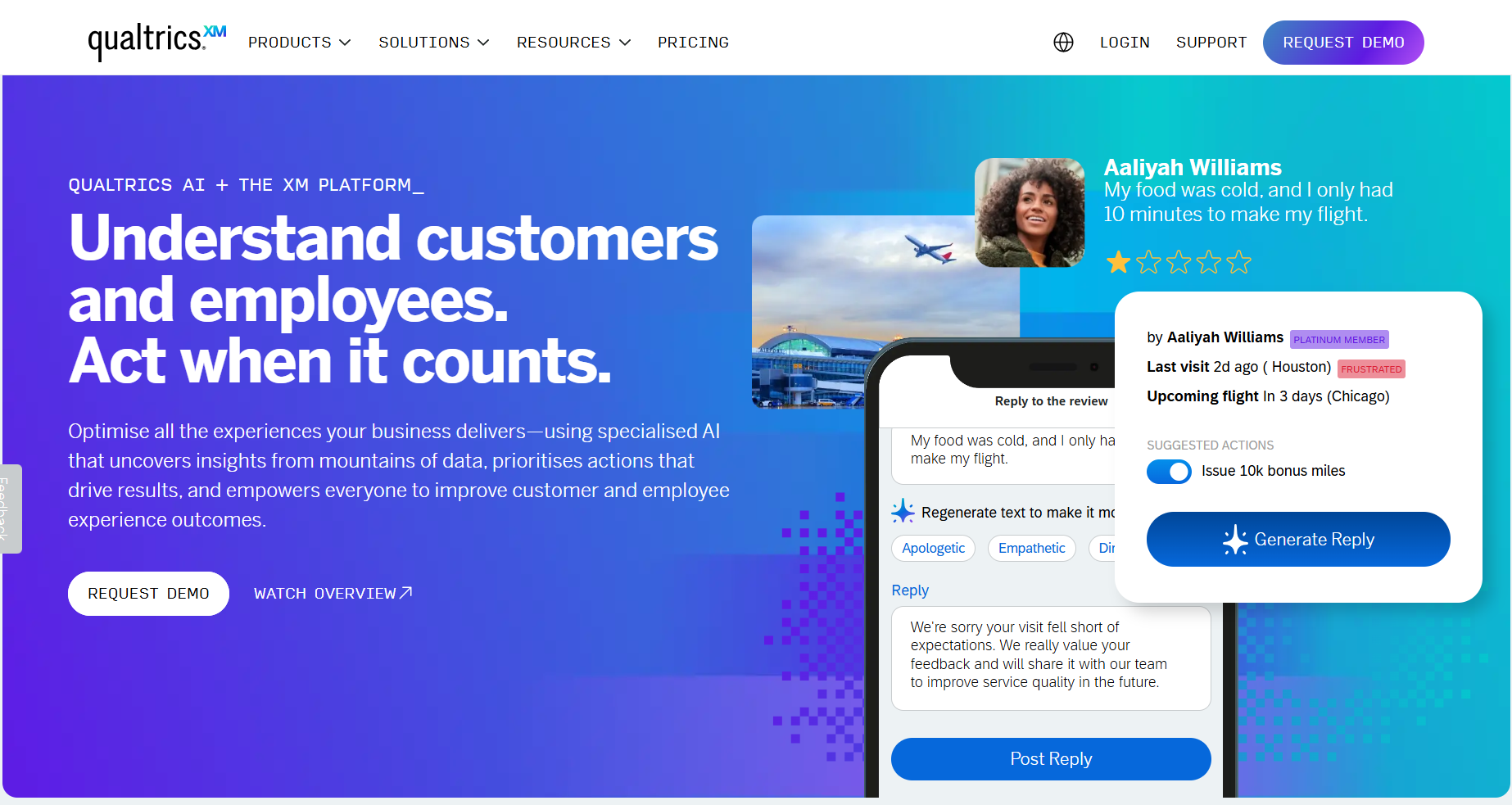
Best for: Large enterprises managing multiple CX programs globally.
Qualtrics is known for analytics depth, governance, and enterprise-level control. It works well for organizations that prioritize compliance, reporting, and centralized visibility across departments.
Key Strengths
- Advanced analytics and segmentation
- Strong governance and compliance framework
- Extensive integrations and ecosystem support
Limitations
- Implementation can be heavy.
- Frontline adoption may feel slow in execution-heavy environments.
Why choose this tool
Choose Qualtrics when leadership reporting and enterprise governance matter more than frontline execution speed.
→ Explore Qualtrics alternatives in India built for faster implementation, simpler execution, and pricing aligned with local CX teams.
3. Medallia: Best for Large-Scale CX Operations
Best for: Enterprises managing complex customer journeys across multiple touchpoints.
Medallia is built for enterprises managing complex customer journeys across multiple touchpoints. It provides strong visibility and AI-driven insights for mature CX ecosystems. The trade-off is heavier implementation and higher operational complexity compared to execution-focused platforms.
Key Strengths
- Omnichannel journey analytics
- Enterprise-grade experience management
- Strong visibility into customer journeys and sentiment
Limitations
- Longer implementation timelines.
- Higher investment and operational complexity.
Why choose this tool
Ideal for enterprises already operating advanced CX ecosystems and looking for deeper journey intelligence.
→ Discover Medallia alternatives in India that help enterprises move from complex enterprise setups to faster, action-driven NPS execution.
4. SurveyMonkey: Best for Simple NPS Measurement
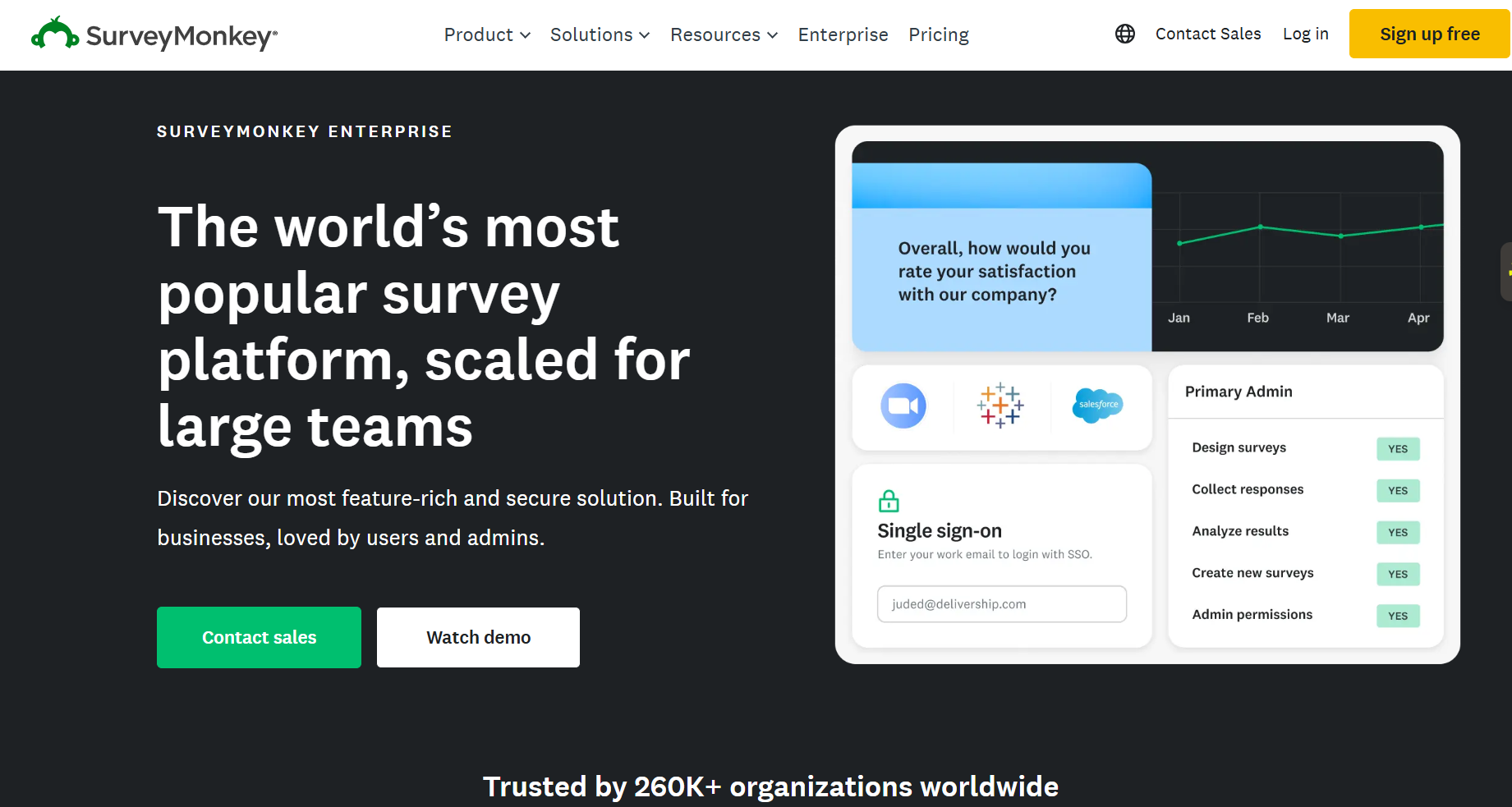
Best for: Teams starting with NPS or running lightweight feedback programs.
SurveyMonkey is ideal for teams that want to launch NPS surveys quickly with minimal setup. It focuses on survey creation and basic reporting rather than operational execution. Ownership tracking and follow-ups typically need to be managed outside the platform.
Key Strengths
- Fast and simple survey setup
- Easy-to-use interface
- Quick deployment without heavy onboarding
Limitations
- Limited closed-loop execution workflows.
- Ownership and follow-ups are often managed outside the platform.
Why choose this tool
A good starting point when the goal is measuring NPS rather than managing operational resolution.
→ See SurveyMonkey alternatives in India designed to go beyond surveys and help teams turn feedback into real ownership, follow-ups, and closure.
5. Zoho Survey: Best Budget-Friendly NPS Option
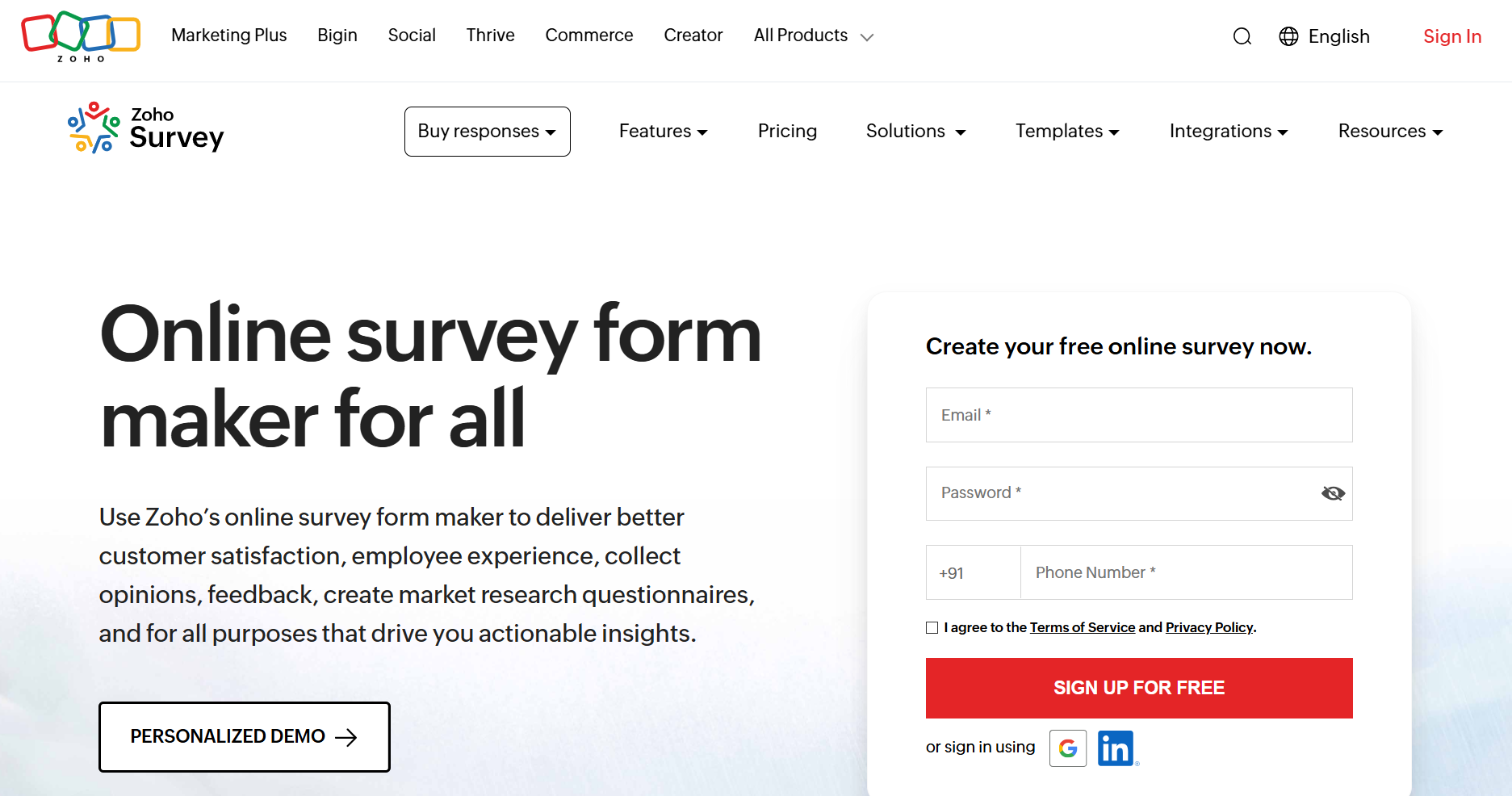
Best for: Growing businesses looking for affordable NPS collection.
Zoho Survey is a simple and affordable option for businesses that need basic NPS collection. It works well for teams already using Zoho tools and looking for easy deployment. However, advanced execution workflows and deeper AI capabilities are limited.
Key Strengths
- Affordable pricing
- Easy setup and usability
- Smooth integration with Zoho products
Limitations
- More survey-focused than execution-focused.
- Limited advanced workflows for enterprise CX teams.
Why choose this tool
Best suited for businesses that need simple NPS tracking without operational complexity.So, while every tool on this list can help you measure NPS, the real difference comes down to how well it helps your team act on feedback. Here’s the key takeaway.
Final Takeaway
NPS success in India isn’t about collecting more feedback.
It’s about acting faster.
The best NPS tools today don’t just measure sentiment; they help teams close the loop, assign ownership, and resolve issues at scale.
If your current platform feels like a reporting system instead of an execution engine, it is time to rethink what your NPS tool should actually do.
And that’s exactly why more Indian CX teams are exploring SurveySensum, not for dashboards, but for real action.
Unlike survey-first tools that stop at reporting, SurveySensum is built to move feedback directly into action with automated workflows, clear ownership tracking, multilingual AI understanding, and multichannel execution designed for Indian CX realities.
So, the real question isn’t which tool collects NPS?
It is: Which tool helps you really understand and improve customer satisfaction?
And that’s why more Indian CX teams are choosing SurveySensum for faster execution and real closure.
NPS only creates impact when teams act fast. See how SurveySensum helps Indian CX teams execute better.
Free Forever • No Feature Limitation • No Credit Card Required • Sign Up For Free
FAQs: Top NPS Tools in India
Which is the best NPS tool in India?
The best NPS tool depends on what you need. If your goal is basic survey collection, many tools work. But for Indian CX teams that need multichannel engagement, multilingual text analytics, and faster issue closure, execution-focused platforms like SurveySensum are often preferred.
Why do Indian CX teams struggle with traditional NPS tools?
Most traditional NPS tools are built for email-first markets. In India, customer interactions move across WhatsApp surveys, calls, SMS, and multi-language feedback, which creates gaps in ownership and follow-up when tools don’t support operational workflows.
Why is multilingual text analytics important for India?
Customer feedback often combines English, Hindi, Hinglish, or regional language contexts. Keyword-based analytics miss intent, forcing teams to manually interpret responses. Context-aware AI analytics help teams understand sentiment more accurately.
How long does it take to implement an enterprise NPS tool?
Implementation timelines vary. Enterprise-heavy platforms may take months due to configuration and integrations, while execution-focused tools designed for operational CX usually offer faster onboarding and quicker time-to-value.
What is closed-loop NPS, and why does it matter?
Closed-loop NPS means feedback automatically triggers action – assigning ownership, tracking follow-ups, and ensuring resolution. Without closed-loop workflows, NPS data often stays inside dashboards without real customer impact.
Are enterprise NPS tools always better?
Not necessarily. Enterprise tools offer advanced analytics, but they can also be complex and slow to deploy. The right choice depends on whether your team prioritizes research depth or operational execution speed.
Still have questions about choosing the right NPS platform? See how SurveySensum fits real Indian CX workflows before you decide.
Free Forever • No Feature Limitation • No Credit Card Required • Sign Up For Free


Increase ROI by 3x with targeted feedback & analysis
Boost Customer Satisfaction by up to 20%
Reduce Churn by identifying pain points in real time
See it in Action
Contents
How much did you enjoy this article?