




Insurance Customer Service Survey: Measure Support Calls, Branch Visits, and Policy Servicing Quality

Request a Demo
A customer may forget the policy details.
But they rarely forget the servicing experience.
Because support interactions are where customers decide:
→ “Can I rely on this insurer?”
→ “Will they actually help when I need them?”
→ “Do I want to renew with them?”
That is why insurance customer service surveys matter.
Not as a reporting exercise.
But as a service quality and retention system.
What is an Insurance Customer Service Survey?
An insurance customer service survey is a short feedback survey sent after:
- support calls,
- branch visits,
- complaint handling,
- policy servicing requests,
- endorsement changes,
- document support,
- or payment-related interactions.
The goal is simple: Measure how the customer experienced the interaction while the experience is still fresh.
Most insurers use these surveys to measure satisfaction (CSAT), effort (CES), resolution quality, staff experience, and operational issues hidden inside open-ended feedback.
Why Insurance Service Surveys Matter More Than Most Teams Realize
Most insurers already track:
- ticket closure,
- SLA compliance,
- average handling time,
- escalation volume.
But customers do not remember metrics.
They remember:
- whether the issue was solved,
- how difficult it felt,
- whether they had to follow up,
- and whether someone took ownership.
That is what shapes trust, retention, complaints, and renewal behavior.
The gap most insurers miss: A ticket can be “closed” operationally while the customer still feels unresolved.
How Service Surveys Help Improve Support Agent Performance
For most insurance support teams, service surveys are not only about customer satisfaction.
They are also used to improve agent performance.
Because operational metrics like:
- average handling time,
- tickets closed,
- or SLA compliance
do not show whether the customer actually felt helped.
Service feedback helps insurers identify:
- agents creating high customer effort,
- poor communication behavior,
- repeat escalation patterns,
- weak ownership,
- and coaching opportunities.
This helps support leaders move beyond: “Who closed the ticket fastest?”
→ to “Who actually created a better customer experience?”
Why Servicing Quality Impacts Retention
Support interactions shape loyalty long before renewal.
| What Happens During Servicing | What It Leads To |
| Issue not resolved properly | Repeat calls and frustration |
| Long delays in updates | Lower confidence in the insurer |
| Multiple follow-ups required | Higher customer effort |
| Poor communication | Trust erosion |
| Branch staff unable to help | Reduced confidence |
| Complaint closed without clarity | Silent churn risk |
This is why servicing quality is not just a support metric.
It is an early retention signal.
Should Insurers Use CSAT, CES, or NPS After Support Interactions?
Each metric serves a different purpose.
| Metric | Best Used For |
| CSAT | Immediate satisfaction |
| CES | Friction and effort |
| Resolution Confidence | Whether the issue is truly solved |
| NPS | Long-term relationship loyalty |
For support interactions:
→ CSAT + CES should usually be the operational core
→ NPS should remain the broader relationship metric
Trying to force NPS into every servicing interaction often creates noisy data.
Best Questions for an Insurance Customer Service Survey
The best-performing insurance service surveys are:
- short,
- immediate,
- and operationally focused.
Most successful programs use 3–6 questions maximum.
Recommended Insurance Customer Service Survey Template
- How satisfied were you with the support you received today? – CSAT Question
- How easy was it to get your issue resolved? – CES Question
- Was your issue fully resolved? – Yes/No Resolution Question
- How would you rate the helpfulness of our representative? – Rating Scale Question
- What could we have done better? – Open-Ended Question
This structure captures satisfaction, effort, resolution quality, staff behavior, and operational root causes, without overwhelming the customer.
When Should Insurers Send the Survey?
Timing matters more than most teams realize.
A survey sent 48 hours later measures memory. A survey sent immediately measures experience.
Best Trigger Points
| Interaction Type | When to Trigger |
| Support call | Within 5–15 minutes |
| Branch visit | Same day |
| Complaint resolution | Within 1 hour |
| Servicing request | On completion |
| Document support | Within 2 hours |
| Payment support | Same day |
Fast timing improves:
- response rates,
- feedback accuracy,
- and recovery opportunities.
Best Channels for Insurance Customer Service Surveys
The right channel depends on how the customer interacted with your team.
- WhatsApp: Best for conversational feedback, fast responses, and servicing follow-ups.
- SMS: Best for support calls, transactional interactions, and quick-response surveys.
- Email: Best for servicing completions, document workflows, and detailed communication.
- In-App or Customer Portal: Best for digitally engaged policyholders, self-service workflows, and mobile-first servicing.
- QR Codes at Branches: Best for branch visits, walk-in interactions, and immediate in-person feedback.
The channel itself is not the strategy. The operational workflow behind it is.
Common Mistakes Insurers Make With Customer Service Surveys
1. Sending Surveys Too Late: Late surveys reduce accuracy, response rates, and recovery opportunities.
2. Asking Too Many Questions: Long surveys create survey fatigue. Shorter surveys consistently perform better.
3. Measuring Only CSAT: CSAT alone misses effort, unresolved issues, and operational friction.
4. Looking Only at Overall Scores: Company-wide averages hide underperforming branches, problematic support queues, and operational inconsistency.
5. Ignoring Open Feedback: Open-ended feedback often contains the most actionable operational insight.
6. No Recovery Workflow: Without action workflows, surveys become reporting exercises instead of improvement systems.
What a Good Insurance Service Survey Program Looks Like
By this point, the strategy is clear.
Now comes execution.
A strong insurance service feedback program should be able to:
- trigger surveys automatically after interactions,
- capture CSAT, CES, and open feedback,
- Analyze feedback at scale,
- identify low-performing branches or queues,
- detect recurring complaints,
- and trigger recovery workflows for poor experiences.
How This Looks in Practice
This is where tools like SurveySensum come in.
Not as the strategy. But as the execution layer.
Instead of manually managing surveys and reports, insurers can:
- automate post-service survey triggers,
- distribute surveys across WhatsApp, SMS, and email,
- analyze open-ended feedback automatically,
- identify low scores instantly,
- and route feedback into recovery workflows.
1. Triggering Surveys Automatically
Rather than sending surveys manually, insurers can automate feedback collection based on:
- call completion,
- complaint closure,
- servicing completion,
- or branch interactions.
This helps insurers collect feedback immediately after the interaction while the experience is still fresh.
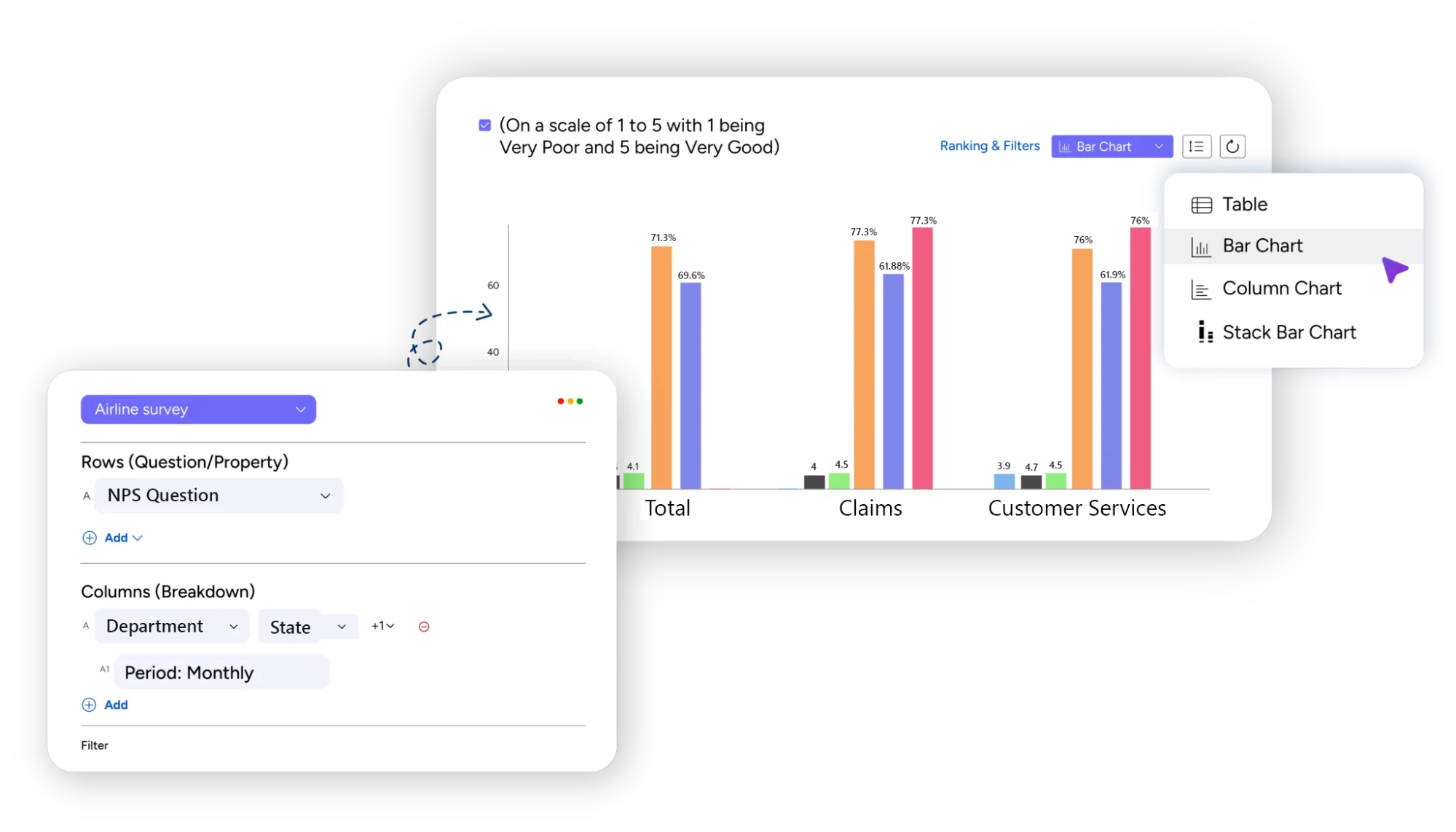
2. Breaking Down Feedback by Agent, Branch, Queue, and Region
Overall CSAT scores are not actionable.
Operational visibility comes from segmentation.
Insurers need to see:
- which agents consistently receive poor feedback,
- which branches score poorly,
- which support queues generate high effort,
- which request types create dissatisfaction,
- and which teams create repeat escalations.
This helps support leaders identify:
- coaching opportunities,
- training gaps,
- staffing issues,
- and high-performing agents worth replicating.
This helps teams move from: “Something is wrong” to “Here is exactly where the operational issue exists.”
3. Understanding the “Why” Behind the Scores
Scores alone do not explain operational problems.
Open-ended feedback does.
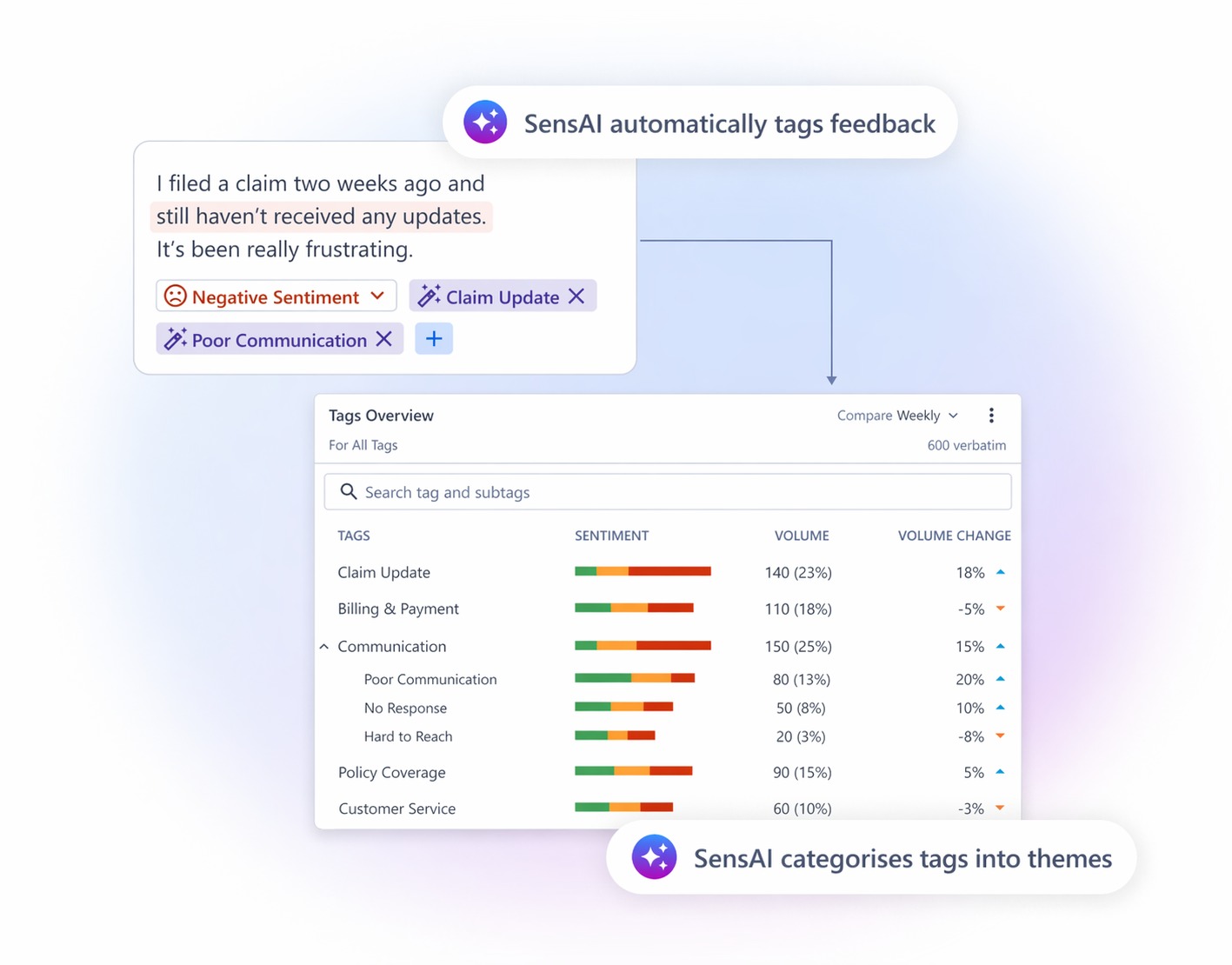
This is where AI text analytics becomes useful.
Instead of manually reading thousands of responses, insurers can identify patterns like:
- repeat calls,
- unclear communication,
- endorsement delays,
- or unresolved complaints automatically.
This helps insurers understand not just what the score is.
But why it happened.
4. Acting on Poor Experiences Faster
The real value of service surveys comes from action.
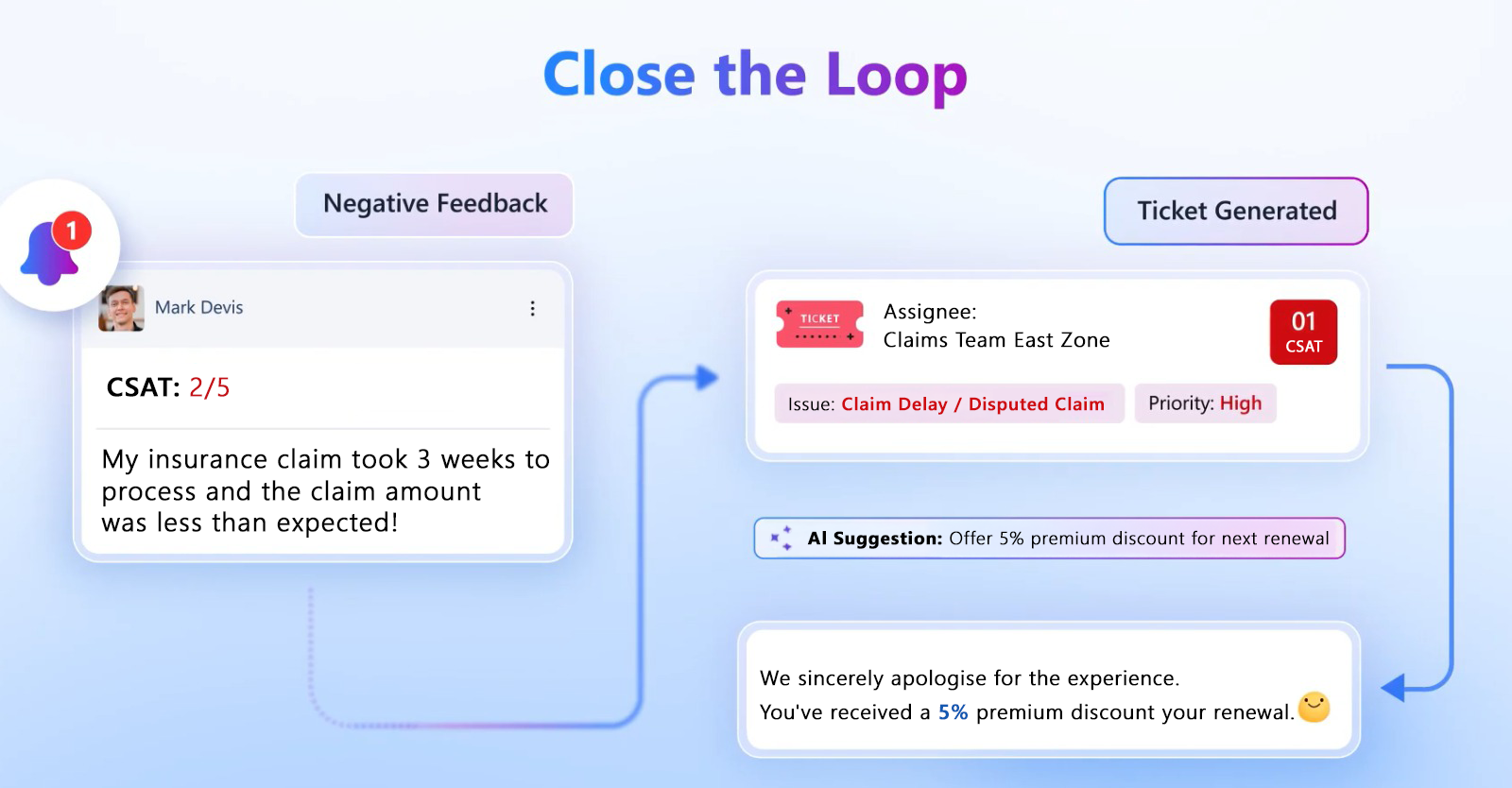
When poor feedback is received:
- the response should be flagged,
- assigned to the right team,
- and followed up quickly.
This is where closed-loop recovery matters.
→ Without recovery: feedback becomes reporting
→ With recovery: feedback becomes operational improvement
What This Enables
With a structured insurance service survey program, insurers can:
- identify recurring servicing issues,
- reduce repeat calls,
- improve branch and agent performance,
- identify coaching opportunities early,
- recover poor experiences faster,
- and strengthen retention before renewal risk appears.
→ Without a system: feedback is delayed, fragmented, and rarely operationalized
→ With a structured workflow: feedback becomes real-time, actionable, and tied to business outcomes
What to Look for in Insurance Customer Feedback Software
If you are evaluating platforms, look for:
- trigger-based automation,
- omnichannel delivery,
- role-based dashboards,
- branch-level reporting,
- real-time alerts,
- text analytics tool,
- and closed-loop workflows.
That is what separates a reporting tool from an operational feedback system.
See How Insurance Teams Operationalize Service Feedback
The insurers improving retention fastest are not just collecting service feedback.
They are:
- identifying friction earlier,
- operationalizing feedback faster,
- and acting on poor experiences before customers silently churn.
Explore how SurveySensum Insurance CX Software helps insurance teams automate service surveys, analyze feedback, and trigger recovery workflows across support journeys →
Free Forever • No Feature Limitation • No Credit Card Required • Sign Up For Free 


Increase ROI by 3x with targeted feedback & analysis
Boost Customer Satisfaction by up to 20%
Reduce Churn by identifying pain points in real time
See it in Action
Contents
How much did you enjoy this article?