




Top 5 Qualtrics Alternatives in Malaysia 2026 – Faster & Affordable CX Tools

Qualtrics is powerful for global reporting, but many Malaysian CX teams struggle with its execution speed, WhatsApp workflows, and cost. This guide explains why teams are switching and the best alternatives for Malaysia in 2026.
Request a Demo
Let’s be honest – when it comes to customer experience tools, powerful doesn’t always mean practical. And for many CX teams in Malaysia, that’s exactly how Qualtrics feels: rasa leceh nak execute.
If you’re searching for Qualtrics alternatives in Malaysia, you’re probably dealing with slow execution, rising licence costs, constant WhatsApp follow-ups, and platforms that don’t quite fit how your teams actually work.
In Kuala Lumpur, Petaling Jaya, and Penang, CX today is no longer just about collecting feedback. It’s about acting on it quickly, closing the loop across WhatsApp and calls, and driving real impact on service and retention.
To understand why Malaysian CX teams are moving away from global-first tools like Qualtrics and toward faster, execution-first CX platforms, let’s take a closer look at what they really deal with every day.
The Malaysian CX Reality: Why Surveys Alone Don’t Close the Loop
Customer experience in Malaysia is relationship-driven. Feedback rarely ends with a single survey link.
Across banking, telco, retail, healthcare, and B2B services, CX workflows typically look like this:
- Email surveys or WhatsApp to initiate feedback
- WhatsApp reminders to improve response rates
- Phone calls for escalations, complaints, or high-value customers
This multi-channel approach reflects local customer behaviour, regulatory sensitivity under Malaysia’s PDPA, and service recovery expectations. Platforms designed around digital-only surveys often struggle to support this operational complexity.
And this is exactly where many Malaysian CX teams start feeling the strain when using global platforms like Qualtrics.
Challenges Malaysian CX Teams Face with Qualtrics
Many Malaysian teams realise that while Qualtrics is powerful, it isn’t always built for local CX realities.
1. High Cost and Complexity
Most Qualtrics contracts are USD-based and structured for global headquarters. Malaysian teams frequently report paying for advanced features they do not actively use, while basic execution workflows require additional modules.
This cost structure often limits ROI for:
- Local business units
- Regional CX teams
- Mid-market organisations
2. Digital-Only Surveys Don’t Cut It in Malaysia
SMS surveys often fail. Links get blocked, delivery rates fluctuate, and response rates are unpredictable. One CX manager said:
“SMS kadang-kadang tak sampai pun. Customer cakap tak pernah terima link.”
WhatsApp is critical for Malaysian CX. Teams want to use their existing WhatsApp Business accounts – approved by IT, familiar to customers, and cost-effective. But Qualtrics’ proprietary WhatsApp integration is expensive and inflexible, resulting in higher costs and less control.
Phone calls (CATI surveys) still matter. Escalations, high-value customers, and complaint resolution often require real conversation. Qualtrics is not designed around this operational reality.
3. Complexity Slows Adoption
Qualtrics dashboards are powerful but can feel heavy for lean Malaysian teams. Customer feedback includes:
- “The learning curve is steep.”
- “Too many steps to get simple insights.”
- “Our frontline staff struggle to use it.”
When teams spend more time analyzing data than solving customer problems, adoption suffers. Malaysian CX leaders need fast, simple, actionable tools.
4. Support is Really Slow
CX in Malaysia moves quickly, but support often doesn’t. Issue resolution can take 10–15 days, with requests passed between multiple teams and unclear ownership.
“Dah follow up banyak kali, tapi progress memang lambat.”
Standard support is slow, and priority support costs extra, leaving teams frustrated.
5. Implementation Takes Too Long
Enterprise-led onboarding models often delay time-to-value. Malaysian teams prioritise:
- Fast pilots
- Branch-level rollouts
- Measurable CX improvements within weeks
Long setup cycles reduce internal momentum and stakeholder confidence.
6. Text Analytics Struggle with Mixed Languages
Malaysian feedback rarely comes in a single language.
It is often written in a mix of Bahasa Malaysia, English, and Manglish, especially on WhatsApp and chat channels. For instance,
- “Service lambat, but staff very friendly.”
- “Process susah sikit, but overall okay.”
- “App hang, lepas update jadi slow.”
Keyword-based analysis often misinterprets sentiment and misses local nuances.
CX leaders also want answers, not just charts:
- “What caused CSAT to drop this week?”
- “Which branches need immediate attention?”
- “What should we fix first?”
Without an AI copilot, teams end up digging through dashboards instead of acting on insights.
7. Lack of Flexibility
Global platforms often ignore local feature requests. Malaysian teams have limited influence over the roadmap, and local needs feel secondary. This frustration drives teams to explore CX-first alternatives that are easy to deploy, flexible, and action-oriented.
These challenges have prompted Malaysian CX leaders to rethink not just their tools, but what they actually need from a CX platform as they plan for 2026.
What Malaysian CX Teams Want in 2026
They are now prioritising customer feedback platform in Malaysia that deliver:
Execution Speed
- Go-live in days, not months
- Simple workflows without heavy IT dependency
Channel Flexibility
- WhatsApp-first engagement
- Easy escalation to calling workflows
Regional Fit
- ASEAN-aligned pricing
- APAC support hours
- Understanding of Malaysian CX maturity
Actionable Insights
- Clear NPS, CSAT, CES visibility – if you’re evaluating dedicated measurement tools, explore the top NPS tools in Malaysia to see what fits your program.
- AI-driven summaries, not just dashboards
This shift in expectations explains why Malaysian teams are actively re-evaluating their CX stack.
With these expectations clearly defined, the next step is to evaluate which CX platforms actually meet the needs of Malaysian teams in 2026.
Top 5 Qualtrics Alternatives in Malaysia for CX Teams (2026 Buyer’s Guide)
Here is a practical, Malaysia-focused list of the top 5 Qualtrics alternatives, based on how real CX teams evaluate tools today.
1. SurveySensum – Best Qualtrics Alternative for Malaysian CX Teams
Best for: Banks, telcos, insurance providers, multi-branch enterprises, and CX teams that rely on fast execution, WhatsApp follow-ups, and operational closure.
SurveySensum was not designed as a global research-heavy platform. It was built for execution-led, WhatsApp-first CX teams across Asia – making it a practical alternative to Qualtrics for Malaysian organisations that need speed, flexibility, and real follow-through.
Why SurveySensum is a better fit than Qualtrics for Malaysia
- Native WhatsApp surveys, email, and calling → Higher response rates
- Client-owned WhatsApp accounts → Lower costs, faster approvals
- AI text analytics tool for Bahasa Malaysia and mixed English → Accurate issue detection
- Integrations → Easy sync with CRM, ticketing, and contact centre systems
- Role-based access and accountability → Separate views for HQ, regional managers, and branch teams
- Built-in closed-loop workflows → Alerts, callbacks, escalations
- Branch- and outlet-level dashboards → Clear operational ownership
- SensAI Copilot → Instant visibility into top issues and priority branches
- ASEAN-aligned pricing → No USD-centric contracts
- Fast implementation → Live in weeks, not quarters
Where Qualtrics falls short
- WhatsApp setup is partner-led and expensive
- Strong push toward Qualtrics-owned numbers
- Slow resolution without paid priority support
- Long, rigid implementation cycles
- Limited localisation for the Malaysian language and workflows
→ For Malaysian CX teams that rely on WhatsApp, need fast issue resolution, and demand local execution control, SurveySensum is a stronger alternative.
Explore SurveySensum for your CX in Malaysia
Free Forever • No Feature Limitation • No Credit Card Required • Sign Up For Free 
While SurveySensum addresses many of these gaps directly, it is not the only option Malaysian teams evaluate.
2. Medallia – Strong Enterprise Platform, Similar Trade-Offs to Qualtrics
Best for: GLCs, MNC regional HQs, and large enterprises with mature CX teams
Where it struggles in Malaysia: Cost, complexity, and speed
Medallia is often evaluated alongside Qualtrics and offers comparable enterprise-grade capabilities.
It works well for organisations that:
- Run large, multi-country CX programs
- Have dedicated analytics and CX operations teams
- Can support longer implementation cycles
However, many mid-market and regional Malaysian teams find that Medallia introduces the same overhead challenges as Qualtrics:
- High total cost of ownership
- Consultant-driven implementations
- Rigid workflows that are slow to adapt locally
In practice, it solves similar problems – but with similar constraints.
3. QuestionPro – Strong for Research, Weaker for Operational CX
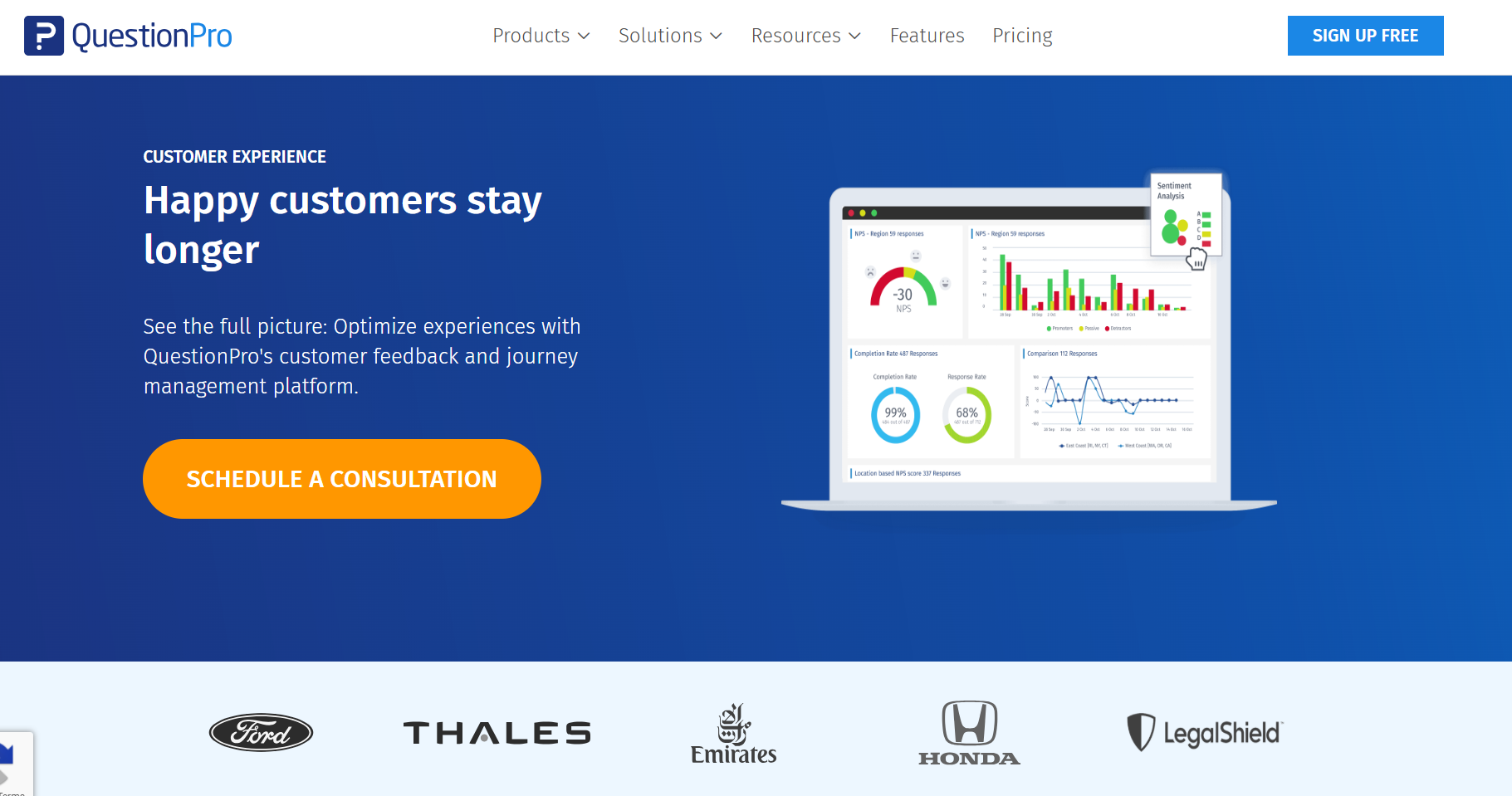
Best for: Research-heavy teams and structured studies
Where it falls short: Day-to-day CX execution and follow-up
QuestionPro is feature-rich from a survey and research perspective and is often considered as a Qualtrics alternative in Malaysia.
It performs well for:
- Academic research
- Market research projects
- Structured survey programs
However, for operational CX teams, limitations appear:
- Dashboards still require manual interpretation
- Insights are not tightly linked to follow-up actions
- Less support for real-time CX decision-making
It is a good choice if research is the primary goal, but less ideal when fast CX action is required.
→ Want QuestionPro-like features without the global complexity? Check these QuestionPro alternatives
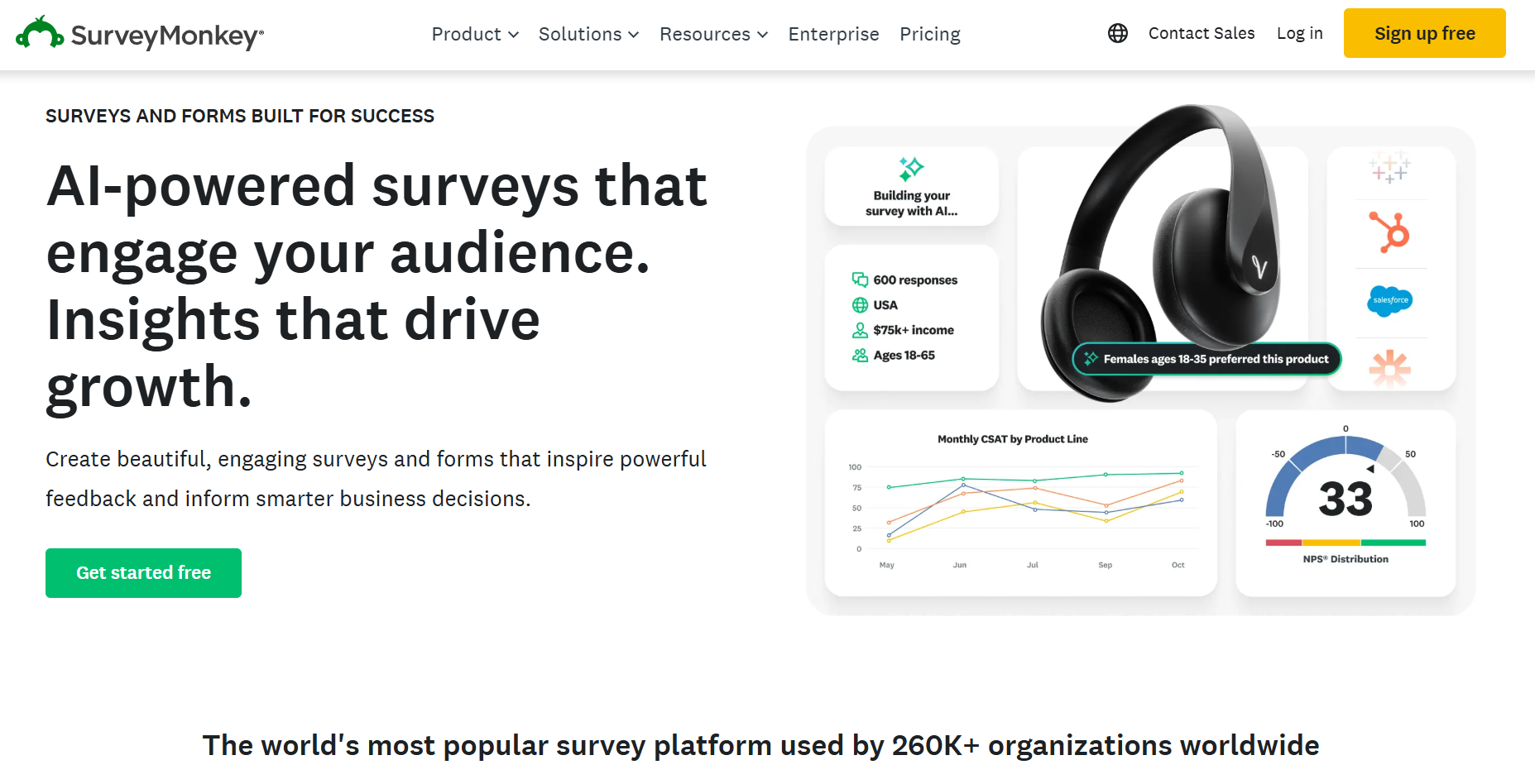
4. SurveyMonkey Enterprise – Easy Entry, Limited Long-Term CX Depth
Best for: Basic feedback collection and quick surveys
Limitation: Not built for end-to-end CX programs
SurveyMonkey is familiar to many Malaysian teams and is easy to deploy.
It works well as:
- An entry-level feedback tool
- A solution for simple, one-off surveys
However, as CX maturity increases, teams often outgrow it due to:
- Limited analytics depth
- Weak support for Bahasa Malaysia text analysis
- Minimal tools for closing the feedback loop
It is a starting point – not a long-term CX platform.
→ Searching for tools beyond SurveyMonkey to scale CX programs in Malaysia? See SurveyMonkey alternatives
5. Local or Regional Survey Tools – Lower Cost Upfront, Scaling Gets Hard
Best for: Small pilots, proof-of-concept initiatives, or short-term feedback programs
Main limitation: Limited scalability, automation, and reporting depth as CX programs mature
Many Malaysian organisations start their CX journey with local or regional survey tools for practical reasons:
- Lower upfront costs and faster approvals
- Shorter procurement cycles
- Vendors who understand local operating realities
At the early stage, this approach makes sense. Teams want to move quickly, not spend months implementing a global platform.
What teams typically start with
A typical early-stage CX setup often uses:
- Respond.io or Rych tools for business messaging and chat
- CX One Sdn Bhd provider for contact centre and interaction management
- Netizen eXperience or DayThree firms for CX or UX strategy and execution support
- Siroi Solutions and InnoQB vendors for custom CRM or loyalty requirements
These tools work well individually, helping teams launch CX initiatives quickly.
However, the challenge emerges later – when feedback volumes increase. CX leaders start asking bigger questions, and CX quietly shifts from “let’s try this” to “we need this to run properly.”
That’s where CX begins to break..
Malaysian CX teams notice problems as CX moves from a pilot to an ongoing program:
- Manual reporting breaks under higher volumes
- No consolidated customer view across branches or regions
- Weak text analytics for mixed Bahasa Malaysia + English feedback
- Disconnected workflows across surveys, messaging, and calls
This isn’t the team failing–these tools simply can’t keep up as CX grows. That’s the scaling gap.
The Scaling Gap
Even when individual tools perform well – like Respond.io for messaging or DayThree for process expertise – they hit limits as CX matures.
The following are the key struggles that emerge at scale:
| Struggle | What to do |
| Turning feedback into actionable decisions | Map all feedback channels this month. Identify gaps where insights are lost. |
| Escalating cases with clear ownership | Define escalation rules and assign owners for every feedback type. |
| Closing the loop consistently | Set up a tracking system and audit it weekly. |
Other warning signs you’ve outgrown your tools:
- Reports still rely on manual consolidation
- Insights differ across channels or branches
- Follow-ups require endless emails or handoffs
Once these appear, it’s time to rethink CX tooling. The moment you recognise it is the moment you can scale effectively.
Why do teams eventually move on?
What saves cost and effort early can create friction later. As CX programs expand, teams often encounter slower insights, fragmented reporting, and increased manual coordination across tools.
Local and specialised solutions are well-suited for:
- Proof-of-concept CX initiatives
- Channel-specific or function-specific use cases
- Small teams with limited reporting needs
But as CX programs scale across multiple branches, customer journeys, and service teams, most Malaysian organisations eventually require a platform that can centralise feedback, automate follow-ups, and scale without increasing CX workload linearly.
Quick Comparison: Qualtrics vs SurveySensum in Malaysia
Here’s how CX tools compare on the criteria Malaysian CX teams care about most.
| Criteria | Qualtrics | SurveySensum |
| Setup Time | Weeks–Months | Days |
| Pricing Transparency | Low | High |
| WhatsApp Flexibility | Limited | High |
| AI Text Analytics | Keyword-based | Contextual AI |
| Bahasa Malaysia Support | Limited | Strong |
| CX Copilot | No | Yes |
| Regional Support | Slow unless paid | Included |
Evaluate Qualtrics against Malaysia-ready CX platforms
Free Forever • No Feature Limitation • No Credit Card Required • Sign Up For Free
Final Takeaway
Qualtrics continues to be a robust global platform for experience management. However, in Malaysia – where customer experience is shaped by WhatsApp-driven follow-ups, fast issue resolution, and branch-level execution – global-first tools often struggle to align with day-to-day operational realities.
This is why many Malaysian CX teams are shifting toward platforms that emphasise:
- Execution over dashboards
- Flexibility over rigid enterprise structures
- Local workflows over global standardisation
For organisations running CX programs across branches, contact centres, and digital channels, SurveySensum is increasingly being adopted as a more practical alternative to Qualtrics in Malaysia, particularly for teams that need faster turnaround and consistent closed-loop execution.
See how SurveySensum supports execution-first CX programs in Malaysia
Free Forever • No Feature Limitation • No Credit Card Required • Sign Up For Free
Top FAQs on Qualtrics Alternatives in Malaysia
What is the best Qualtrics alternative in Malaysia?
SurveySensum is widely considered the best Qualtrics alternative in Malaysia for CX teams that need faster deployment, WhatsApp flexibility, and hands-on service recovery workflows.
Is Qualtrics suitable for Malaysian CX teams?
Qualtrics works well for large global programs, but many Malaysian teams find it too complex, slow to implement, and costly relative to local CX needs.
Which CX platform supports Bahasa Malaysia best?
Platforms with contextual AI, such as SurveySensum, perform better with mixed Bahasa Malaysia and English feedback than keyword-based tools.
Can Qualtrics run WhatsApp surveys in Malaysia?
Yes, but typically through proprietary integrations that are more expensive and less flexible than using existing WhatsApp Business accounts.
How much does Qualtrics typically cost in Malaysia?
Qualtrics pricing is usually USD-based and designed for global enterprise contracts. Many Malaysian teams find the total cost of ownership high once WhatsApp, support, and workflow modules are added.
Can CX platforms integrate with existing WhatsApp Business accounts in Malaysia?
Some platforms support native integration with client-owned WhatsApp Business numbers, which reduces cost and approval delays compared to vendor-owned messaging setups.
Start with a pilot before making a long-term decision.
Free Forever • No Feature Limitation • No Credit Card Required • Sign Up For Free


Increase ROI by 3x with targeted feedback & analysis
Boost Customer Satisfaction by up to 20%
Reduce Churn by identifying pain points in real time
See it in Action
Contents
How much did you enjoy this article?