



6 Best Market Research Tools for Enterprise in 2026

The best enterprise market research tools in 2026 are built for speed, AI-powered analysis, and continuous research operations. SurveySensum leads for AI-native end-to-end research and continuous intelligence workflows, Qualtrics for enterprise-scale governance and administration, Quantilope for advanced quantitative methodologies, and Attest for agile concept testing and fast research execution. The right platform depends on how your research team operates, how fast the business expects answers, and whether your current workflow is built for continuous insight generation or periodic project delivery.
Request a Demo
Most enterprise research teams are not struggling to run surveys.
They are struggling to turn research into decisions fast enough to matter.
Business cycles have compressed. Strategy teams want answers in days, not quarters. Brand teams expect real-time signals, not end-of-year reports. Regional teams need multilingual intelligence, not translated slide decks delivered three weeks late.
That pressure is reshaping what enterprises actually need from market research technology.
The question is no longer: “Which platform can run a study?”
It is: “Which market research platform can move our organization from research questions to strategic decisions faster than anything else?”
This guide covers the best enterprise market research tools in 2026, broken down by platform type, AI capabilities, research use case, and buying criteria.
Whether you are evaluating enterprise research platforms for the first time or replacing a legacy research stack, this guide gives you a structured way to make the right decision.
What are Enterprise Market Research Tools?
Enterprise market research tools are research technology platforms that help large organizations design, execute, analyze, and operationalize market research programs at scale.
Unlike basic data collection tools, enterprise market research platforms are built to manage the full research workflow across teams, geographies, and business functions.
They are designed for organizations running multiple simultaneous research programs, managing global fieldwork, and delivering insights to stakeholders across the business.
Modern enterprise market research software increasingly combines:
- AI-powered questionnaire design and questionnaire generation
- Global panel access for large-scale quantitative research
- Automated data quality control and validation workflows
- Real-time dashboards and statistical analysis tools
- AI-led insight generation and automated reporting
- Multilingual research capabilities for global programs
- Governance controls, compliance workflows, and enterprise security standards
- Closed-loop research workflows connected to operational decision-making
The defining characteristic of an enterprise market research platform is that it is built not just to collect data, but to convert that data into strategic intelligence that drives business decisions across the organization.
That is what separates enterprise-grade market research platforms from traditional data collection tools. The focus is not on data volume. The focus is on decision velocity.
Best Enterprise Market Research Tools (Quick Answer)
If you want the short version:
| Platform | Best For |
| SurveySensum | AI-native continuous research and insight automation |
| Qualtrics | Enterprise governance and global research management |
| Quantilope | Advanced quantitative methodologies |
| Attest | Agile research and fast concept testing |
| Remesh / Yabble | AI-powered conversational qualitative research |
| AlphaSense | Competitive intelligence and market monitoring |
But choosing the right enterprise market research platform depends heavily on your research operating model, workflow complexity, AI maturity, and how frequently your team needs to generate insights.
Let’s break that down properly.multilingual consumer insights creates analysis bottlenecks
Why Traditional Enterprise Research Workflows Are Breaking
The old enterprise research model was built around periodic studies.
Launch a project. Collect responses. Analyze manually. Create slides. Share findings. Wait for the next cycle.
That model is under pressure because business no longer waits.
Product teams ship faster. Marketing teams test more often. CX teams need immediate visibility into customer issues. Leadership expects answers in real time, not in next month’s deck.
The problem is not a lack of data.
The problem is the gap between data and decision-making.
A few things are breaking traditional workflows:
- research cycles are too slow
- reporting takes longer than decision windows
- open-text analysis is still highly manual
- research is spread across too many tools
- dashboards often show issues without driving action
- insights stay disconnected from operations
- annual studies cannot keep up with market changes
- multilingual open-text responses create analysis bottlenecks
Traditional market research platforms were built for project-based execution.
Modern enterprises need always-on intelligence.
That is a very different requirement.
What Enterprises Need From Modern Market Research Platforms
When enterprises buy market research tools today, they are not just buying data collection.
They are buying capability.
They want a platform that fits how research really works inside the organization.
1. Faster Research Execution
Modern enterprise research teams need:
- faster study launches
- agile research workflows
- rapid concept testing
- continuous tracking programs
- real-time customer intelligence
Slow research execution creates operational delays.
That is why modern market research platforms increasingly prioritize automation and workflow speed.
2. AI-Powered Analysis
This is now a core requirement. Enterprises want AI to help with:
- summaries
- open-text analytics
- theme detection
- conversation intelligence
- recommendations
- automated reporting
3. Multilingual Intelligence
Global enterprises increasingly run research programs across:
- regions
- languages
- dialects
- mixed-language customer conversations
Traditional keyword analytics often struggle in these environments.
Modern AI-powered market research platforms use contextual AI models to understand meaning, sentiment, and conversational nuance across multiple languages.
This is especially important in multilingual markets where consumers naturally switch between multiple languages in research responses.
4. Governance and Control
Enterprise buyers care about:
- role-based access
- compliance workflows
- security standards
- auditability
- data controls
5. Mixed-Method Research Support
Modern enterprise research programs combine:
- quantitative research
- qualitative research
- conversational research data
- customer experience data
- operational insight data
The best enterprise market research tools support both structured and unstructured data analysis.
6. Workflow Integration
Insights should not sit in a dashboard and disappear. They should connect with:
- CRM systems
- CX workflows
- support systems
- operational teams
- ticketing and action workflows
That is the difference between reporting and execution.
Types of Enterprise Market Research Tools
Not all market research tools solve the same problem.
This is where many buyers get stuck. They compare every platform against every other platform, even when the categories are different.
Here is the cleaner way to look at it.
| Category | Purpose | Example Platforms |
| Enterprise Research Suites | Governance-heavy enterprise research management | Qualtrics |
| Agile Research Platforms | Fast iterative studies and concept testing | Attest |
| AI-Native Research Platforms | AI-led continuous research and insight automation | SurveySensum |
| Advanced Quantitative Platforms | Conjoint, MaxDiff, segmentation research | Quantilope |
| Conversational AI Research Platforms | AI-moderated qualitative research | Remesh, Yabble |
| Market Intelligence Platforms | Competitive and external intelligence | AlphaSense |
The right category depends less on which platform has the most features and more on which research operating model fits how your enterprise actually generates and uses insights.
With that framing in place, let’s look at the specific capabilities enterprises should evaluate.
Key Capabilities Enterprises Should Evaluate
The best enterprise market research software should reduce friction across the full research workflow.
Here are the most important capabilities enterprises should evaluate.
| Capability | Why It Matters |
| AI analytics accuracy | Reduces manual analysis workload |
| Multilingual contextual AI | Supports global research scalability |
| Workflow automation | Improves research execution speed |
| Reporting automation | Reduces operational overhead |
| Integration ecosystem | Connects research to business workflows |
| Governance controls | Supports enterprise security |
| Closed-loop workflows | Improves operational actionability |
| Research flexibility | Enables agile market research |
| Scalability | Supports enterprise-wide deployment |
| Compliance readiness | Simplifies procurement |
Beyond features, enterprises should also evaluate:
- implementation complexity
- onboarding effort
- vendor support
- migration assistance
- AI transparency
- adoption requirements
Many market research software decisions fail not because of missing features, but because workflows become difficult to operationalize.
Once you understand the category, the next step is to compare platforms by the kinds of research operating models they support.
Enterprise Market Research Tools Comparison Table
Choosing the right enterprise market research platform depends on your research goals, AI requirements, workflow complexity, and execution model. Here is a quick comparison of the leading enterprise market research tools in 2026.
| Tool | Best For | AI Capabilities | Quant Research | Qual Research | Multilingual Support | Reporting Automation | Closed-Loop Workflows |
| SurveySensum | AI-native continuous research | Strong | Yes | Yes | Strong | Strong | Yes |
| Qualtrics | Enterprise governance | Strong | Yes | Yes | Moderate | Moderate | Partial |
| Quantilope | Advanced quantitative research | Strong | Yes | Limited | Moderate | Strong | Limited |
| Attest | Agile concept testing | Moderate | Yes | Limited | Moderate | Moderate | Limited |
| Remesh / Yabble | Conversational qualitative research | Strong | Limited | Yes | Moderate | Moderate | Limited |
| AlphaSense | Competitive intelligence | Strong | Limited | Limited | Moderate | Moderate | Limited |
Each platform approaches enterprise market research differently. Some prioritize governance and scale, others focus on advanced methodology, agile execution, AI automation, or competitive intelligence.
Now let’s look at each platform in detail.
6 Best Market Research Tools for Enterprises
Most research teams arrive at this stage with two or three platforms on their shortlist. What follows is a detailed breakdown of each, covering where they excel, where they fall short, and who they are actually built for.
1. SurveySensum
Best For: AI-Native Enterprise Research and Continuous Intelligence
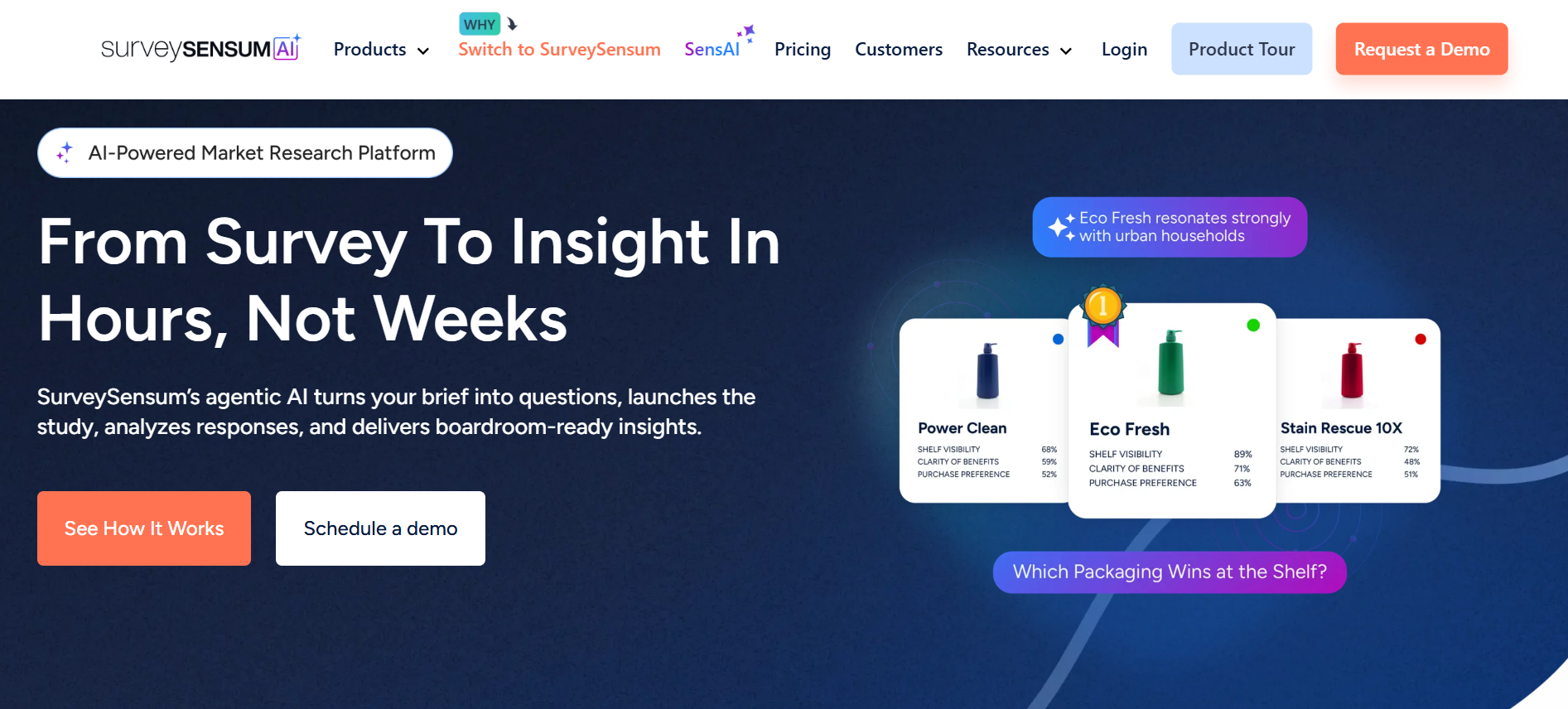
SurveySensum is an AI-powered enterprise market research platform designed for organizations that need faster research execution, automated insight generation, and always-on consumer and market intelligence.
Rather than automating one step in the research process, SurveySensum is built to manage the entire research workflow, from questionnaire design and panel access to real-time analysis, automated reporting, and closed-loop actioning, inside a single unified platform.
At the center of the platform is SensAI, the intelligence layer that powers AI questionnaire generation, automated text analytics, multilingual sentiment analysis, and executive-ready insight delivery directly from research data.
SurveySensum supports a wide range of enterprise research programs, including brand tracking, concept testing, product research, usage and attitude studies, pricing research, segmentation, and continuous consumer intelligence.
Key Features
- AI-powered questionnaire builder trained on 30,000+ professional market research surveys across 40+ categories and 50+ countries
- SensAI Chat-based engine to get instant answers to your research questions without deep diving into the data.
- Integrated global panel access with 150 million-plus panelists across geographies, demographics, and consumer segments
- Automated AI quality control that identifies straightlining, speeding, contradictions, and duplicate responses in real time
- Live dashboards that activate as data collection begins, with cross-tab, drill-down, and statistical analysis built in
- AI conversation analysis applying topic modelling and sentiment analysis across open-ended responses and unstructured data
- AI-generated PowerPoint reports with executive summaries, significance testing, and presentation-ready visualizations
- Support for CAWI, CAPI, and CATI research methods within the same platform
- Multilingual contextual AI analysis for global research programs
- Role-based dashboards and governance controls for enterprise research teams
- Closed-loop research workflows connected to operational actioning
AI and Automation Capabilities
SurveySensum stands out for its depth of AI automation across the full research workflow.
Its AI capabilities include automated thematic analysis, AI-generated summaries, multilingual sentiment analysis, conversational intelligence, AI-powered research recommendations, and end-to-end automated reporting workflows.
The platform is designed to reduce manual analysis effort significantly, giving research teams more time to focus on strategy and interpretation rather than data processing.
Strengths
- Strong AI automation across the full research workflow
- Faster research execution from brief to insight delivery
- Continuous consumer and market intelligence capabilities
- Operational decision support through closed-loop workflows
- Flexible research setup across methodologies and regions
- Accessible for cross-functional teams beyond the core insights function
Pricing
Custom pricing based on research scale, platform modules, and implementation requirements.
When to Choose SurveySensum
Choose SurveySensum if you need AI-powered enterprise market research, continuous intelligence workflows, and faster operational decision-making across your organization.
→ If your team is evaluating AI-native market research platforms, seeing how an end-to-end research workflow operates in practice usually makes the platform differences much clearer.
Explore how enterprise teams are running continuous research programs with SurveySensum.
2. Qualtrics
Best For: Enterprise Research Governance and Global Program Management
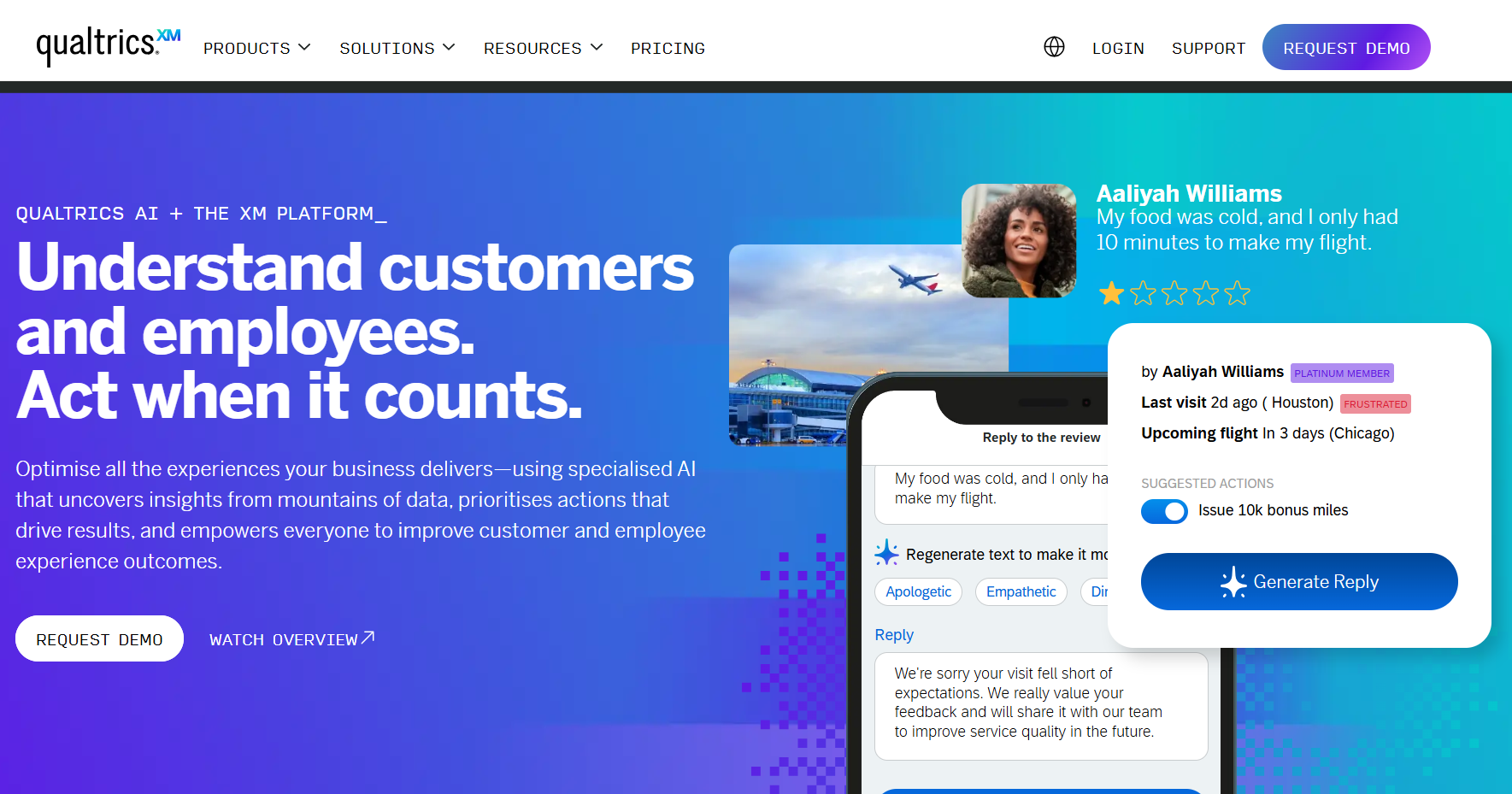
Qualtrics is one of the most established enterprise market research platforms. It is widely used by large global organizations managing complex research programs, brand tracking, and large-scale market intelligence operations across multiple business units and regions.
Key Features
- Enterprise research management and governance
- Advanced dashboarding and analytics
- Global workflow orchestration
- Brand tracking and quantitative research
- Role-based permissions and access controls
- Large integration ecosystem
- Multi-channel research collection
- Enterprise security and compliance standards
Strengths
- Strong enterprise governance and workflow management
- Mature ecosystem and integration capabilities
- Scalable global deployment across business units
- Advanced analytics and cross-functional research management
- Strong enterprise security and compliance readiness
- Established vendor with deep implementation support
Tradeoffs
- Higher implementation complexity and onboarding timelines
- Enterprise-heavy workflows can create friction for agile research
- Steeper learning curve for non-research stakeholders
- Premium pricing structure
Pricing
Custom enterprise pricing based on modules, scale, implementation requirements, and usage.
When to Choose Qualtrics
Choose Qualtrics if you need enterprise-grade governance, global research standardization, and large-scale workflow management across a mature, structured research organization.
→ Teams looking for faster AI-powered research execution often evaluate Qualtrics alternatives for market research when enterprise-heavy governance structures become difficult to operationalize for continuous, agile insights programs.
3. Quantilope
Best For: Advanced Quantitative Research Automation
Quantilope is a research automation platform designed for enterprises running sophisticated quantitative market research programs. It combines advanced statistical methodologies with automation workflows to help insights teams execute complex studies faster and with greater consistency.
Key Features
- Conjoint analysis and MaxDiff studies
- Advanced segmentation and pricing research
- Automated quantitative research workflows
- Research analytics dashboards
- Consumer behavior modeling
- Automated reporting with statistical analysis
- Research template library
Strengths
- Strong advanced quantitative methodologies
- Research automation capabilities for complex studies
- Faster execution of methodology-intensive programs
- Enterprise-grade statistical modeling support
- Reduces manual analytical workload for quant-heavy teams
Tradeoffs
- Higher learning curve for non-research users
- Better suited for mature, methodology-focused insights teams
- Less suitable for qualitative or continuous intelligence programs
- Premium pricing structure
Pricing
Custom enterprise pricing based on methodology requirements and research scale.
When to Choose Quantilope
Choose Quantilope if your enterprise runs high-frequency, methodology-intensive quantitative research programs requiring conjoint analysis, MaxDiff, or advanced segmentation.
4. Attest
Best For: Agile Market Research and Fast Concept Validation
Attest is a market research platform built for agile research execution, fast concept testing, and self-serve research workflows. The platform focuses on usability, accessibility, and rapid deployment for marketing and innovation teams that need research results without operational complexity.
Key Features
- Concept testing and audience validation
- Fast research setup and deployment
- Audience targeting and panel access
- Brand tracking capabilities
- Automated dashboards and reporting
- Research templates for common use cases
- Cross-market research support
Strengths
- Easy-to-use platform with low operational overhead
- Fast research setup and rapid iteration cycles
- Good for agile marketing and innovation teams
- Lower implementation complexity
- Accessible for non-specialist research users
- Flexible for concept, messaging, and audience testing
Tradeoffs
- Less advanced enterprise governance for large-scale programs
- More lightweight analytics compared to full enterprise research platforms
- Limited AI-powered research automation
- Less suited for continuous intelligence or complex methodology programs
Pricing
Flexible pricing based on research volume, audience targeting, and platform access.
When to Choose Attest
Choose Attest if your team needs fast, accessible, self-serve market research workflows for campaign testing, concept validation, and rapid audience intelligence.
5. Remesh / Yabble
Best For: AI-Powered Conversational Qualitative Research
Remesh and Yabble are conversational AI research platforms designed to scale qualitative research through AI-moderated discussion and automated thematic analysis. They help research teams run large-scale qualitative programs that would traditionally require significant manual facilitation and analysis time.
Key Features
- AI-moderated qualitative research and discussion management
- Scalable conversational research with large participant groups
- Automated thematic analysis and insight generation
- Sentiment analysis across qualitative responses
- Real-time research facilitation
- Qualitative research reporting
Strengths
- Scalable qualitative research without proportional manual effort
- AI moderation reduces research facilitation overhead
- Faster qualitative insight generation
- Strong for brand, innovation, and strategic research programs
- Useful where the depth of consumer understanding matters
Tradeoffs
- More specialized toward qualitative than mixed-method research
- Less suitable for large-scale quantitative programs
- More limited enterprise governance compared to full-suite platforms
- Better as a complement to quantitative research tools than a standalone solution
Pricing
Custom pricing based on research scope, participant volume, and platform requirements.
When to Choose Remesh or Yabble
Choose Remesh or Yabble if your enterprise needs to scale qualitative research programs, AI-moderated consumer discussions, and faster conversational insight generation.
6. AlphaSense
Best For: Competitive Intelligence and External Market Monitoring
AlphaSense is an enterprise market intelligence platform focused on competitive research, financial intelligence, and external market monitoring. It is widely used by strategy, corporate development, and market intelligence teams that need to track market signals, competitive moves, and industry developments in real time.
Key Features
- Competitive intelligence and market monitoring
- Financial research and earnings analysis
- AI-powered search across research and market documents
- Market signal tracking and alerting
- Industry and regulatory intelligence
- Expert insights and primary research access
- Research synthesis and reporting
Strengths
- Strong competitive and external market intelligence
- Deep financial and industry research capabilities
- Real-time market signal monitoring
- Useful for strategy, M&A, and market development teams
- AI-powered search across large volumes of market data
Tradeoffs
- Not designed for primary quantitative or qualitative research
- Less suitable for consumer insight programs
- Limited research workflow functionality
- Pricing and complexity suited primarily to large enterprise strategy functions
Pricing
Enterprise pricing based on data access, user volume, and analytics modules.
When to Choose AlphaSense
Choose AlphaSense if your enterprise needs competitive intelligence, financial market monitoring, and external market signal tracking for strategy and corporate development teams.
Different enterprise market research platforms are built for fundamentally different research goals, methodologies, and operating models. Before finalizing a platform decision, it is important to understand which type of tool aligns with how your research function actually operates.
Continuous vs Project-Based Research
This is one of the biggest shifts in enterprise market research.
Traditional research is project-based. Modern research is becoming continuous.
| Model | Characteristics |
| Project-Based Research | Periodic studies, slower cycles, agency-style workflows |
| Continuous Research Operations | Always-on intelligence, insight-to-action workflow, operational integration |
Project-based research is useful when you need a one-time answer.
Continuous research is better when you need to stay close to the market all the time.
That is why modern enterprise market research platforms are shifting toward always-on insight systems.
The operating model is changing. And the software has to change with it.
So, How to Choose the Right Enterprise Market Research Platform?
The right platform depends on your research maturity and the kind of insight operation you want to build.
| Your Situation | What You Need |
| Traditional annual studies | Structured enterprise research suite |
| Fast campaign testing | Agile research platform |
| Continuous customer intelligence | AI-native research platform |
| Advanced statistical studies | Quantitative research platform |
| Global multilingual programs | Contextual multilingual analytics |
When comparing vendors, do not stop at feature lists.
Look at:
- workflow fit
- AI readiness
- operational maturity
- scalability
- implementation effort
- governance strength
- multilingual capability
The best enterprise market research platform is not the one with the longest feature sheet.
It is the one that fits how your team actually works.
AI Trends in Enterprise Market Research
AI is no longer an add-on in enterprise market research.
It is becoming the operating layer behind modern enterprise research workflows. From questionnaire generation to open-text analysis and automated reporting, enterprises are increasingly using AI to accelerate insight generation, reduce manual analysis, and support continuous intelligence operations.
Some of the biggest AI trends reshaping enterprise market research include:
- AI questionnaire generation for faster questionnaire creation and research design
- AI-powered open-text analytics that understand meaning instead of just keywords
- Conversational AI research for scalable interviews and qualitative studies
- Automated reporting that reduces manual dashboard and presentation work
- Predictive and prescriptive insights that recommend next-best actions
- Research democratization that gives non-research teams access to insights
- Real-time intelligence systems replacing static reporting cycles
- Contextual multilingual AI that understands regional language nuance and multilingual consumer insights
The biggest shift is that AI is moving enterprise research from reactive reporting toward continuous insight operations.
And that is fundamentally changing what enterprises expect from modern market research platforms.
Enterprise Market Research Software Implementation Considerations
Enterprise market research platform implementations involve operational considerations that comparison guides often overlook. Here is what research leaders should plan for.
→ Deployment Complexity
Different platforms carry very different implementation timelines. Enterprise governance platforms can require months of configuration, role mapping, and workflow setup. AI-native platforms with modern architecture typically deploy faster, but still require structured onboarding for enterprise rollouts.
→ Adoption Challenges
Platform adoption across a large research organization requires training, workflow transition planning, and change management. The best platform technically can still underdeliver if adoption across the insights function is incomplete.
→ Data Governance
Enterprise research platforms handle sensitive consumer and market data. Procurement and legal teams will require documentation on compliance certifications, including SOC2, GDPR, HIPAA, PII masking processes, and regional data hosting arrangements.
→ AI Transparency
Research teams increasingly need to explain how AI-generated insights were derived. Platforms with explainable AI capabilities and clear methodology documentation build more trust with senior stakeholders than black-box AI systems.
→ Vendor Support
Enterprise research programs depend on vendor responsiveness. Evaluate SLA responsiveness, implementation support quality, migration assistance, and the practical availability of customer success resources before committing to a platform.
→ Pricing Structure
Enterprise market research platform pricing varies significantly between vendors. Understand the difference between modular licensing, usage-based pricing, enterprise contracts, and service dependency before comparing the total cost of ownership across platforms.
The reality is that even the most feature-rich market research software can become difficult to operationalize if implementation is slow, adoption is poor, or workflows remain disconnected.
That is why enterprises increasingly evaluate market research platforms not only on capabilities, but on how easily those capabilities fit into existing business operations.
FAQs: Market Research Tools for Enterprises
What are enterprise market research tools?
Enterprise market research tools are platforms that help organizations collect, analyze, manage, and operationalize research at scale. They often include AI analytics, reporting automation, governance, and multilingual support.
What features should enterprises look for in market research software?
Enterprises should look for AI analytics, workflow automation, multilingual support, governance, reporting automation, integrations, scalability, and compliance readiness.
Which market research platform is best for enterprises?
It depends on the use case. SurveySensum works well for continuous AI-led insight operations, Qualtrics for governance-heavy programs, Quantilope for advanced quant, and Attest for agile testing.
How is AI used in enterprise market research?
AI is used for questionnaire generation, open-text analytics, conversation intelligence, automated reporting, multilingual analysis, and recommendations.
What are the best AI-powered market research tools?
Some of the leading AI-powered market research tools include SurveySensum, Qualtrics, Remesh, Yabble, and Quantilope, depending on the use case.
Can enterprise market research platforms support multilingual research?
Yes. Modern platforms increasingly support multilingual analysis through contextual AI and regional language understanding.
Are enterprise market research platforms secure and compliant?
Most enterprise-grade tools support security and compliance features such as SOC2, GDPR, HIPAA, access controls, and PII masking.
Final Thoughts
The enterprise market research category is no longer defined by data collection alone.
The real difference now lies in:
- how quickly insights are generated
- how effectively research connects to operations
- how much manual work AI removes
- how continuously organizations can listen and respond
Traditional research management systems were built for structured studies.
Modern AI-native platforms are built for continuous intelligence operations.
That is the shift happening right now.
And the best enterprise market research platform is not the one that simply collects research data.
It is the one that helps the business act on it.
→ See how SurveySensum helps enterprise research teams automate insight generation, run continuous intelligence programs, and accelerate AI-powered research workflows at scale.
Free Forever • No Feature Limitation • No Credit Card Required • Sign Up For Free 


Increase ROI by 3x with targeted feedback & analysis
Boost Customer Satisfaction by up to 20%
Reduce Churn by identifying pain points in real time
See it in Action
How much did you enjoy this article?