



8 Best Qualtrics Alternatives for Market Research (2026 Comparison)

Looking for the best Qualtrics alternatives for market research? This guide compares the top platforms based on AI capabilities, pricing, and real-world research workflows to help you choose the right tool for faster insights and better decision-making.
Request a Demo
TLDR: Which Qualtrics Alternative is Best for Market Research?
The best Qualtrics alternative depends on how your team runs research.
- For end-to-end AI-driven workflows → SurveySensum
- For concept and ad testing → Zappi
- For global panel-based research → Toluna
- For enterprise benchmarking and validated methods → Kantar Marketplace
- For fast, self-serve research → Attest
- For advanced quantitative methods → Quantilope
- For large-scale qualitative insights → Remesh
- For quick consumer pulse studies → Pollfish
There is no one-size-fits-all solution. The right choice depends on your research workflow, speed requirements, and analysis needs.
Market research today is expected to move at the speed of decisions. Whether it’s concept testing, brand tracking, or campaign evaluation, teams are under pressure to generate insights continuously, not once every quarter.
Many teams using Qualtrics run large, structured research programs successfully.
But for teams running rapid, iterative studies, the platform can feel heavier than needed.
Setup, governance, and workflow configuration, strengths in enterprise environments, can slow down teams that need to launch research quickly and act on insights in real time.
This gap between research and action is exactly why teams are rethinking their stack. They’re looking for platforms that support always-on research, faster turnaround, and AI-driven analysis that can surface insights without weeks of effort.
In this guide, we break down the best Qualtrics alternatives for market research, based on how well they support modern research workflows, from rapid testing to continuous insight generation.
Why Teams Look for Qualtrics Alternatives for Market Research
Before we get into the tools, it is worth understanding what actually drives research teams to look elsewhere for the best market research tools. These are the patterns we hear most often.
→ Cost vs. Usage Frequency
Qualtrics pricing is built around enterprise contracts. If your team runs research in bursts, or if you are in a mid-market company that does not need the full XM suite, you end up paying for a lot of things you simply do not use. For teams running iterative, agile research cycles, the cost-to-value ratio often does not add up.
→ Speed of Research Execution
Setting up a study in Qualtrics can take time, especially if you rely on an implementation team or internal admin to configure workflows. For research teams that need to go from brief to fieldwork in 48 hours, that lag is a real problem.
→ Insight Generation Challenges
Response collection is the easy part. The hard part is making sense of thousands of open-ended responses. Many teams find themselves exporting data into Excel or separate text analytics tools just to get to the insight layer. That breaks the workflow and adds days to every research cycle.
→ Overlap Between CX and Market Research
Qualtrics was built as an Experience Management platform, which means it spans CX, EX, and market research under one roof. That is powerful for enterprise XM programs, but for teams focused purely on market research workflows, the platform can feel overbuilt in some areas and underbuilt in others.
→ Adoption Across Teams
Dashboards that do not get used are not insights. Many Qualtrics users report that the platform works well for power users, but see low adoption across broader research and product teams who find exports easier than navigating the interface.
This has led to the rise of faster, more flexible, and increasingly AI-driven market research platforms that are designed specifically for research workflows rather than enterprise experience management at scale.
👉 See how research teams reduce manual analysis and speed up insight delivery with AI-driven workflows
Not every team faces all of these challenges. But if your research workflows are becoming slower, more manual, or harder to scale, it is usually a signal that your platform is no longer the right fit.
This shift in expectations has led to the rise of faster, more flexible, and increasingly AI-driven market research platforms.
What Makes a Good Qualtrics Alternative for Market Research?
The best Qualtrics alternatives for market research typically offer:
- Faster study setup and deployment
- Built-in analysis for open-ended responses
- Support for continuous and iterative research
- Flexible pricing aligned with study frequency
- Tools designed specifically for research workflows, not just surveys
How to Compare Qualtrics Alternatives for Market Research
Not all market research platforms are built the same. Some focus on speed, others on methodology, and some on end-to-end workflows.
Before comparing tools, it helps to evaluate them across three key dimensions:
- Research Speed → How quickly can you go from brief to fieldwork?
- Insight Generation → Does the platform automate analysis or require manual work?
- Workflow Fit → Does it match how your team runs research day-to-day?
The comparison below is based on these factors.
Comparison of Qualtrics Alternatives for Market Research
Here is a quick comparison of the top Qualtrics alternatives for market research to help you identify which platform fits your research workflow.
| Tool | Best For | AI Capabilities | Research Coverage | Pricing | Ease of Use |
| SurveySensum | End-to-end research workflows | Advanced text analytics and automation | Full research lifecycle | Custom pricing | High |
| Zappi | Automated consumer testing | Automated insights and dashboards | Concept and campaign testing | Mid to high | High |
| Toluna | Global panel research | AI-assisted analytics | Quantitative research and panels | Custom pricing | Medium |
| Kantar Marketplace | Enterprise research programs | Automated reporting | Brand and advertising research | Enterprise pricing | Medium |
| Attest | Agile research teams | AI-driven dashboards | Market and brand research | Mid-tier subscription | High |
| Quantilope | Advanced methodologies | Automated statistical analysis | Quant and advanced research | Premium pricing | Medium |
| Remesh | Qualitative insights | AI conversation analysis | Focus groups and qualitative research | Custom pricing | Medium |
| Pollfish | Mobile-first surveys | Basic automation | Fast audience sampling | Usage-based pricing | High |
Now that you have a high-level comparison, let us look at each platform in detail so you can understand where it fits in real research workflows.
Each platform solves a different research problem. The best choice depends on how your team runs studies, analyzes data, and delivers insights.
8 Best Qualtrics Alternatives for Market Research
Let us start with a platform built specifically for end-to-end research workflows.
1. SurveySensum
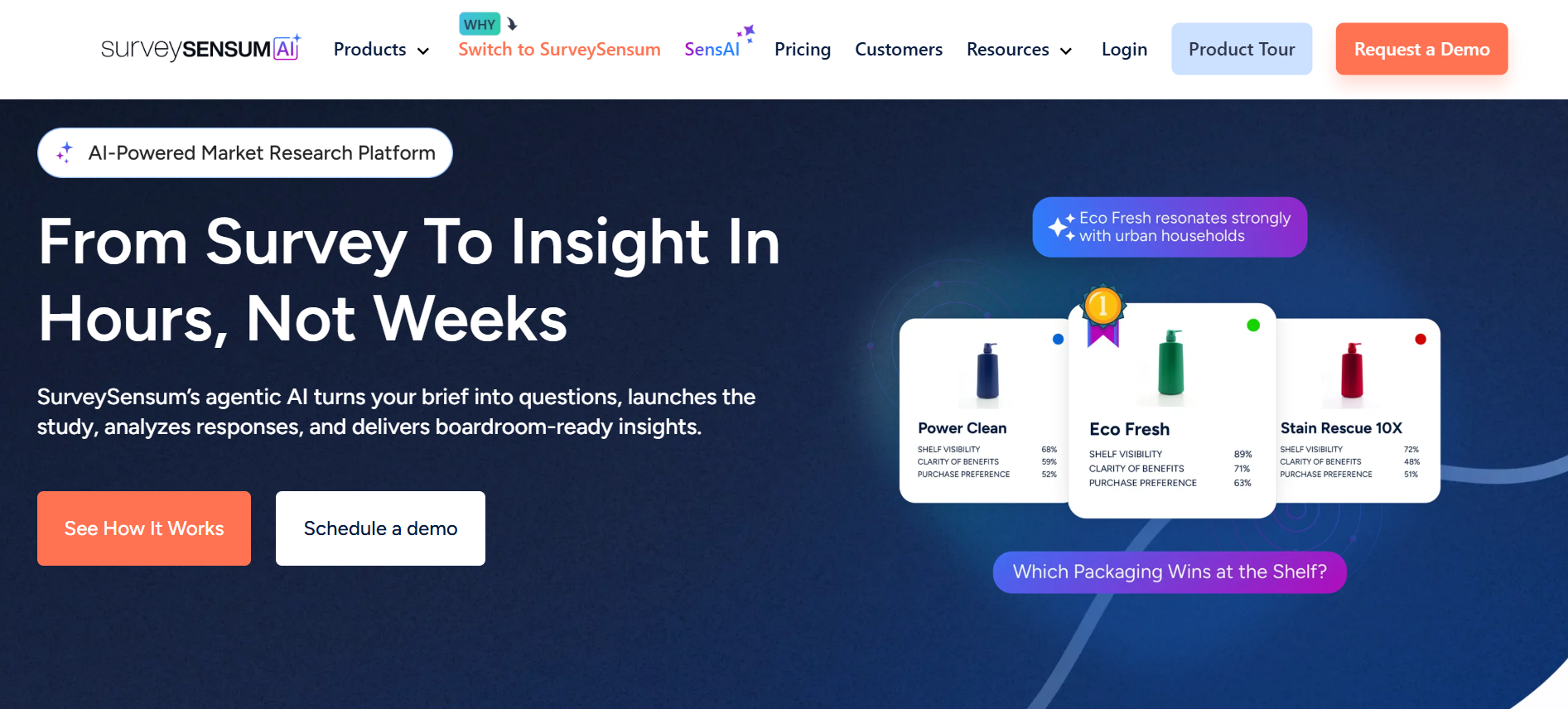
Best For: Market research and insights teams that want to move from project-based research → continuous, AI-driven insight generation, without the complexity and cost of traditional enterprise platforms.
SurveySensum is an end-to-end market research platform designed to help teams move from data collection to actionable insights quickly.
Instead of separating research execution, analysis, and reporting across tools, it combines the entire workflow, from study setup to insight delivery, into a single system designed for speed and usability.
Key Features:
- End-to-end research workflows, from questionnaire creation to insight delivery
- AI-powered questionnaire builder for faster study setup
- Multi-channel research deployment for higher response capture
- Real-time dashboards designed for both research and business stakeholders
- Role-based reporting for insights, marketing, and leadership teams
- Flexible project management across multiple studies and markets
AI Capabilities (Core Differentiator):
- SensAI (chat-based insights engine) → ask questions directly to your research data and get instant answers
- AI text analytics → automatic theme detection, sentiment analysis, and root cause identification
- Auto-generated summaries → convert large datasets into decision-ready insights
- Trend and driver analysis → identify what’s impacting outcomes without manual slicing
→ Unlike traditional platforms, where analysis still requires manual effort, SurveySensum focuses on reducing the time between data collection and insight generation.
Research Use Cases:
- Concept and ad testing with rapid turnaround
- Brand tracking with continuous insight visibility
- Product and feature validation studies
- Campaign performance measurement
- Always-on research programs across markets
Pricing:
- Custom pricing based on response volume and features
- Positioned as a more cost-efficient alternative to enterprise research platforms like Qualtrics, especially for teams running continuous studies
Contact the team for a tailored quote based on your research volume and needs.
Why It Stands Out:
- Strong AI text analytics that replaces manual open-ended coding
- Multi-channel research in a single platform
- Conversational querying through SensAI removes analyst dependency
- Faster deployment compared to traditional enterprise platforms
- Closed-loop workflows that connect insights to action
Limitations:
- May require setup alignment for very large enterprise research operations
👉 See how SurveySensum turns research data into actionable insights in one unified workflow.
2. Zappi
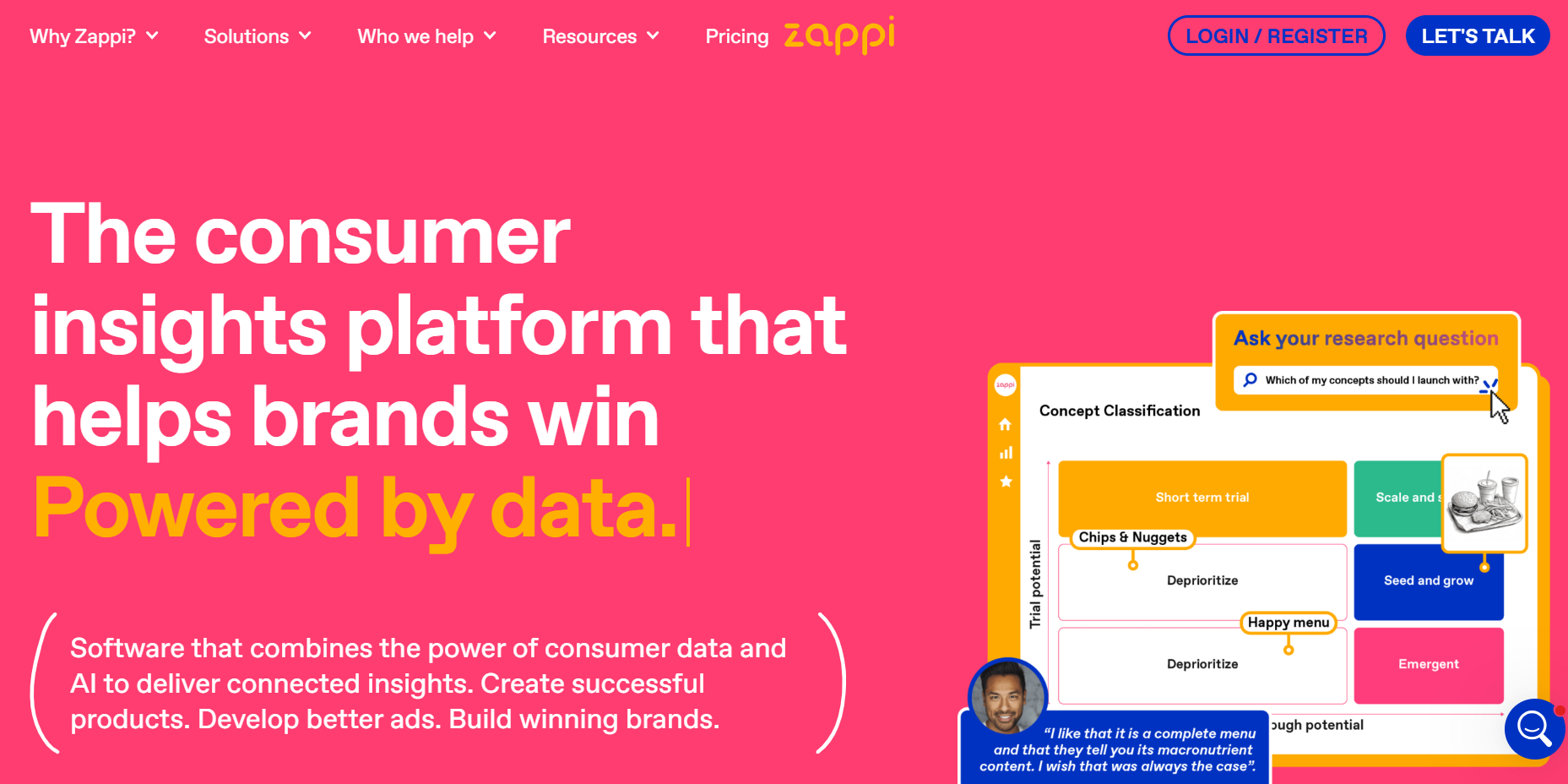
Best For: Brand and insights teams at large organizations that run regular ad testing, concept testing, and innovation research, and want automated workflows with benchmark context.
Zappi is a consumer insights platform built specifically for brand and innovation research. The core idea is automation. Zappi has pre-built research methodologies for ad testing, concept testing, and pack testing that let you launch studies quickly and get back results against industry benchmarks.
If your team runs a lot of standardized research, Zappi removes the setup burden significantly.
Key Features
- Pre-built research templates for ad testing, concept testing, and innovation
- Automated study deployment and fielding
- Normative benchmarking against category and industry data
- Consumer panel access built into the platform
- Integration with creative and brand strategy workflows
AI Capabilities
- Automated scoring of concepts and creative assets against performance benchmarks
- AI-assisted pattern recognition in consumer response data
- Predictive performance indicators for ad and concept testing
- Automated report generation with actionable summaries
Research Use Cases
- Advertising effectiveness testing
- New product and concept testing
- Pack and packaging research
- Brand equity studies
- Innovation pipeline screening
Pricing
Zappi uses custom pricing, typically structured around enterprise agreements. Pricing scales based on study volume and the methodologies you access. It is positioned toward larger research teams and agencies running consistent volumes of standardized studies.
Why It Stands Out:
- Pre-built methodologies reduce setup time significantly
- Benchmarks give context to your results immediately
- Built for research speed in brand and innovation workflows
- Removes the need to build every study from scratch
Limitations
- Less flexibility for custom or bespoke research designs
- Enterprise pricing may not work for smaller teams
- Primarily focused on brand and innovation, less suited for broader market research needs.
3. Toluna

Best For: Market research teams and agencies that need reliable panel access for large-scale quantitative studies, particularly across multiple geographies.
Toluna is a market research platform with a strong panel component at its core. It gives you access to a large global consumer panel alongside research platforms, making it a solid choice for quantitative research that requires specific audience targeting across markets.
For teams that need to reach niche audiences or run multi-country studies, Toluna’s panel depth is a meaningful advantage.
Key Features
- Access to a large proprietary global consumer panel
- Study creation and programming tools
- Audience targeting by demographics, psychographics, and behaviors
- Multi-country study capability
- Real-time data collection and reporting
AI Capabilities
- Automated panel targeting and quota management
- AI-assisted questionnaire quality checks to detect low-quality responses
- Reporting dashboards with filtering and segmentation
- Basic sentiment and text analysis tools
Research Use Cases
- Global quantitative research studies
- Market segmentation and sizing
- Consumer behavior research
- Brand tracking across geographies
- Competitive landscape research
Pricing
Toluna uses custom pricing based on panel reach, geography, and study specifications. Volume-based agreements are available for teams running regular research programs. Contact Toluna directly for a quote tailored to your study requirements.
Why It Stands Out:
- Large, diverse global panel for audience access
- Good for multi-country research programs
- Handles quota management and panel logistics at scale
- Established platform with a long track record in MR
Limitations
- Analytics capabilities are more basic compared to AI-first platforms
- Less suited for qualitative or insight-generation focused research
- Interface can feel dated compared to newer research platforms
4. Kantar Marketplace
Best For: Enterprise research teams that need validated methodologies, category benchmarks, and the credibility that comes with research backed by one of the industry’s most recognized names.
Kantar Marketplace is an automated research platform from one of the world’s largest research companies. It combines Kantar’s decades of normative data and validated research methodologies with a self-serve platform interface, giving enterprise research teams access to proven frameworks without the full-service price tag.
If your team needs research outputs that come with built-in credibility and category benchmarks, Kantar Marketplace offers something that newer platforms cannot: decades of normative data.
Key Features
- Access to Kantar’s validated research methodologies
- Normative databases for benchmarking against category and market norms
- Pre-built modules for brand health, ad testing, and innovation
- Self-serve and managed service options
- Global reach through Kantar’s panel network
AI Capabilities
- Automated benchmarking against normative datasets
- AI-assisted report generation with context from historical data
- Predictive modeling for brand and campaign performance
- Automated data quality checks and response validation
Research Use Cases
- Brand equity and health tracking
- Advertising pre-testing and post-testing
- Innovation and concept research
- Audience understanding and segmentation
- Competitive brand monitoring
Pricing
Kantar Marketplace uses custom pricing structured around enterprise agreements. Access to normative databases and validated methodologies is reflected in premium pricing. It is best suited for large organizations with established research budgets.
Why It Stands Out:
- Kantar’s normative data adds real benchmark context
- Validated methodologies reduce methodological risk
- Both self-serve and managed options are available
- Global panel reaches across major markets
Limitations
- Premium pricing reflects the Kantar brand premium
- Less flexible for bespoke or exploratory research designs
- Can feel slower to set up compared to agile-first platforms
5. Attest
Best For: Brand, marketing, and product teams that want to run fast, self-serve research without a dedicated research function, particularly for brand tracking and product validation.
Attest is an agile research platform built for brand, marketing, and product teams that need answers fast. It combines a built-in consumer audience with a clean, easy-to-use questionnaire tool and an insights layer that makes results accessible to non-research professionals.
If your team includes marketers and product managers who need to run their own research without relying on a dedicated research function, Attest is worth a serious look.
Key Features
- Built-in consumer panel across 58 countries
- Clean, intuitive questionnaire builder with logic and branching
- Pre-built research templates for brand, product, and audience studies
- Real-time results dashboard with filtering
- Collaboration tools for sharing findings across teams
AI Capabilities
- AI-assisted analysis that highlights significant findings automatically
- Crosstab and segmentation tools for audience comparison
- Trend analysis for tracking studies over time
- Automated flagging of response quality issues
- AI-generated insight summaries that reduce time-to-report
Research Use Cases
- Brand awareness and perception tracking
- Product feedback and concept testing
- Audience profiling and segmentation
- Content and messaging testing
- Competitive awareness research
Pricing
Attest pricing starts at approximately $0.50 per response, with platform access fees on top. Enterprise plans with higher volume and additional features are available on a custom pricing basis. This makes Attest a more accessible entry point than fully custom-priced enterprise platforms.
Why It Stands Out:
- Fast from brief to fieldwork, often within hours
- Built-in audience removes the need for separate panel sourcing
- Accessible to non-researchers across the business
- Transparent, response-based pricing model
- Strong for brand and product research use cases
Limitations
- Less suited for complex, multi-method research designs
- Analytics depth is moderate compared to specialist platforms
- Best for standardized rather than highly exploratory research
6. Quantilope
Best For: Research teams and agencies that regularly run advanced quantitative methodologies and want to automate the analysis layer without sacrificing methodological rigor.
Quantilope is a research automation platform built for teams that run advanced quantitative research methodologies. Where most platforms stop at basic surveys, Quantilope automates complex methods like MaxDiff, Conjoint, TURF analysis, and Implicit Association Tests, making them accessible without specialist programming or manual analysis.
If your team regularly needs advanced research methods but wants to move faster than traditional research agencies, Quantilope is a strong contender.
Key Features
- Automated implementation of advanced research methods (MaxDiff, Conjoint, Kano, Segmentation)
- Automated analysis and visualization of complex data outputs
- Real-time dashboard with interactive charts
- Template library for common research frameworks
AI Capabilities
- Automated statistical analysis for complex quantitative methods
- AI-powered segmentation and cluster analysis
- Predictive demand modeling from Conjoint outputs
- Automated report generation with visualization
- AI-assisted questionnaire optimization for better response quality
Research Use Cases
- Product feature prioritization (MaxDiff, Kano)
- Pricing research (Conjoint, Van Westendorp)
- Market segmentation and persona development
- Brand posiing research
- Innovation piptione screening
Pricing
Quantilope uses custom pricing based on the methodologies you run and your study volume. It is positioned toward research teams and agencies running advanced quantitative work at regular cadences. Reach out to their team for a quote based on your methodology requirements.
Why It Stands Out:
- Makes advanced research methods genuinely accessible without specialist skills
- Automated analysis removes manual data processing
- Excellent for teams that need MaxDiff or Conjoint regularly
- Clean visualization of complex outputs
Limitations
- Less suited for qualitative or exploratory research
- Pricing requires a custom conversation
- Advanced methodology focus means it is not the right fit for simple research
7. Remesh
Best For: Insights teams and research agencies that want the depth of qualitative research with significantly faster turnaround and the ability to engage large audiences simultaneously.
Remesh is a qualitative research platform that uses AI to enable live, large-scale conversations with your audience. Think of it as a focus group that scales. You can engage hundreds of participants simultaneously, with AI moderating and clustering responses in real time.
For research teams that need qualitative depth but cannot afford weeks of ethnographic work or dozens of individual focus groups, Remesh offers a genuinely different approach.
Key Features
- Live, AI-moderated audience conversations at scale (up to 1,000 participants)
- Real-time response clustering and thematic analysis
- Both open-ended and quantitative question formats in the same session
- Participant recruitment via built-in panel or your own audience
- Session recordings and full transcripts
AI Capabilities
- Real-time AI thematic clustering of open-ended responses
- Sentiment analysis during live sessions
- AI moderation that groups and surfaces the most representative responses
- Automated insight extraction from session transcripts
- Quantitative scoring of qualitative themes for easy reporting
Research Use Cases
- Concept and message testing with qualitative depth
- Brand perception and positioning research
- Product feedback and co-creation sessions
- Audience understanding and segmentation
- Post-campaign qualitative analysis
Pricing
Remesh uses custom pricing based on session volume, participant numbers, and whether you use their panel or your own. It is positioned at the higher end of qualitative research tools, reflecting the technology and facilitation capabilities built in. Contact their team for a quote.
Why It Stands Out:
- Qualitative depth at a scale that traditional methods cannot match
- Real-time AI analysis means no waiting for transcripts to be coded
- Engages large audiences simultaneously
- Both qual and quant in the same session
Limitations
- Custom pricing can be prohibitive for smaller teams
- Best suited for teams with clear qualitative research needs
- Live session format requires scheduling and coordination
8. Pollfish
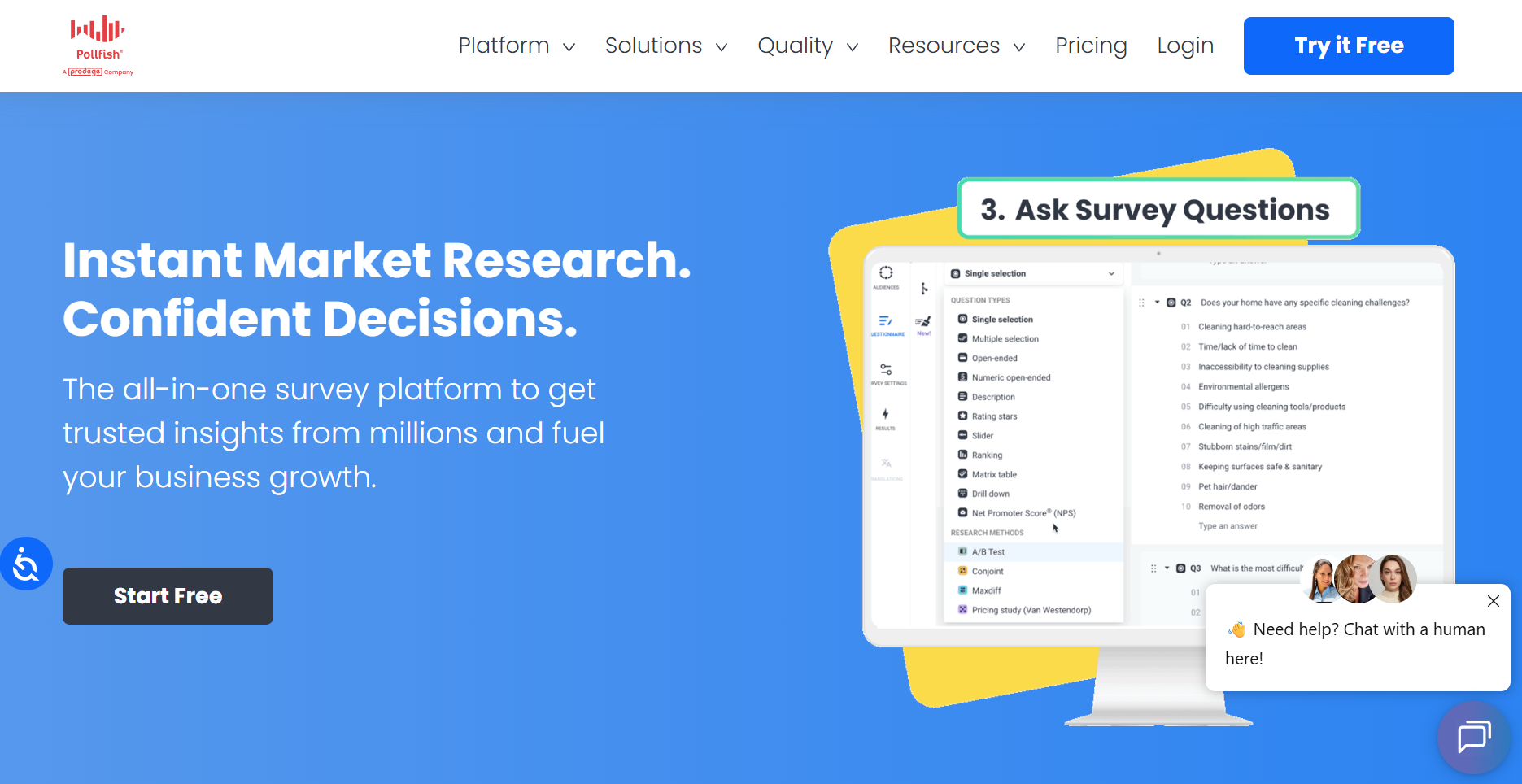
Best For: Research teams and marketers who need fast consumer input at a reasonable cost, particularly for quick polls, brand tracking pulses, and consumer opinion studies. Pollfish is best suited for fast consumer input rather than full end-to-end research workflows.
Pollfish is a mobile-first research platform that gives you access to real consumers through a network of apps and mobile experiences. The key differentiator is reach: Pollfish serves studies to people inside apps they are already using, which typically generates higher engagement and more natural responses than email-based panels.
If you need fast, real-world consumer input at a reasonable cost, Pollfish is one of the most accessible options on this list.
Key Features
- Mobile-first research delivery through a network of apps
- Access to a large, diverse consumer audience globally
- Simple questionnaire builder with skip logic and quotas
- Real-time data collection with live results
- API access for teams that want to integrate research data into their own systems
AI Capabilities
- Automated response quality checks and bot detection
- Basic sentiment analysis on open-ended responses
- Demographic filtering and audience targeting
- Real-time reporting with basic statistical outputs
- Data export for further analysis in external tools
Research Use Cases
- Fast consumer opinion studies and pulse research
- Brand awareness and recall studies
- Product feedback collection
- Market sizing and consumer behavior research
- Ad recall and effectiveness tracking
Pricing
Pollfish pricing starts at approximately $0.95 per completed response for consumer audiences. Pricing varies based on the specificity of your target audience and study length. This transparent, per-response model makes it easy to estimate costs before launching a study.
Why It Stands Out:
- Fast fielding: studies can be live within hours
- Real-world mobile audience produces natural responses
- Transparent, per-response pricing with no hidden costs
- Good for quick pulse surveys and consumer opinion research
- API integration for developers and data teams
Limitations
- Analytics capabilities are basic compared to full research platforms
- Not suited for complex, multi-method research designs
- Less depth in the insight layer: you will need external tools for heavy analysis
Discover how modern research workflows scale without enterprise-level complexity →
Now that you have seen the leading Qualtrics alternatives for market research, the next step is understanding how to choose the right platform for your research workflow.
Not All Qualtrics Alternatives Solve the Same Problem
While all these platforms can replace parts of Qualtrics, they are not direct substitutes for each other.
Some are built for:
- Speed and agility (Attest, Pollfish)
- Methodology and statistical depth (Quantilope)
- Benchmark-driven research (Zappi, Kantar)
- End-to-end workflows with AI-driven insights (SurveySensum)
Choosing the right tool is less about features and more about how well it fits your research workflow.
How to Choose the Right Qualtrics Alternative for Market Research
Choosing the right Qualtrics alternative for market research depends on your research workflow, study frequency, and analysis needs.
Here’s how you can quickly identify the right type of market research platform for your team.
| If your team needs | Choose this platform |
| End-to-end research with AI analysis | SurveySensum |
| Fast ad or concept testing | Zappi |
| Global panel access for large studies | Toluna |
| Proven methodologies and benchmarks | Kantar Marketplace |
| Simple, fast self-serve research | Attest |
| Advanced quantitative methods | Quantilope |
| Large-scale qualitative insights | Remesh |
| Quick mobile surveys | Pollfish |
→ Simple Rule to Remember: The best platform is not the one with the most features. It is the one that fits how your team runs research everyday.
The next step is understanding how the transition typically works.
What Switching to a New Market Research Platform Actually Looks Like
Switching platforms can feel risky.
You worry about disruption, data migration, and team adoption.
But in practice, most transitions follow a simple, predictable path.
You do not replace everything at once. You start small, validate the workflow, and scale gradually.
Here is what that typically looks like.
Step 1: Run a Pilot Study
Start with one controlled project instead of migrating your entire research program.
Choose a study you already run regularly. For example:
- a concept test
- a brand tracking study
- an ad pre-test or campaign evaluation
- a pricing study (Van Westendorp, Conjoint)
- a usage and attitudes (U&A) study
The goal is simple: See how the new platform performs in a real workflow.
Focus on:
- setup time
- ease of study deployment
- speed of analysis
- reporting effort
- stakeholder feedback
This step builds confidence quickly without introducing risk.
Step 2: Validate the Workflow
Once the pilot is complete, evaluate how the platform fits your day-to-day research operations.
Ask questions like:
- Did the team launch the study faster
- Was the analysis easier to complete
- Did reporting take less time
- Were insights clearer for stakeholders
- Did adoption improve across teams
→ If the workflow becomes simpler, the platform is working.
At this stage, many teams start standardizing recurring studies on the new system.
Step 3: Scale Gradually
After validating the workflow, scaling becomes straightforward.
Most organizations transition in phases.
For example:
- move monthly tracking studies first
- migrate new research projects next
- retire legacy workflows gradually
This phased approach keeps operations stable while improving efficiency.
The result is not disruption. It is smoother and faster research execution.
Why This Matters for Teams Evaluating Qualtrics Alternatives
Many teams delay switching because they assume migration will be complex.
In reality, the process is structured and manageable.
When the transition is done step by step, the risk is low, and the benefits appear quickly.
That is why many organizations pilot a new platform before making a full commitment.
Once you know how to evaluate a platform, the next question becomes strategic. What capabilities will matter most as research expectations continue to evolve?
Questions to Ask Before Choosing a Market Research Platform
Before you commit to any vendor, pause and run through this quick checklist.
Not every platform will pass all of these.
But the right one should answer most of them confidently.
Here’s a quick evaluation checklist for research teams:
Study Launch Speed
- Can your team launch a study without technical help?
- Does setup take hours instead of days?
- Can you run multiple studies simultaneously?
Insight Generation Speed
- Can the platform analyze open-ended responses automatically?
- Does it detect sentiment and themes without manual tagging?
- Can it generate summaries instantly?
Reporting and Adoption
- Are dashboards easy for non-researchers to understand?
- Can stakeholders access insights without exporting data?
- Does reporting happen automatically?
Implementation and Support
- Is onboarding structured and guided?
- Does the vendor provide responsive support?
- Are training resources readily available?
Scalability and Flexibility
- Can the platform handle increasing research volume?
- Does pricing remain predictable as usage grows?
- Can you automate recurring studies?
→ Remember: If a platform slows down your workflow, it will slow down your decisions. The best market research platform is not the one with the most features. It is the one that helps your team run research faster and act on insights sooner.
After identifying what to evaluate, the next question becomes clear. What capabilities will matter most as research expectations continue to rise?
How AI Is Transforming Market Research Platforms
AI in market research is used to automate analysis, reduce manual effort, and generate insights in real time.
In the past, research teams focused on gathering data and building reports.
Today, teams are expected to deliver insights faster and support decisions in real time.
What AI Actually Replaces in Market Research Workflows
AI is not just speeding up research; it is replacing some of the most time-consuming steps in the research lifecycle.
Today, AI is actively used to:
- Code open-ended responses automatically (instead of manual tagging)
- Cluster verbatims into themes without human intervention
- Surface hypotheses and key drivers from large datasets
- Generate automated toplines and summaries within minutes
- Detect anomalies in tracking studies (brand trackers, campaign tracking)
- Enable conversational querying across studies (ask questions across datasets)
This shift is driving the adoption of AI market research platforms that can automate analysis and reduce manual work. Here is how that shift plays out.
1. Manual Analysis → Automated Insights
Traditional research workflows often involved exporting responses, manually coding open-ended data, building reports, and waiting days to arrive at insights.
AI-driven workflows fundamentally change this process. Instead of manually tagging thousands of verbatim responses, AI can now automatically classify responses, cluster them into themes, detect sentiment, and surface key drivers in real time.
This significantly reduces analysis time and allows research teams to move from data collection to insight generation within hours, not days.
This is especially valuable in high-volume studies where thousands of responses need to be analyzed quickly.
2. Dashboards → Decisions
Modern market research platforms are shifting from reporting tools to decision support systems.
Instead of only displaying data, AI now helps research teams:
- Identify emerging themes across studies
- Detect shifts in sentiment and perception over time
- Surface key drivers behind outcomes
- Highlight what actually requires action
AI is not just visualizing data, it is prioritizing what matters.
This reduces the effort required to interpret results and ensures insights are not just reported, but acted on.
3. Lag → Real-Time Decisions
Speed is becoming a critical advantage in market research.
When insights are generated in real time, teams can:
- Validate concepts before launch
- Adjust campaigns while they are still live
- Identify shifts in brand perception early
- Respond to market signals
This is especially important for ongoing research like brand tracking, campaign measurement, and product testing.
For example, a product team can identify usability issues within hours of testing instead of waiting for post-study analysis, allowing fixes to be implemented before the next release cycle.
This is why AI-driven analysis is becoming a standard capability in modern market research platforms.
Traditional Market Research vs AI-Driven Market Research
| Traditional Market Research Workflow | AI-Driven Market Research Workflow |
| Manual data cleaning and tagging | Automated text analysis |
| Time-consuming report creation | Instant dashboards and summaries |
| Delayed insight delivery | Real-time insights |
| Reactive decision-making | Proactive decision support |
This is why AI is becoming a standard capability in modern market research software.
So, Why Does This Matter for Teams Evaluating Qualtrics Alternatives?
Many organizations evaluating Qualtrics alternatives for market research are not just looking for research platforms.
They are looking for platforms that can:
- reduce manual analysis
- speed up insight delivery
- support continuous research
- help teams make decisions faster
In short, AI is turning market research from periodic reporting into continuous insight generation.
See how AI-driven research workflows improve speed and insight delivery →
FAQs: Qualtrics Alternatives for Market Research
What are the best Qualtrics alternatives for market research?
The best Qualtrics alternatives for market research include SurveySensum, Zappi, Toluna, Kantar Marketplace, Attest, Quantilope, Remesh, and Pollfish. The right choice depends on your research workflow, speed requirements, and budget.
Why do companies switch from Qualtrics?
Companies switch from Qualtrics when research becomes too slow, complex, or expensive to run regularly. Teams often look for faster deployment, simpler workflows, and more predictable pricing.
What is the difference between survey tools and market research platforms?
Survey tools focus on collecting responses. Market research platforms manage the full research lifecycle, including study design, analysis, and insight generation.
Which tools offer AI capabilities in market research?
Most modern market research platforms like SurveySensum offer AI features such as text analysis, sentiment detection, and automated insight generation.
Are there affordable alternatives to Qualtrics?
Yes. Many platforms offer more affordable and flexible pricing than Qualtrics, especially for teams running frequent or smaller studies. For growing research teams, predictable pricing and ease of deployment are often more important than advanced features.
When Qualtrics is Still the Right Choice
Qualtrics remains a strong choice for certain types of research programs.
It is particularly well suited for organizations that:
- Need a single platform across CX, EX, and market research
- Run large, structured enterprise research programs
- Require advanced governance, compliance, and role management
- Have dedicated teams managing complex implementations
For teams operating at this scale, Qualtrics offers flexibility and control that many tools cannot match.
However, for teams focused on faster, iterative research workflows, many alternatives offer a more streamlined and efficient approach
Conclusion: Choosing the Right Qualtrics Alternative Comes Down to Workflow
There is no single best Qualtrics alternative for market research.
The right platform depends on what your team needs to do, how often you run studies, and how quickly you need insights.
Some tools are built for simple study deployment. Others support more advanced research programs that require ongoing analysis and reporting. The most important factor is choosing a platform that fits how your team works in practice.
In simple terms, the best choice is the platform that supports your research workflow from data collection to decision-making.
Looking for a platform that supports end-to-end research?
If your team needs faster analysis, clearer insights, and smoother research execution, it may be time to evaluate a platform designed for continuous research.
SurveySensum helps research teams run studies, analyze responses, and deliver insights without manual effort. This makes it easier to run frequent studies and act on results quickly.
Explore how SurveySensum supports end-to-end research workflows →
Free Forever • No Feature Limitation • No Credit Card Required • Sign Up For Free 


Increase ROI by 3x with targeted feedback & analysis
Boost Customer Satisfaction by up to 20%
Reduce Churn by identifying pain points in real time
See it in Action
Contents
How much did you enjoy this article?