



10 Consumer Insights Platforms Replacing Traditional Market Research

The best consumer insights platforms in 2026 are built for speed, AI-led analysis, and continuous research execution. SurveySensum leads for AI-powered end-to-end consumer insights, Qualtrics for enterprise-scale programs, Toluna for large-scale panel research, and Attest for agile research execution. The right platform depends on how frequently your team runs research, how fast the business expects answers, and whether your current workflow supports continuous, decision-ready insight generation.
Request a Demo
Most research teams are not struggling to collect data.
They are struggling to turn data into decisions fast enough.
The market has changed. Business teams no longer wait weeks for a research report. Brand managers want to validate concepts in days. Strategy teams expect continuous consumer understanding, not quarterly study updates. Product teams want real-time signals, not static presentations.
That shift is what is driving the rapid adoption of consumer insights platforms across industries.
The question is no longer: “Which tool can run a survey?”
It is: “Which market research platform can move our team from research questions to business decisions faster than anything else?”
This guide covers the 10 best consumer insights platforms in 2026, broken down by use case, AI capabilities, workflow fit, and pricing model.
Whether you are evaluating consumer intelligence platforms for the first time or replacing a legacy research stack, this guide gives you a structured way to make the right call.
What is a Consumer Insights Platform?
A consumer insights platform is a research technology solution that helps organizations collect, analyze, and operationalize consumer data to support faster, more confident business decisions.
Unlike standalone basic data collection software, consumer insights platforms are designed to manage the full research workflow, from study design and audience targeting to data quality control, analysis, and insight delivery.
Modern consumer research platforms increasingly combine:
- AI-powered questionnaire creation and research design
- Access to global consumer panels for scalable audience targeting
- Automated data quality control to ensure reliable research output
- Real-time dashboards and analytical tools for faster interpretation
- AI-led insight generation and reporting that reduces manual analysis time
The defining characteristic of a consumer insights platform is that it is built not just to collect responses, but to convert those responses into strategic recommendations that business teams can act on.
This is what separates purpose-built consumer intelligence platforms from traditional market research tools. The focus is not on data. The focus is on decisions.
Best Consumer Insights Platforms (Quick Answer)
If you want the short version:
| Platform | Best For |
| SurveySensum | AI-led end-to-end consumer insights |
| Qualtrics | Enterprise research ecosystems |
| Toluna | Large-scale consumer panels |
| Zappi | Structured ad and concept testing |
| Quantilope | Advanced quant methodologies |
| Suzy | Rapid-turn consumer data |
| Attest | Agile market research |
| GWI | Audience intelligence |
| NIQ | Retail and FMCG intelligence |
| Brandwatch | Social and digital consumer insights |
But choosing the right consumer insights platform depends heavily on your research operating model, workflow complexity, speed requirements, and AI maturity.
Let’s break that down first.
Why Consumer Insights Platforms Are Replacing Traditional Research Workflows
Traditional research workflows were built for a different era of business decision-making.
Studies were designed weeks in advance. Fieldwork ran over days or weeks. Analysis happened offline. Reports were delivered in slide decks. By the time insights reached decision-makers, the business question had often already moved on.
That operating model no longer keeps pace with modern business. Consumer insights platforms are replacing traditional research tools because the expectations around research have fundamentally changed.
1. Faster Decision Cycles
Traditional research workflows were built for periodic studies.
Modern business environments are not.
Consumer insights teams now support:
- weekly campaign decisions
- rapid product iterations
- continuous brand tracking
- real-time consumer intelligence
- agile innovation cycles
Waiting several weeks for reporting no longer works.
That is why modern consumer research platforms prioritize:
- rapid insight generation
- AI-assisted analysis
- automated dashboards
- faster stakeholder visibility
The focus has shifted from “research completion” to “decision velocity.”
2. Continuous Consumer Understanding
Most legacy market research tools were designed around individual projects.
Modern consumer insights platforms are designed around continuous intelligence.
That includes:
- continuous consumer research programs
- longitudinal research
- ongoing audience monitoring
- consumer trend tracking
- continuous brand perception analysis
This is especially important for enterprises running large-scale consumer research, brand, and innovation programs simultaneously.
3. AI-Led Insight Generation
AI consumer insights platforms help research teams automate analysis, reduce reporting time, and generate insights faster.
The best AI-powered consumer insights platforms now automate:
- open-text analysis
- theme detection
- sentiment analysis
- research summaries
- insight recommendations
- report generation
- dashboard narratives
- anomaly detection
Instead of manually interpreting hundreds of responses, teams can now use AI insight generation to surface patterns instantly.
This is why AI market research tools are quickly becoming core infrastructure for modern insights teams.
4. Democratization of Research
Research is no longer limited to dedicated insights teams.
Modern consumer insights software allows:
- marketing teams
- product managers
- brand managers
- innovation teams
- regional stakeholders
to access insights directly through dashboards, AI assistants, and automated reporting.
This shift is pushing platforms toward self-serve research workflows instead of analyst-dependent systems.
5. From Data Collection to Decision Support
The biggest category shift is this:
Traditional market research platforms helped teams collect data.
Modern consumer intelligence platforms help teams make decisions.
That means platforms increasingly compete on:
- workflow automation
- insight accessibility
- AI recommendations
- decision enablement
- cross-functional collaboration
not just research capabilities.
What to Look for in a Consumer Insights Platform
The best consumer insights platforms are not just data collection tools anymore. Modern consumer intelligence platforms need to support faster research workflows, AI-powered analysis, and continuous decision-making across teams.
- Research Flexibility: The platform should support everything from brand tracking and concept testing software to agile consumer research and innovation studies.
- AI-Powered Text Analysis Tool: Modern AI consumer insights platforms should automate open-text analysis, sentiment detection, summaries, and insight generation.
- Speed of Insight Generation: Fast research deployment and automated reporting reduce the gap between collecting data and making decisions.
- Audience Access and Panels: Strong panel access becomes critical for large-scale consumer research and global audience targeting.
- Dashboards and Decision Support: The best insights and analytics platforms help teams interpret data, not just visualize it.
- Collaboration and Stakeholder Access: Research platforms should make insights accessible across marketing, strategy, innovation, and product teams.
- Pricing and Scalability: The ideal consumer insights software should scale with research complexity without creating operational overhead.
- AI-Powered Insight Generation: The best AI consumer insights platforms should surface themes, identify patterns, generate research summaries, and accelerate insight discovery without heavy manual analysis.
The strongest consumer insights platforms balance research depth, AI automation, and operational usability instead of focusing only on research functionality.
Now, let’s compare the best consumer insights platforms in 2026 side by side.
Comparison Table: Best Consumer Insights Platforms at a Glance
Choosing the right consumer insights platform depends on your research goals, AI requirements, workflow complexity, and speed of execution. Here is a quick comparison of the top consumer insights software platforms in 2026.
| Platform | Best For | Key Strength | AI Capabilities | Pricing |
| SurveySensum | AI-led consumer insights | End-to-end automation | Strong | Custom |
| Qualtrics | Enterprise programs | Governance + scale | Strong | Enterprise pricing |
| Toluna | Large-scale research | Consumer panels | Moderate | Custom |
| Zappi | Concept testing | Structured workflows | Moderate | Mid-high |
| Quantilope | Quant research | Advanced methodologies | Strong | Premium |
| Suzy | Rapid insights | Speed | Moderate | Mid-high |
| Attest | Agile research | Ease of use | Moderate | Flexible |
| GWI | Audience intelligence | Consumer datasets | Moderate | Enterprise |
| NIQ | FMCG intelligence | Retail data depth | Moderate | Enterprise |
| Brandwatch | Digital insights | Social intelligence | Strong | Enterprise |
Each platform approaches consumer insights differently – some prioritize enterprise governance, others focus on agile research, AI-powered automation, audience intelligence, or rapid testing workflows.
Now, let’s look at the 10 best consumer insights platforms in 2026 in more detail.
10 Best Consumer Insights Platforms in 2026
Most teams reach this point with a shortlist of two or three platforms. What follows is a detailed breakdown of each, covering where they excel, where they fall short, and who they are actually built for.
1. SurveySensum
Best for: AI-Led, End-to-End Consumer Insights
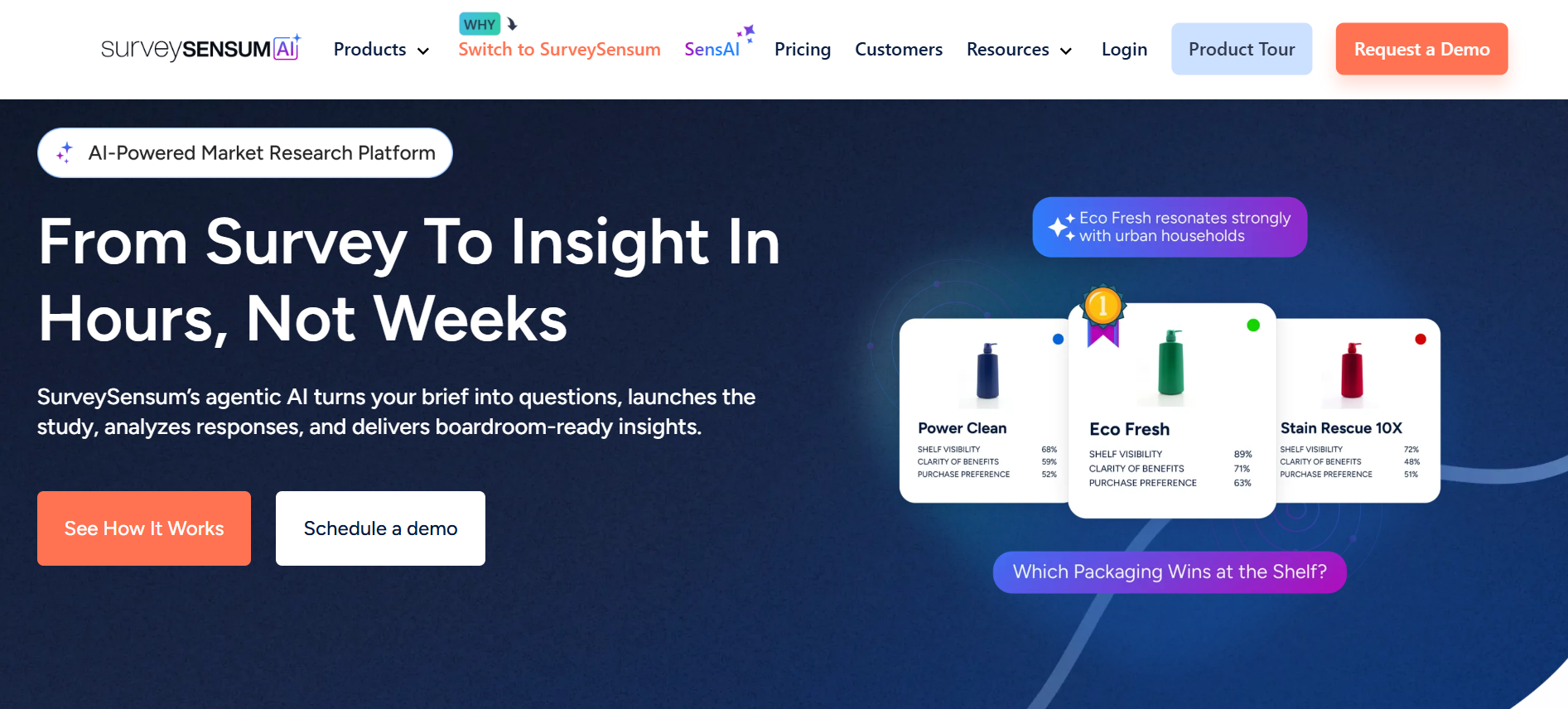
SurveySensum is an AI-powered consumer insights platform designed for teams that want faster research execution, automated insight generation, and continuous consumer intelligence workflows.
It combines AI-powered questionnaire creation, global panel access, automated quality control, real-time analysis, and boardroom-ready reporting into a single, unified consumer insights platform. Rather than automating one step in the research process, SurveySensum reimagines the entire workflow, from brief to insight delivery, under one AI-powered roof.
At the center of the platform is SensAI, the intelligence layer that powers everything from research-grade questionnaire generation to automated executive summaries and strategic recommendations pulled directly from research data.
SurveySensum supports the full range of consumer research verticals, including concept testing, pack testing software workflows, ad testing, product testing, usage and attitude studies, pricing research, brand health tracking, segmentation, and more.
Key Features
The platform supports the full range of research verticals:
- AI-powered questionnaire builder trained on 30,000+ professional research surveys across 40+ categories and 50+ countries
- SensAI Copilot for on-demand deep-dive analysis, pattern recognition, driver identification, and narrative generation from any dataset
- Integrated global panel access with 150 million-plus panelists across geographies, demographics, and consumer segments
- Automated AI quality control that flags straightlining, speeding, contradictions, and duplicates in real time
- Live dashboards that activate the moment data collection begins, with cross-tab, drill-down, and statistical analysis built in
- AI conversation analysis that applies topic modelling and sentiment analysis across open-ended responses, support tickets, call transcripts, and reviews
- AI-generated PowerPoint reports with executive summaries, significance testing, and ready-to-present visualizations
- Support for online (CAWI), offline (CAPI), and CATI research methods within the same platform
AI and Automation Capabilities
SurveySensum stands out strongly in AI-driven research workflows.
Its AI capabilities include:
- automated thematic analysis
- AI-generated summaries
- AI insight generation
- multilingual sentiment analysis
- conversational intelligence
- AI-powered recommendations
- automated reporting workflows
The platform focuses heavily on reducing manual analysis effort.
Strengths
- Strong AI automation
- Faster research execution
- Continuous consumer intelligence workflows
- Operational decision support
- Flexible research setup
- Better accessibility for cross-functional teams
Tradeoffs
- Smaller enterprise ecosystem than legacy vendors
- Less consulting-heavy than traditional research firms
- May require process adaptation for teams used to analyst-led workflows
Pricing
Custom pricing based on research scale, modules, and implementation requirements.
When to Choose SurveySensum
Choose SurveySensum if you need AI-powered consumer insights, continuous research workflows, and faster operational decision-making.
→ If your team is evaluating AI-led market research platforms, seeing how an end-to-end consumer insights workflow operates in practice usually makes the differences much clearer. Explore how teams are running this with SurveySensum.
2. Qualtrics
Best for: Enterprise Insights Programs
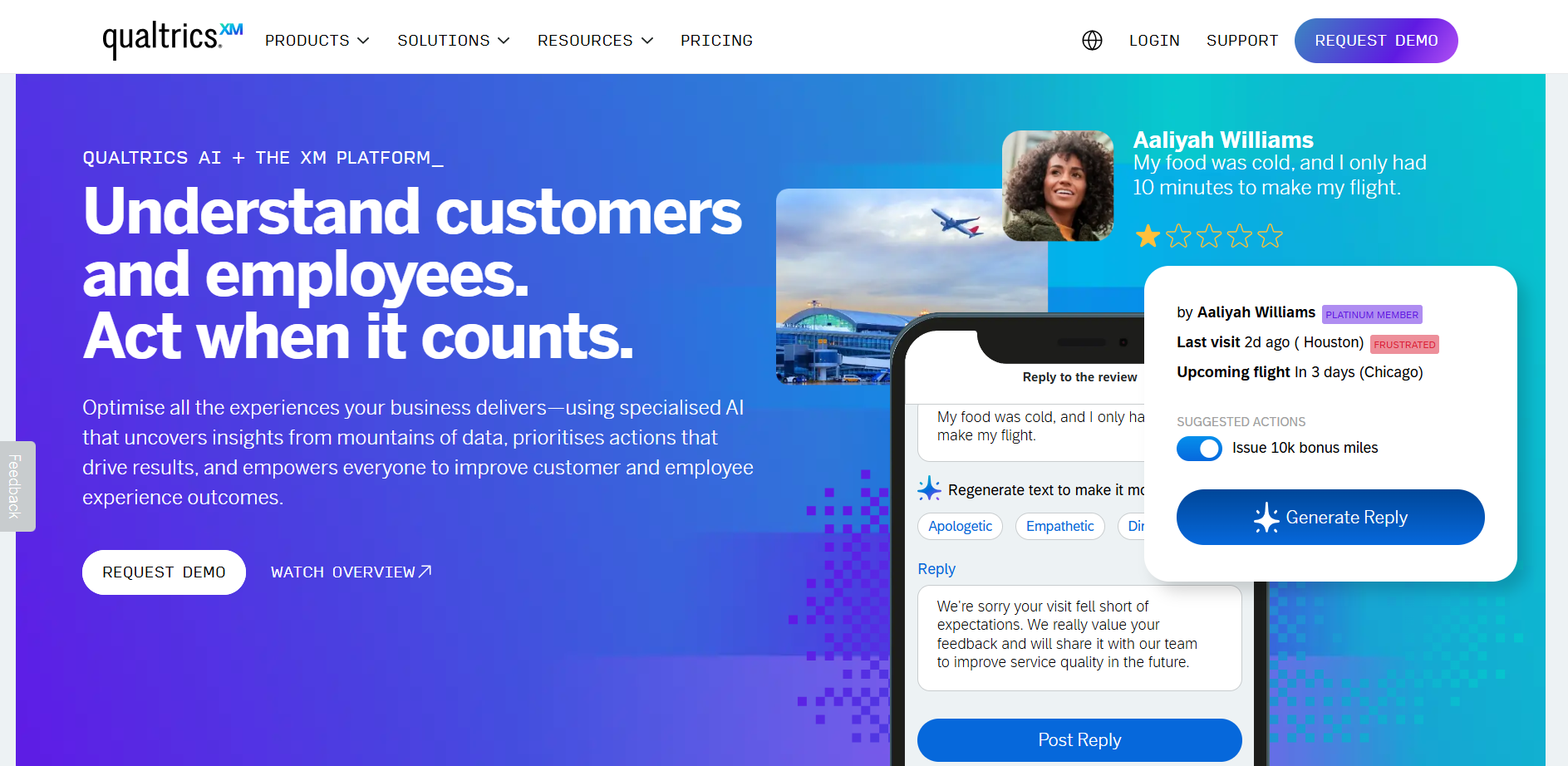
Qualtrics is one of the most established enterprise consumer insights platforms in the market. The platform is widely used by large organizations managing complex market research, brand tracking, audience intelligence, and large-scale consumer research programs.
Key Features
- Enterprise research management
- Advanced dashboarding and analytics
- Global workflow orchestration
- Brand tracking and consumer research
- Research management capabilities
- Role-based permissions and governance
- Large integration ecosystem
- Multi-channel research collection
Strengths
- Strong enterprise governance
- Mature ecosystem and integrations
- Scalable global deployment
- Advanced analytics capabilities
- Cross-functional research management
- Strong enterprise security and compliance
Tradeoffs
- Higher implementation complexity
- Enterprise-heavy workflows
- Steeper learning curve for non-research teams
- Premium pricing structure
- Can feel operationally rigid for agile research environments
Pricing
Custom enterprise pricing based on modules, scale, implementation, and usage requirements.
When to Choose Qualtrics
Choose Qualtrics if you need enterprise-grade governance, global research standardization, and large-scale workflow management.
→ Teams looking for faster AI-powered research workflows often evaluate a Qualtrics alternative for market research when enterprise-heavy systems become difficult to operationalize across agile insights teams.
3. Toluna
Best for: Large-Scale Consumer Research
Toluna is one of the most recognized consumer research platforms for large-scale quantitative research and global panel access. The platform is widely used by enterprises and research agencies running structured market research studies across multiple regions.
Key Features
- Global consumer panels
- Quantitative research workflows
- Research and polling tools
- Brand tracking capabilities
- Audience targeting
- Real-time reporting dashboards
- Sample management
- Multi-market research support
Strengths
- Strong global panel network
- Large-scale research capabilities
- Reliable audience targeting
- Enterprise research scalability
- Strong international research coverage
- Well-established market research infrastructure
Tradeoffs
- Less flexible for agile research workflows
- More project-oriented than continuous insights-focused
- AI automation capabilities are still evolving
- Can feel operationally heavy for smaller teams
Pricing
Custom pricing based on panel access, research scale, sample requirements, and platform usage.
When to Choose Toluna
Choose Toluna if you need large-scale quantitative research and access to global consumer panels.
→ Organizations exploring Toluna alternatives often look for platforms with stronger AI automation, more agile research execution, and continuous consumer intelligence workflows.
4. Zappi
Best for: Structured Concept and Ad Testing
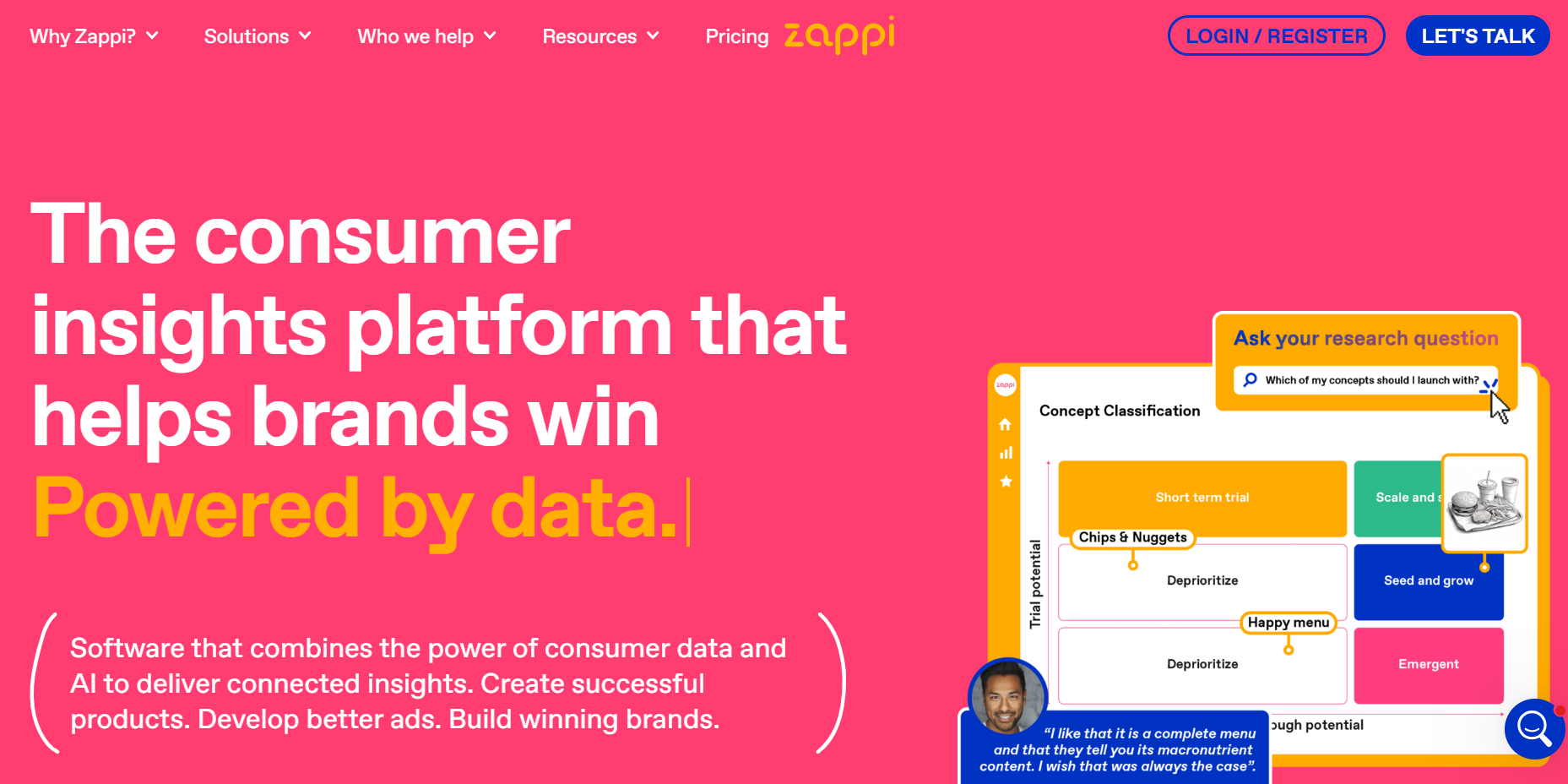
Zappi is a consumer insights platform focused heavily on automated concept testing, creative testing, and advertising research workflows. It is especially popular among brands running high-frequency campaign validation and innovation testing programs.
Key Features
- Concept testing software
- Creative and ad testing
- Innovation research workflows
- Automated benchmarking
- Brand tracking
- Pre-built research templates
- Consumer data analytics
- Campaign performance insights
Strengths
- Fast testing workflows
- Strong benchmarking capabilities
- Structured research methodologies
- Good for campaign optimization
- Easy deployment for marketing teams
- Scalable concept testing workflows
Tradeoffs
- Less flexible outside standardized research use cases
- Limited customization for complex research programs
- More testing-focused than full consumer intelligence platforms
- Less suitable for broad, continuous insights operations
Pricing
Custom pricing depending on testing volume, modules, and enterprise requirements.
When to Choose Zappi
Choose Zappi if you need fast, standardized concept testing and ad testing workflows.
→ Many brands evaluating Zappi alternatives eventually move toward broader AI market research platforms with more flexible consumer insights and research automation capabilities.
5. Quantilope
Best for: Advanced Quantitative Research
Quantilope is a research automation platform designed for advanced quantitative consumer research. The platform combines sophisticated statistical methodologies with automation workflows to help insights teams run complex studies faster.
Key Features
- Conjoint analysis
- MaxDiff studies
- Advanced segmentation
- Pricing research
- Automated quantitative workflows
- Research analytics dashboards
- Consumer behavior modeling
- Automated reporting
Strengths
- Strong quantitative methodologies
- Advanced analytics depth
- Research automation capabilities
- Faster execution of complex studies
- Enterprise-grade research sophistication
- Strong statistical modeling support
Tradeoffs
- Higher learning curve for non-research users
- Better suited for mature insights teams
- Premium pricing structure
- Less lightweight than agile research platforms
Pricing
Custom enterprise pricing depending on methodology requirements and research scale.
When to Choose Quantilope
Choose Quantilope if you need advanced quantitative research and automated statistical methodologies.
6. Suzy
Best for: Rapid Consumer Insights
Suzy is a consumer insights platform built around speed and rapid data collection. The platform helps brands run fast-turn consumer research for campaigns, innovation, product ideas, and messaging validation.
Key Features
- Rapid consumer surveys
- Audience targeting
- Mobile-first research workflows
- Real-time consumer research data
- Fast reporting dashboards
- Brand and campaign validation
- Agile insights workflows
- Research collaboration tools
Strengths
- Very fast research deployment
- Agile workflows for modern teams
- Easy-to-use interface
- Strong speed-to-insight capabilities
- Good for rapid iteration cycles
- Accessible for non-research stakeholders
Tradeoffs
- Less suited for highly complex enterprise governance
- Limited advanced methodology depth
- Smaller ecosystem than large enterprise vendors
- Less comprehensive for large-scale continuous insights operations
Pricing
Custom pricing based on audience access, research frequency, and enterprise requirements.
When to Choose Suzy
Choose Suzy if you need rapid consumer data and agile research execution for fast-moving teams.
7. Attest
Best for: Agile Consumer Research
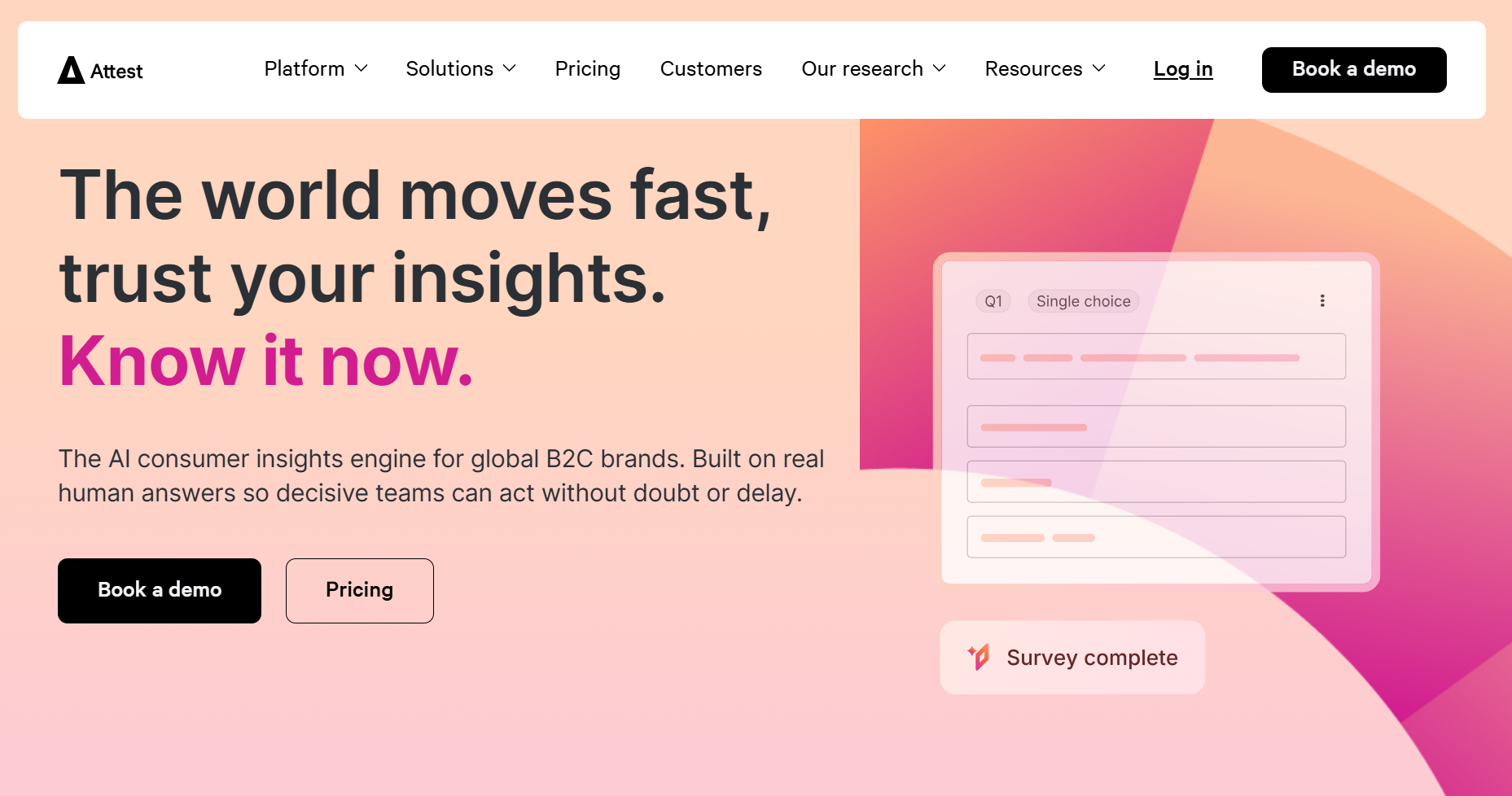
Attest is a consumer research platform designed for agile market research and self-serve consumer insights workflows. The platform focuses on usability, accessibility, and fast deployment for teams that need research without operational complexity.
Key Features
- Consumer research platform
- Audience targeting
- Brand tracking
- Concept testing software
- Market sizing research
- Automated dashboards
- Research templates
- Cross-market insights
Strengths
- Easy-to-use platform
- Fast research setup
- Good for agile teams
- Lower operational complexity
- Flexible consumer research workflows
- Strong accessibility for non-specialists
Tradeoffs
- Less advanced enterprise governance
- More lightweight analytics depth
- Limited advanced AI research workflows
- Smaller enterprise ecosystem
Pricing
Flexible pricing based on research volume, audience targeting, and platform access.
When to Choose Attest
Choose Attest if you need simple, flexible, and self-serve consumer research workflows.
8. GWI
Best for: Audience Intelligence and Market Trends
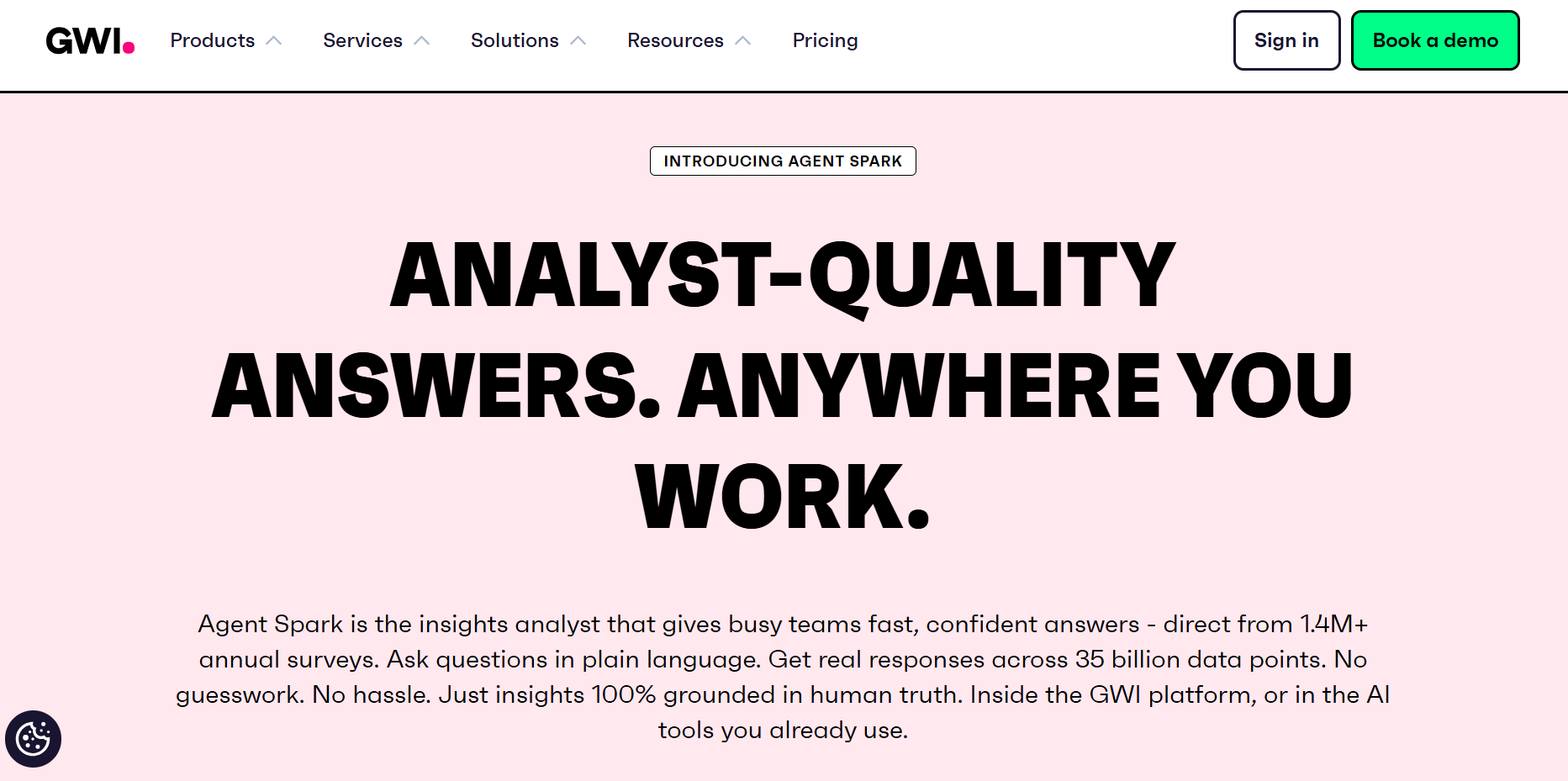
GWI is one of the leading audience intelligence platforms focused on consumer behavior, digital trends, and market intelligence. Unlike traditional survey-heavy consumer research platforms, GWI specializes in large-scale audience datasets that help brands understand who their consumers are, what they care about, and how they behave online.
Key Features
- Global consumer datasets
- Audience segmentation
- Digital behavior insights
- Media consumption analysis
- Market trend tracking
- Audience intelligence dashboards
- Consumer profiling
- Cross-market comparisons
Strengths
- Strong audience intelligence depth
- Large-scale consumer datasets
- Excellent for market and trend analysis
- Useful for media and brand strategy
- Fast access to consumer behavior insights
- Strong cross-market visibility
Tradeoffs
- Less focused on custom primary research
- Limited research workflow capabilities
- Not designed for full research automation
- Less suitable for deep qualitative analysis
Pricing
Custom enterprise pricing based on dataset access, users, and market coverage.
When to Choose GWI
Choose GWI if you need audience intelligence, consumer behavior insights, and market trend analysis.
9. NIQ
Best for: Retail and FMCG Consumer Intelligence
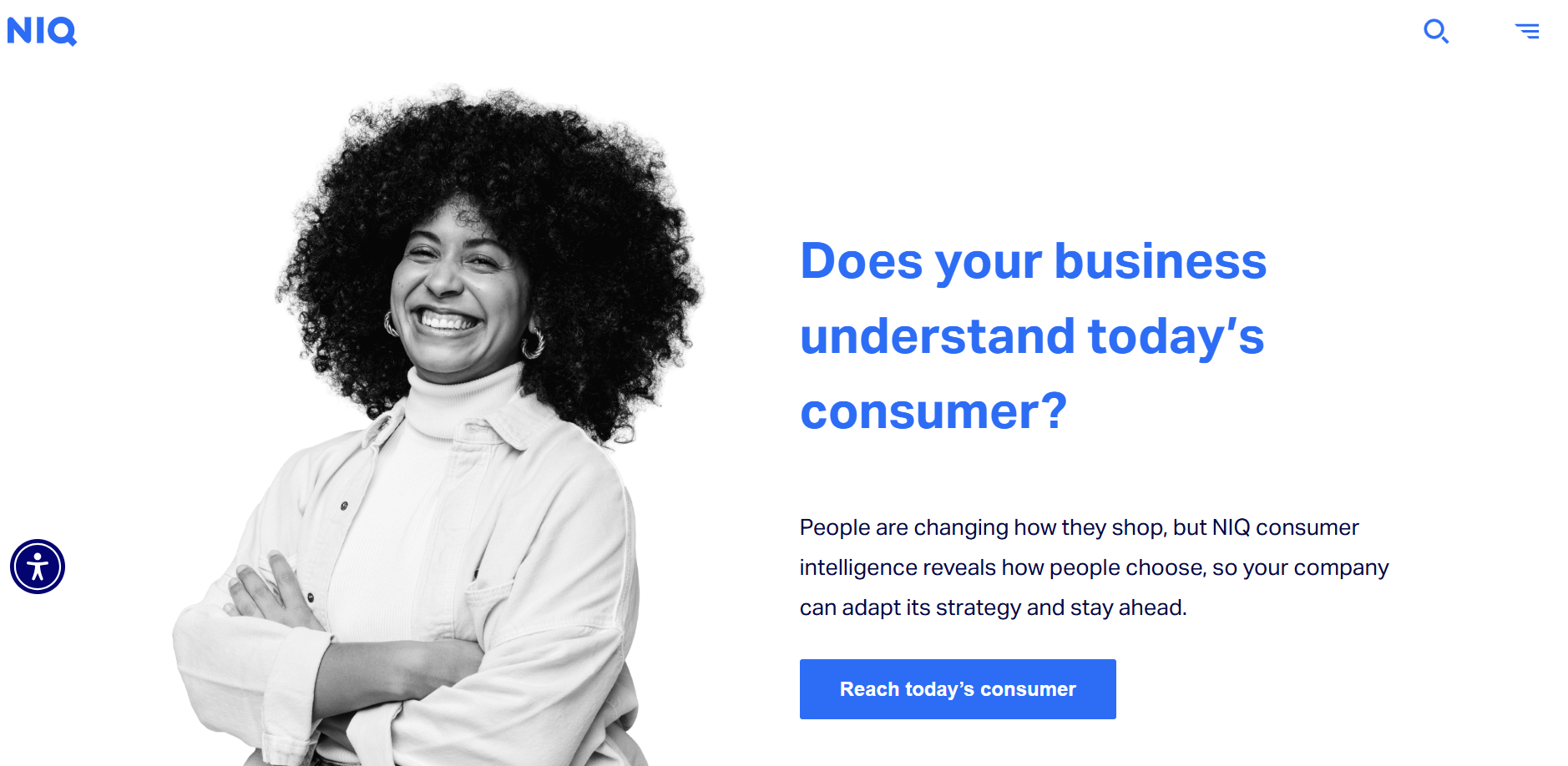
NIQ is one of the most established consumer intelligence platforms for retail, FMCG, and shopper analytics. The platform combines retail measurement, consumer purchasing data, category intelligence, and market analytics to help enterprises understand buying behavior at scale.
Key Features
- Retail measurement data
- Shopper intelligence
- FMCG analytics
- Category performance tracking
- Consumer purchasing insights
- Market share analysis
- Competitive benchmarking
- Omnichannel retail intelligence
Strengths
- Strong retail and FMCG intelligence
- Massive market datasets
- Deep category insights
- Enterprise-scale analytics
- Strong syndicated intelligence capabilities
- Global market coverage
Tradeoffs
- Enterprise-heavy workflows
- Higher operational complexity
- Less agile for rapid custom research
- More analytics-centric than survey-centric
Pricing
Enterprise pricing based on datasets, market access, analytics modules, and business scale.
When to Choose NIQ
Choose NIQ if you need deep retail intelligence, shopper analytics, and FMCG market data..
10. Brandwatch
Best for: Social and Digital Consumer Insights
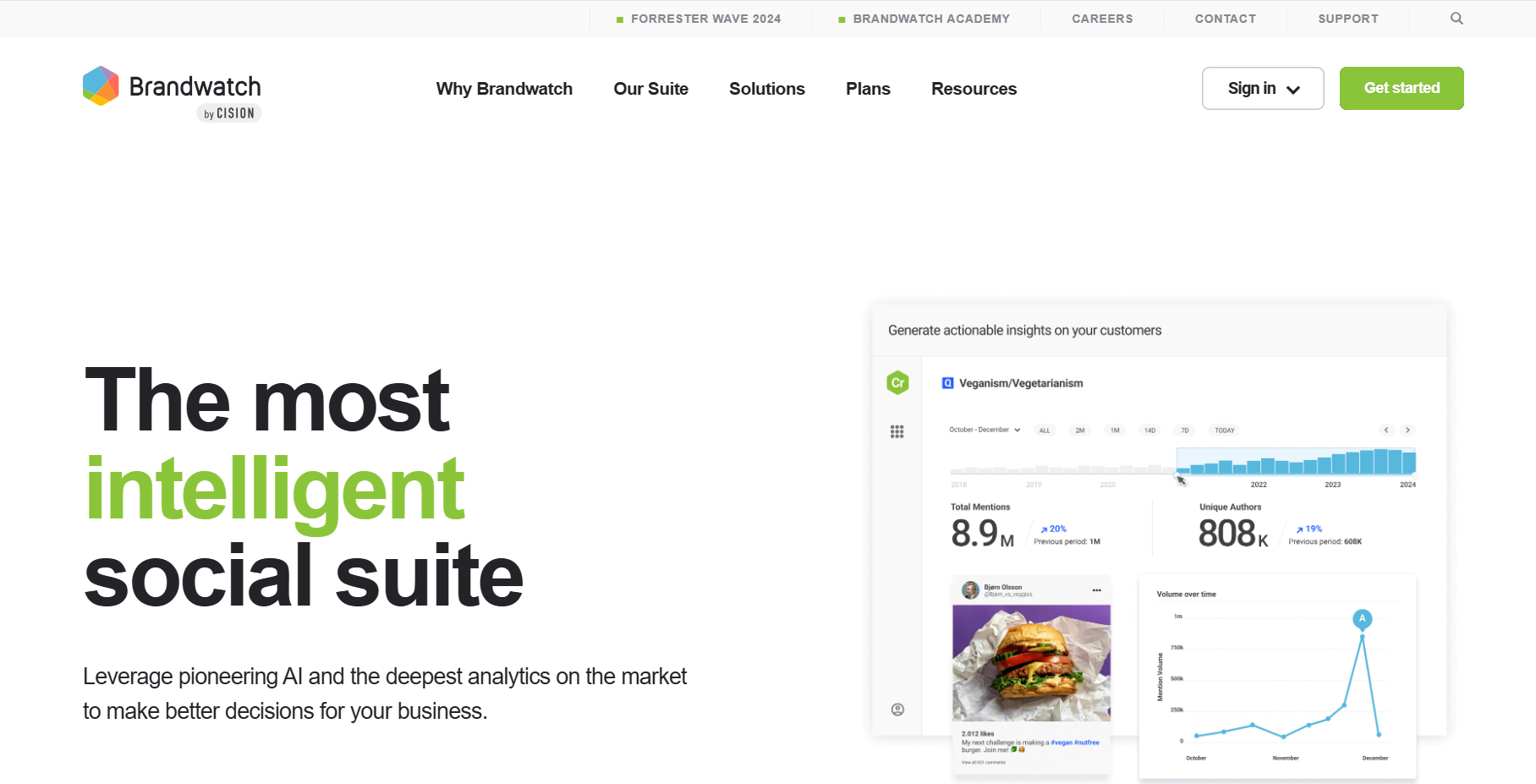
Brandwatch is a consumer intelligence platform focused on social listening, digital behavior analysis, and online consumer sentiment. The platform helps brands monitor conversations happening across social media, forums, blogs, reviews, and digital communities in real time.
Key Features
- Social listening
- Consumer sentiment analysis
- Digital trend monitoring
- Brand reputation tracking
- Online conversation analytics
- Competitive social intelligence
- Influencer monitoring
- Real-time alerts and dashboards
Strengths
- Strong social listening capabilities
- Real-time digital intelligence
- AI-powered sentiment analysis
- Strong trend monitoring
- Useful for brand and PR teams
- Large-scale online conversation analysis
Tradeoffs
- Less suited for structured quantitative research
- Limited quantitative market research workflows
- More digital-focused than full-spectrum consumer insights platforms
- Not ideal for advanced custom research methodologies
Pricing
Custom pricing based on users, listening volume, analytics requirements, and enterprise needs.
When to Choose Brandwatch
Choose Brandwatch if you need real-time social listening, digital consumer intelligence, and online sentiment analysis.
Different consumer insights platforms are built for different research goals, workflows, and team structures.
Before choosing a platform, it is important to understand which tools align best with your business needs.
Who This Guide Is For
Not every team uses consumer insights platforms the same way. The right platform depends on your research goals, workflow complexity, and decision-making speed.
- Consumer Insights Teams: For teams running continuous consumer research, brand tracking, and insight programs across regions or business units.
- Brand and Marketing Teams: For marketers looking to validate campaigns, understand audience behavior, and improve messaging faster.
- Strategy and Innovation Teams: For teams evaluating new markets, testing ideas, and reducing decision risk through consumer intelligence.
- Product and Research Teams: For organizations using consumer research software to improve product development, prioritization, and consumer understanding.
The best consumer insights platforms are the ones that align with how your teams actually collect, analyze, and operationalize research.
Now let’s look at how modern consumer insights platforms differ from traditional market research tools.
Consumer Insights Platforms vs Traditional Market Research Tools
Traditional market research tools were designed primarily for data collection and reporting. Modern consumer insights platforms are built for continuous intelligence, AI-powered analysis, and faster decision-making.
| Capability | Traditional Market Research Tools | Modern Consumer Insights Platforms |
| Research Model | Project-based studies | Continuous consumer insights |
| Analysis | Manual reporting and interpretation | AI-powered analysis and automation |
| Speed | Slower turnaround cycles | Faster insight generation |
| Insights Delivery | Static reports and presentations | Real-time dashboards and alerts |
| Accessibility | Mostly limited to research teams | Cross-functional stakeholder access |
| AI Capabilities | Limited or add-on based | Built-in AI insight generation |
| Workflow Focus | Data collection | Decision support and operational intelligence |
| Research Flexibility | Structured and methodology-heavy | Agile and iterative workflows |
| Automation | Minimal workflow automation | End-to-end research automation |
| Scalability | Research-team dependent | Organization-wide intelligence workflows |
The shift from traditional market research platforms to AI-powered consumer insights software is fundamentally about speed, accessibility, and operational decision-making.
Now let’s look at some of the most common mistakes teams make when choosing consumer insights platforms.
Common Mistakes Teams Make When Choosing Consumer Insights Platforms
Many organizations evaluate consumer insights platforms based on features alone. But the real challenge is choosing a platform that fits how your research workflows actually operate.
→ Prioritizing Data Collection Over Insights
Many teams evaluate platforms primarily on survey capability, panel access, and data collection features. But data collection is a commodity.
The differentiating factor between consumer insights platforms is what happens after the data comes in. AI-led insight generation, automated reporting, and decision-support capabilities determine whether the platform actually accelerates business decision-making.
→ Ignoring Workflow Speed
Research economics differ significantly between teams running weekly studies and those running quarterly projects. A platform that works well for occasional enterprise studies may create serious operational friction for continuous research programs.
Always evaluate platform speed and execution overhead against your actual research frequency, not a hypothetical research volume.
→ Overbuying Enterprise Complexity
Many teams leave one operationally heavy platform and evaluate an equally complex alternative with a different brand name.
The result is similar workflow friction, similar implementation timelines, and similar execution delays. Evaluating platforms on operational simplicity alongside capability depth prevents this pattern.
→ Choosing Tools Without AI Capabilities
AI is reshaping the entire consumer research workflow, from questionnaire generation and quality control to analysis, reporting, and insight generation. Platforms without strong AI capabilities will increasingly create operational disadvantages as AI-native research platforms continue to accelerate research execution and automate insight delivery.
Treating AI as a nice-to-have instead of a core evaluation criterion is a strategic mistake in 2026.
The best consumer insights platforms are not necessarily the ones with the most features. They are the ones that help teams move from research to decisions faster and more consistently.
With that in mind, let’s answer some of the most common questions buyers ask when evaluating consumer insights software.
→ See how SurveySensum supports continuous consumer research without operational complexity.
Frequently Asked Questions
What is a consumer insights platform?
A consumer insights platform helps businesses collect, analyze, and operationalize consumer data for decision-making using surveys, AI analysis, dashboards, and research automation workflows.
What are the best consumer insights platforms?
A consumer insights platform helps businesses collect, analyze, and operationalize consumer data for decision-making using surveys, AI analysis, dashboards, and research automation workflows.
What are the best consumer insights platforms?
Some of the best consumer insights platforms in 2026 include SurveySensum, Qualtrics, Toluna, Zappi, Quantilope, Suzy, Attest, GWI, NIQ, and Brandwatch.
How are consumer insights platforms different from market research tools?
Traditional market research tools focus mainly on data collection and reporting. Modern consumer insights platforms focus on continuous intelligence, AI-powered analysis, and operational decision support.
What are AI consumer insights platforms?
AI consumer insights platforms use AI-powered analysis, automated reporting, conversational analytics, and machine learning to accelerate research workflows and insight generation.
Which consumer insights platform is best for enterprises?
Qualtrics and NIQ are strong enterprise-focused platforms, while SurveySensum offers a more AI-led and operationally agile approach for enterprise consumer insights programs.
Which consumer insights platform is best for agile research teams?
SurveySensum, Suzy, and Attest are strong choices for agile consumer research workflows and faster insight generation.
Final Thoughts
Choosing a consumer insights platform is not really about choosing the tool with the longest feature list.
It is about choosing the platform that fits how your research actually runs.
Some teams need structured, project-based market research with governance, benchmarking, and large-scale panel access. Others need faster research execution, AI-powered insight generation, continuous tracking, and automated reporting that helps the business move quickly.
That is why the consumer insights platform category is shifting so fast. The strongest platforms in 2026 are no longer just market research tools. They are becoming AI-powered consumer intelligence systems built to help teams move from data to action faster.
→ See how SurveySensum helps market research teams automate insight generation, accelerate reporting, and run faster AI-led consumer research workflows.
Free Forever • No Feature Limitation • No Credit Card Required • Sign Up For Free 


Increase ROI by 3x with targeted feedback & analysis
Boost Customer Satisfaction by up to 20%
Reduce Churn by identifying pain points in real time
See it in Action
Contents
How much did you enjoy this article?