




Top 5 SurveyMonkey Alternatives in the Philippines for CX Teams (2026)
SurveySensum is one of the best SurveyMonkey alternatives in the Philippines because it supports multilingual feedback analysis (Tagalog + English), closed-loop workflows, and omnichannel feedback across Viber, Facebook Messenger, calls, and email.
Request a Demo
If you’re searching for a SurveyMonkey alternative in the Philippines, chances are the issue isn’t collecting customer feedback, but acting on it.
SurveyMonkey works well if your goal is simple:
- Send a survey
- Collect responses
- Export the results
But Philippine CX teams today are not just collecting feedback.
They are:
- Managing customers across Viber, Facebook Messenger, and calls
- Running multi-branch operations across Luzon, Visayas, and Mindanao
- Handling feedback in English, Tagalog, Taglish, and slang
- Chasing detractors who don’t respond to email or SMS surveys
- Looking for real closure, not just a score
That’s where execution breaks down.
This is why many teams are actively looking for a SurveyMonkey alternative in the Philippines that supports execution, ownership, and faster resolution.
So before exploring the alternatives, let’s talk about the real challenges Philippine CX teams face when using SurveyMonkey.
Where SurveyMonkey Falls Short for Philippine CX Teams
Let’s break them down.
1. Dashboards Without Guidance: No AI for Next Actions
Many CX teams ask a simple question after looking at the data:
→ “Okay… but what should we do next?”
Modern Philippine CX teams don’t want:
- 15 dashboard tabs
- Manual filter by branch, region, and date
- A 2-hour analytics session before every leadership meeting
They want to ask:
- “Top 3 issues this week?”
- “Which branches need attention today?”
- “Why did NPS drop in Cebu?”
And they expect answers quickly.
This is where SurveyMonkey starts feeling limited.
It provides dashboards, but:
- No chat-based AI engine
- No automated insight summaries
- No next-action recommendations
So teams still spend time manually analyzing feedback to find answers.
For large operations like banks with hundreds of branches or telcos spread across multiple islands, dashboards without guidance create more data to review – not faster decisions.
2. Basic Survey Tool Not Designed for Enterprise CX
SurveyMonkey is simple. That’s both its strength and its limitation.
You can collect responses, but what happens after that?
- No built-in ticketing system or closed-loop workflows
- Limited advanced dashboarding and analytics
- No structured ownership or escalation
- Analysis often moves to Excel manually
So teams end up managing operations outside the platform, which slows everything down.
And you end up asking yourself: If your team still exports data to spreadsheets to act on feedback, is the platform really helping?
3. Email-First Thinking Doesn’t Match Philippine Reality
Many customer feedback platforms in the Philippines assume email or SMS is enough.
But in the Philippines:
- SMS links often get ignored or fail
- Teams start with email or Viber, but closure happens on calls
- Customers actively use Facebook Messenger and Viber
CX here is not linear. It’s multi-step.
But SurveyMonkey doesn’t support native workflows that combine email surveys → messaging → calling.
There’s no structured flow for:
- starting with digital outreach
- escalating to messaging channels
- then moving to calls for resolution
So, CX teams end up managing these follow-ups outside the platform, which slows down customer closure.
And when closure becomes manual, CX programs lose momentum.
4. Priority Customer Support Costs Extra, and It’s Still Slow
This is where frustration turns into distrust.
What teams experience:
- Normal support → slow
- Faster turnaround → “Please upgrade to Priority Support” (extra cost)
Even after paying:
- 10-15 day resolution timelines
- Issue passed from person to person
- No clear ownership
One CX head in Manila said it plainly: “By the time they replied, the issue had already escalated to our COO.”
Enterprise-grade pricing should not mean enterprise-grade waiting.
5. Taglish Feedback? Keyword Analytics Misses Everything
Feedback in the Philippines rarely comes in clean, formal English.
Here’s a real response from a Filipino customer:
“Ok naman yung service pero medyo matagal yung response, nakaka-frustrate. Di ko na sana irerecommend pero sige, bibigyan ko pa ng chance.”
Keyword-based analytics tags “service” as neutral. Maybe flags “recommend.” Misses everything else.
What it actually contains: clear frustration, a near-churn signal, and conditional loyalty hanging by a thread. That’s a detractor.
But keyword tagging often labels feedback like this as neutral or passive.
Because feedback in the Philippines mixes:
- English + Tagalog + Taglish
- Slang and conversational phrasing
- Indirect sentiment hidden between words
Without AI text analytics tool, CX teams often end up reading and interpreting responses manually just to understand what customers really mean.
All these challenges point to one thing: teams need a better way to execute CX.
So, What Philippine CX Teams Are Looking for
Strong CX teams are looking for a customer feedback platform in the Philippines that supports:
- Multichannel workflows (email → messaging → calls)
- Closed-loop ticketing system with clear ownership
- AI text analytics that understands Tagalog + English context
- Guidance on next actions, not just dashboards
- Hierarchical dashboards with role-based access across branches
- Fast implementation
- Enterprise-grade structure that scales
- Real-time responsive customer support
Because here, execution matters more than reporting.
That brings us to the tools that better fit Philippine CX realities.
Top 5 SurveyMonkey Alternatives in Philippines
Here’s a comparison of the tools based on what CX teams actually need from a modern customer feedback platform in the Philippines – from feedback collection to ownership, execution, and real customer closure.
1. SurveySensum: Overall Best SurveyMonkey Alternative in the Philippines
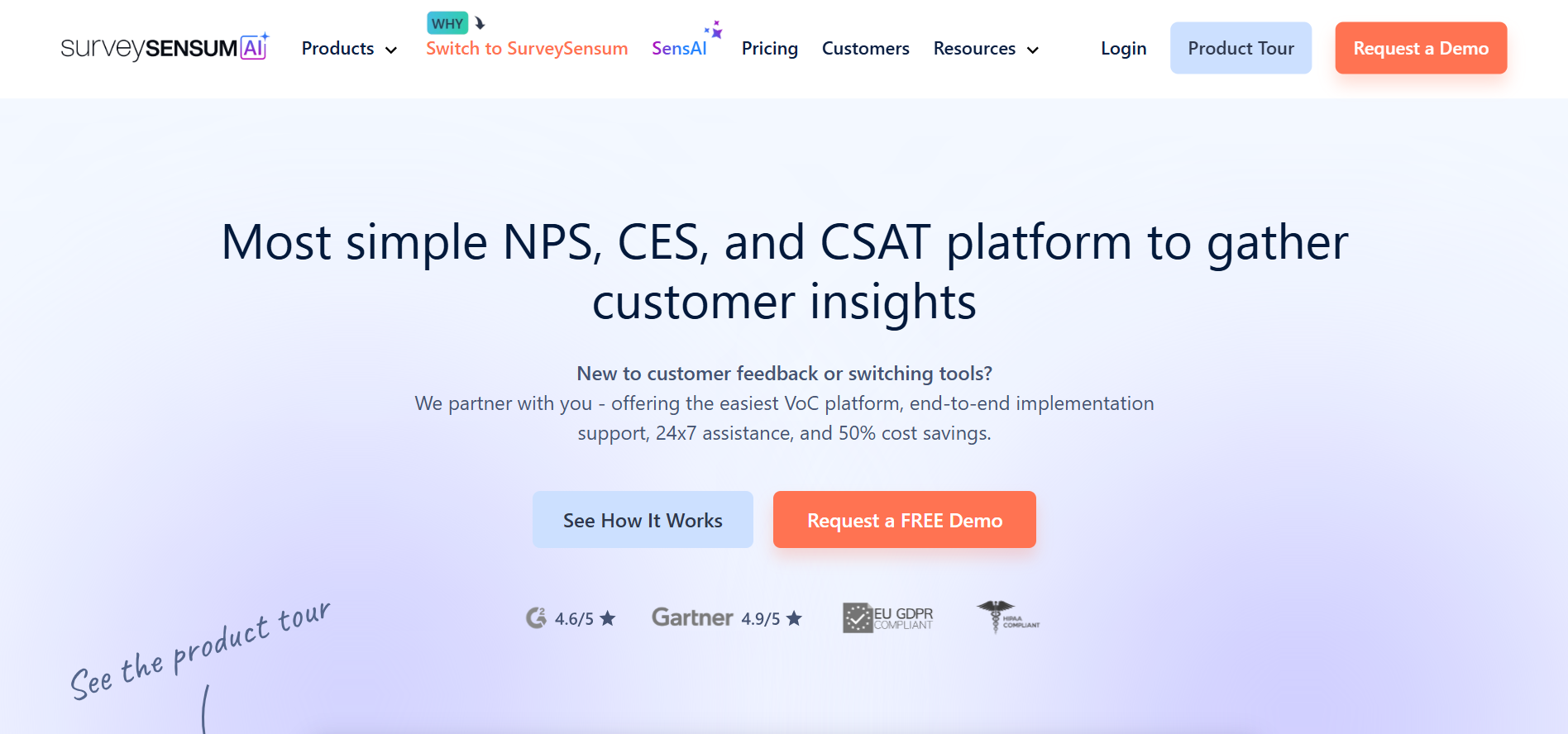
Best for: BPOs, banks, insurance companies, telcos, retail chains, healthcare networks, and any multi-location enterprise in the Philippines managing large-scale customer feedback and follow-ups.
SurveySensum is designed as a customer feedback platform for the Philippines, helping enterprises manage multilingual feedback and structured CX execution.
Instead of feedback sitting inside dashboards, the platform helps teams analyze multilingual responses, assign ownership of issues, and move faster toward resolution.
This is especially useful in the Philippines, where customer conversations often move across Messenger, Viber, WhatsApp, calls, and branch teams before issues are resolved. SurveySensum connects feedback directly to structured follow-ups and workflows, helping teams turn customer input into action rather than letting it sit in dashboards.
Strengths
- Unified omnichannel survey distribution supporting Messenger, Viber, WhatsApp, email, and call-based follow-ups
- Contextual AI text analytics that understands English, Tagalog, and Taglish feedback
- SensAI Chat-based Insight Engine for instant answers, summaries, and next-action guidance
- AI survey builder that creates surveys from a single prompt without IT dependency
- Root-cause detection to identify recurring customer issues automatically
- Role-based hierarchical dashboards with branch → team → leadership visibility and access control
- Built-in closed-loop ticketing system so every issue has clear ownership and follow-through
- Automated alerts for detractors so critical feedback gets attention quickly
- Enterprise-ready deployment including cloud, on-prem, or hybrid hosting, with compliance-ready governance
- Fast go-live with minimal setup, ideal for high-volume BPO environments
- Transparent, scalable pricing aligned to operational CX programs
Verdict: SurveySensum is one of the best SurveyMonkey alternatives in the Philippines for teams that treat CX as an operational function, not just a reporting exercise – making it the strongest choice when execution and accountability matter more than basic survey collection.
See how SurveySensum helps Philippine CX teams close the loop faster, without hidden costs. View SurveySensum Pricing
Free Forever • No Feature Limitation • No Credit Card Required • Sign Up For Free 
2. Qualtrics: Enterprise Experience Management Platform
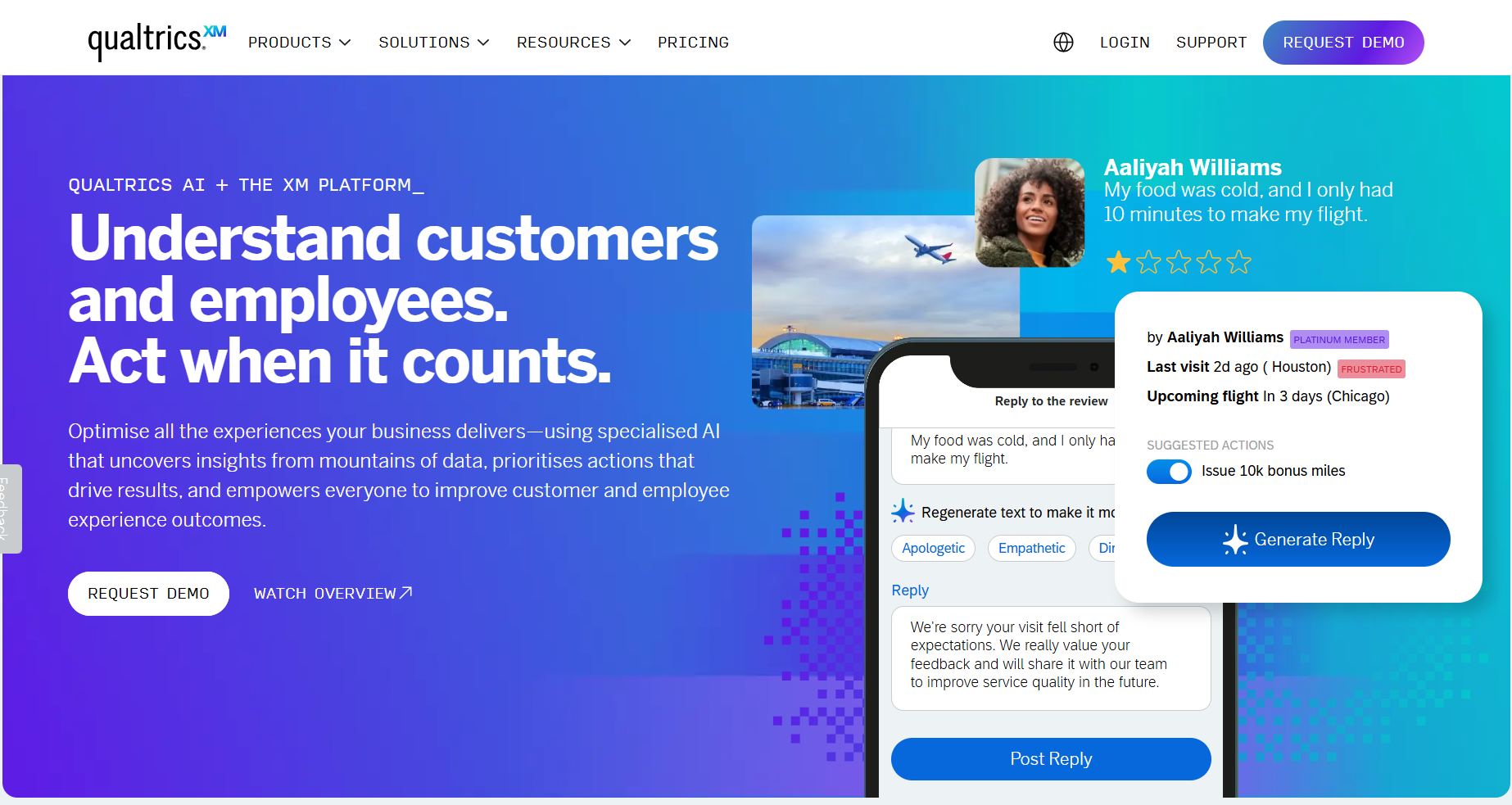
Best for: Large enterprises, telecom, banking, and organizations running structured global CX programs.
Qualtrics is known for advanced analytics and enterprise governance. It helps organizations manage large datasets and build sophisticated reporting frameworks. Teams looking for deep measurement and executive-level visibility often consider it when scaling their CX programs.
Strengths
- Powerful analytics and reporting tools
- Highly configurable workflows
- Scales well across regions and departments
- Extensive integration ecosystem
Limitations as per Philippines CX Team
- Expensive for mid-sized businesses
- Complex for fast-moving CX teams
Verdict: Excellent for enterprise analytics and governance, but may be more structured than teams needing quick operational execution.
→ Explore Qualtrics alternatives in the Philippines built for faster execution, simpler workflows, and real customer issue closure.
3. Medallia: Large-Scale Experience Management
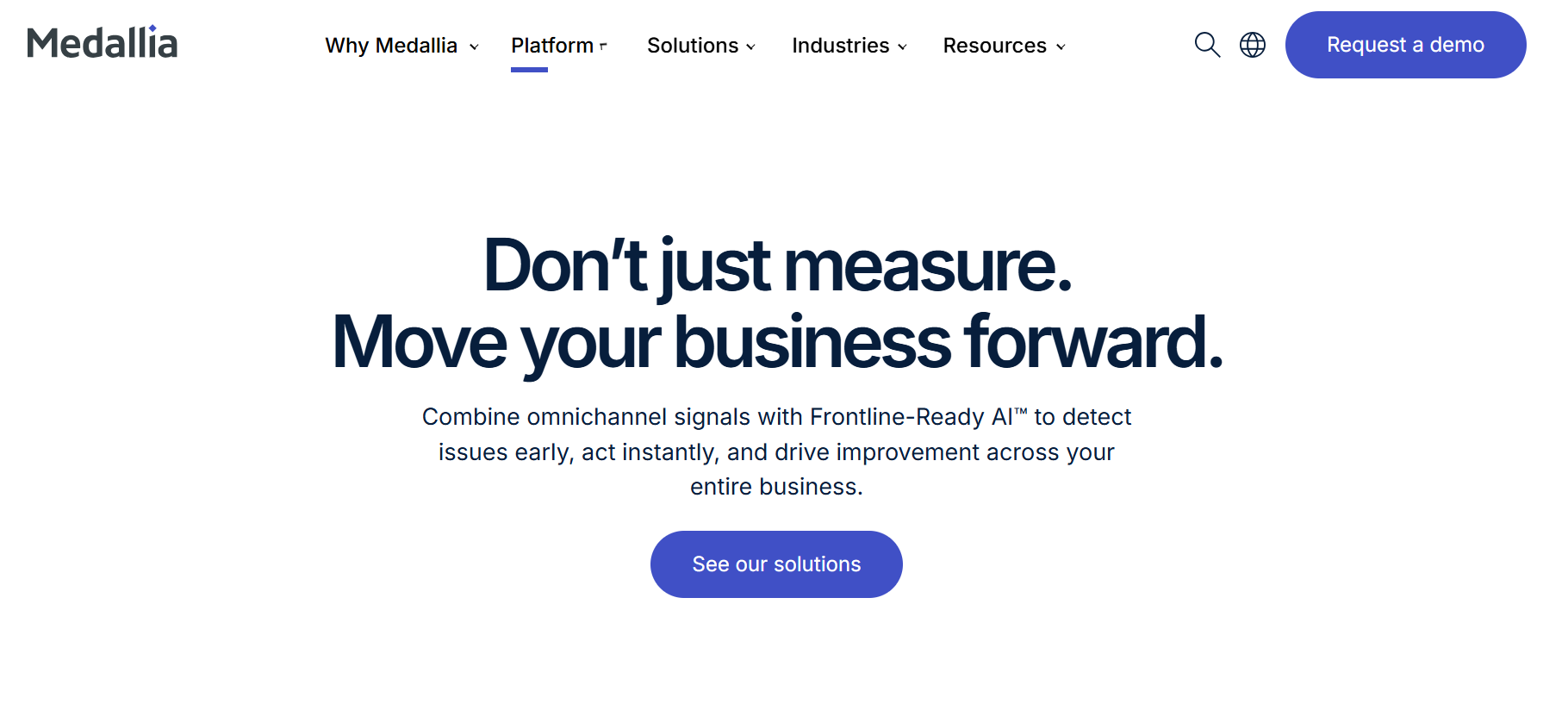
Best for: Global enterprises and mature CX programs focused on leadership visibility and enterprise insights.
Medallia is designed for organizations that want deep visibility into customer experience across channels. It supports large-scale programs and offers strong analytical depth, making it suitable for enterprise environments with dedicated CX teams.
Strengths
- Strong executive-level reporting
- Omnichannel feedback collection
- Scalable architecture for large organizations
- Mature enterprise ecosystem
Limitations as per Philippines CX Team
- Higher implementation effort
- Operational follow-up flows may require customization
Verdict: Powerful for enterprise-level insight management, but may feel heavy if the primary goal is faster operational closure.
→ See Medallia alternatives in the Philippines designed for teams that need practical CX execution, multilingual insights, and clearer ownership.
4. Typeform: Engagement-First Survey Experience

Best for: Marketing teams, startups, product feedback programs, and brands prioritizing response experience.
Typeform focuses on making surveys feel conversational and easy for customers to complete. It works well for engagement and quick feedback collection, but is primarily designed for experience, not operational CX management.
Strengths
- High response engagement
- Clean and modern interface
- Easy survey setup
- Strong brand experience
Limitations as per Philippines CX Team
- No closed-loop workflow system
- Limited enterprise governance features
Verdict: Excellent for collecting engaging feedback, but not designed for teams managing complex CX operations.
5. Local CX Tools in the Philippines: Regionally Adapted Solutions
Best for: Local businesses, regional service providers, and teams that prioritize local support and simpler deployment.
Several Philippine-focused or regionally adapted CX tools are emerging to support local workflows. These platforms usually focus on affordability, local implementation support, and easier onboarding for businesses transitioning from manual feedback processes.
Strengths
- Local market understanding
- Easier onboarding for regional teams
- Faster local support response
- Simpler deployment models
Limitations as per Philippines CX Team
- Limited scalability for large enterprises
- Fewer advanced AI capabilities
- Smaller integration ecosystems
- May lack deep analytics or governance features
Verdict: Good for organizations wanting local alignment and simplicity, but larger teams may eventually need more advanced operational capabilities.
To make the decision easier, here’s how SurveyMonkey and SurveySensum compare based on real operational needs.
Quick Comparison: SurveyMonkey vs SurveySensum for Philippines CX Teams
Here’s a comparison of the best survey tools used by CX teams in the Philippines, based on what organizations need to move from feedback collection to customer closure.
| Feature That Matters in the Philippines | SurveyMonkey | SurveySensum |
| Primary Focus | Survey creation & feedback collection | End-to-end CX execution |
| AI Survey Builder | Basic AI-assisted survey creation | AI Survey Builder for structured CX programs |
| Closed-Loop Resolution | Manual follow-ups outside the platform | Built-in closed-loop ticketing with ownership and escalation |
| Dashboards & Access Control | Standard dashboards with basic sharing | Branch → Regional → Leadership visibility with role-based access |
| AI Text Analytics | Basic sentiment and keyword tagging | AI text analytics for English, Tagalog, and Taglish feedback |
| AI Guidance | Reporting insights only | SensAI Chat-based insight engine that recommends next actions |
| Omnichannel Collection | Email, web links, embedded surveys | Unified feedback across messaging, email, calls, in-app, and web |
| Enterprise Support | Tier-based support model | Execution-focused onboarding and CX support |
| Implementation Approach | Quick survey setup | Fast go-live for full CX workflows |
| Best Fit in the Philippines | Basic research and feedback programs | Multi-branch CX teams needing structured follow-ups and faster closure |
In short: SurveyMonkey helps you measure feedback, while SurveySensum helps teams execute and close customer issues faster and if NPS measurement is a priority, here’s a breakdown of the top NPS tools available in the Philippines worth considering alongside your platform choice.
If your team is drowning in follow-ups instead of resolving them, it’s time to move beyond basic survey tools. See how SurveySensum turns feedback into faster closure.
Free Forever • No Feature Limitation • No Credit Card Required • Sign Up For Free
Wrapping Up,
SurveyMonkey is a solid tool for basic survey collection.
But in the Philippines, the real challenge isn’t listening – it’s closing the loop fast enough.
When follow-ups live in spreadsheets and ownership is unclear, teams stay busy, but customer issues stay open. That’s where CX programs start losing momentum.
SurveySensum closes that gap. It turns feedback into clear actions, assigns ownership automatically, and helps teams move toward resolution without manual chasing.
The difference is simple: SurveyMonkey measures experience, while SurveySensum helps teams execute and improve it.
For Philippine CX teams managing messaging, calls, and multi-branch operations, execution is what drives real customer closure, not just dashboards.
Collecting feedback is easy. Executing on it is where teams struggle. Discover how SurveySensum brings clear ownership and accountability to every case.
Free Forever • No Feature Limitation • No Credit Card Required • Sign Up For Free
FAQs: SurveyMonkey Alternatives in Philippines
What is the best SurveyMonkey alternative in the Philippines for CX teams?
The best alternative is SurveySensum as it focuses on execution, not just survey collection. It is designed for CX teams that want feedback to move directly into action and resolution.
Why do Philippine CX teams move beyond SurveyMonkey?
Teams often outgrow SurveyMonkey when feedback collection is no longer the main challenge. As operations scale, they need accountability, faster follow-ups, and clearer ownership to close customer issues.
Is SurveyMonkey enough compared to other survey tools in the Philippines for enterprise CX programs?
SurveyMonkey works well for collecting feedback, but enterprise CX programs typically need additional capabilities like closed-loop workflows, role-based visibility, and operational tracking to manage execution effectively.
Why is execution more important than surveys for Philippine CX teams?
Customer issues in the Philippines often move across calls, messaging apps, and multiple teams before resolution. Surveys identify problems, but execution ensures someone owns the issue and drives closure.
How do I know if my team has outgrown SurveyMonkey?
If your team is managing follow-ups in spreadsheets, struggling to assign ownership, or relying on manual coordination after surveys, it’s a strong sign you need a more execution-focused CX platform.
Is it easy to migrate from SurveyMonkey to SurveySensum?
Yes. Survey data from SurveyMonkey can be exported and migrated into SurveySensum smoothly. Most teams move their surveys, historical responses, and workflows without major disruption, making the transition straightforward.
Customers don’t churn because feedback was missed. They churn because action was slow. Explore how SurveySensum helps teams move from feedback to closure faster.
Free Forever • No Feature Limitation • No Credit Card Required • Sign Up For Free

New to NPS?
List of Features

Looking for NPS Alternative?
Here's the Comparison

Increase ROI by 3x with targeted feedback & analysis
Boost Customer Satisfaction by up to 20%
Reduce Churn by identifying pain points in real time
See it in Action
Contents
How much did you enjoy this article?