



Top 6 VOC Tools in Indonesia (2026) | Best Customer Feedback Software
The best VOC tools in Indonesia must handle Bahasa–English mixed feedback, WhatsApp-first interactions, and local compliance needs. SurveySensum stands out by combining multilingual AI text analytics, WhatsApp-native surveys, and closed-loop workflows, helping CX teams understand feedback and resolve issues faster.
Request a Demo
If you’re searching for the top VOC tools in Indonesia, the real challenge is not collecting feedback.
It is understanding what customers really mean and turning that feedback into action fast.
That becomes harder in Indonesia, where customer responses often come in Bahasa Indonesia mixed with English, dissatisfaction is not always stated directly, and engagement happens more naturally on WhatsApp than on traditional survey channels.
This is where many VOC platforms start falling short.
They may help teams collect responses, but they often struggle to interpret multilingual feedback correctly, surface clear priorities, and support the follow-up needed for real customer closure.
That is why more businesses are now rethinking their customer feedback software in Indonesia.
They are not just looking for survey tools.
They are looking for platforms that can help them understand feedback clearly, act faster, and run VOC programs more effectively.
So, what exactly makes VOC execution in Indonesia difficult today?
Let’s break it down.
Challenges Indonesian CX Teams Face While Choosing a VOC Tool
Here’s what’s quietly killing CX programs across Indonesia’s fastest-growing companies.
1. Your Keyword Analytics Can’t Understand Indonesian Feedback
Here’s a real feedback example from an Indonesian customer:
“Servicenya oke sih, tapi the delivery was super late and no update from CS.”
This kind of Bahasa and English code-switching is extremely common.
Traditional keyword-based analytics struggles with it. Context gets lost. Sentiment is misread. Sometimes the response is even categorized as neutral.
But the challenge runs deeper.
Indonesian customers rarely complain directly. They soften dissatisfaction. They give a 7 out of 10, say lumayan, and move on.
The frustration exists. The platform just fails to surface it clearly.
2. Your Team Is Drowning in Feedback Without Any Support
As businesses scale, feedback volume grows rapidly.
Survey responses increase. Support tickets pile up. Open-text comments arrive from multiple channels.
On paper, this looks like a healthy feedback program.
In practice, it creates another problem.
Instead of identifying patterns, CX analysts spend hours reading individual responses, trying to manually understand what customers are actually complaining about.
The insight is buried somewhere in the data.
But without intelligent categorization and prioritization, the platform cannot surface fast enough for teams to act.
3. You’re Surveying on the Wrong Channel, the Wrong Way
Most VOC programs still rely on email and SMS surveys.
The problem is: Customers rarely respond to them anymore.
In Indonesia, customer conversations happen on WhatsApp. That is where support queries begin, complaints escalate, and issues actually get resolved.
Yet many VOC platforms treat WhatsApp as a secondary add-on instead of a primary feedback channel.
As a result, low response rates and incomplete feedback loops.
There is also a usability gap internally. Many frontline CX teams work primarily in Bahasa, while the platform interface, dashboards, and documentation remain English-first.
When the platform does not match how customers communicate or how teams operate, the entire feedback program becomes harder to run effectively.
4. The Compliance Question That Stops Procurement
There is one question that often slows procurement immediately: Where is our customer data stored?
For businesses regulated by Otoritas Jasa Keuangan (OJK), the answer matters. Many global VOC platforms host data in Singapore, the US, or Europe.
That single detail can trigger months of compliance reviews, data residency checks, and legal approvals.
For regulated industries in Indonesia, local compliance infrastructure is not a differentiator. It is a baseline requirement.
Once the challenges become clear, the next question is simple: What does a better VOC platform actually look like for Indonesia? Let’s dive in.
What Indonesian CX Teams Should Actually Look for in a VOC Tool
Indonesian teams need a platform that helps them launch faster, understand feedback better, and close the loop across the right channels.
Here is what matters most.
- True DIY control so teams can launch surveys, workflows, and dashboards without vendor dependency.
- Fast implementation so feedback programs go live quickly and start creating value sooner.
- Transparent pricing without extra charges for basic features, changes, or support.
- Local Indonesian support that responds quickly and can work in Bahasa when needed.
- Local cloud hosting and Indonesian data residency to meet OJK, security, and enterprise compliance needs.
- AI text analytics tool for Bahasa + English feedback so teams can understand real customer intent, not just keywords.
- AI summaries and recommendations for quick decisions.
- Action-led workflows that help teams prioritize issues, assign ownership, and track resolution.
- Native WhatsApp feedback collection because email and SMS alone are not enough in Indonesia.
- Omnichannel workflows that support WhatsApp → call → resolution → confirmation.
In short, Indonesian teams need a VOC platform that helps them collect feedback on the right channels, understand it clearly, and act on it fast.
Now, let’s move to a quick comparison of the best VOC tools in Indonesia.
Comparison Table: Best VOC Tools in Indonesia (2026)
To make the shortlist easier, here is a quick comparison of the best VOC tools in Indonesia based on channel fit, Bahasa support, AI capability, and execution strength.
| Tool | Best For | Channels That Work in Indonesia | Bahasa & Local Fit | AI Strength | Key Advantage | G2 Rating |
| SurveySensum | Mid-to-large businesses running serious CX programs | WhatsApp, email, web, SMS | Handles Bahasa Indonesia + English feedback better; stronger regional fit | SensAI chat-based engine, text analytics, summaries, prioritization | Built for fast action, closed-loop workflows, and better local feedback understanding | ⭐ 4.6/5 |
| Qualtrics | Large enterprises with complex CX needs | Email, web, app | Supports multilingual programs; global enterprise setup | Advanced analytics and predictive AI | Strong enterprise governance and reporting depth | ⭐ 4.4/5 |
| Medallia | Enterprises managing CX across many touchpoints | Web, app, email | Enterprise-grade, but less locally tailored | Sentiment analysis, alerts, analytics | Strong for large-scale journey and experience management | ⭐ 4.5/5 |
| SurveyMonkey | Small teams needing simple surveys | Email, web | Basic fit for general feedback collection | Limited AI depth for VOC use cases | Easy to launch and simple to use | ⭐ 4.4/5 |
| Forsta | Research-led enterprises and formal feedback programs | Email, web, app | Better suited for structured research environments than local operational CX | Strong analytics for formal insights programs | Good fit for research-heavy VOC and experience measurement | ⭐ 4.2/5 |
| Local CX tools in Indonesia | Teams that prefer local vendor familiarity | Usually web, email, sometimes WhatsApp | Better local familiarity; capability varies by vendor | Often limited or inconsistent | Easier coordination and local market comfort | Varies |
Let’s understand each tool in depth.
Top 6 VOC Tools in Indonesia (2026)
Now that we know what Indonesian teams actually need, let’s look at some of the top VOC tools in Indonesia and where each one fits.
1. SurveySensum: Best VOC Tool in Indonesia
Best for: BFSI, retail, healthcare, telecom, hospitality, and multi-location businesses that need faster issue resolution from customer feedback.
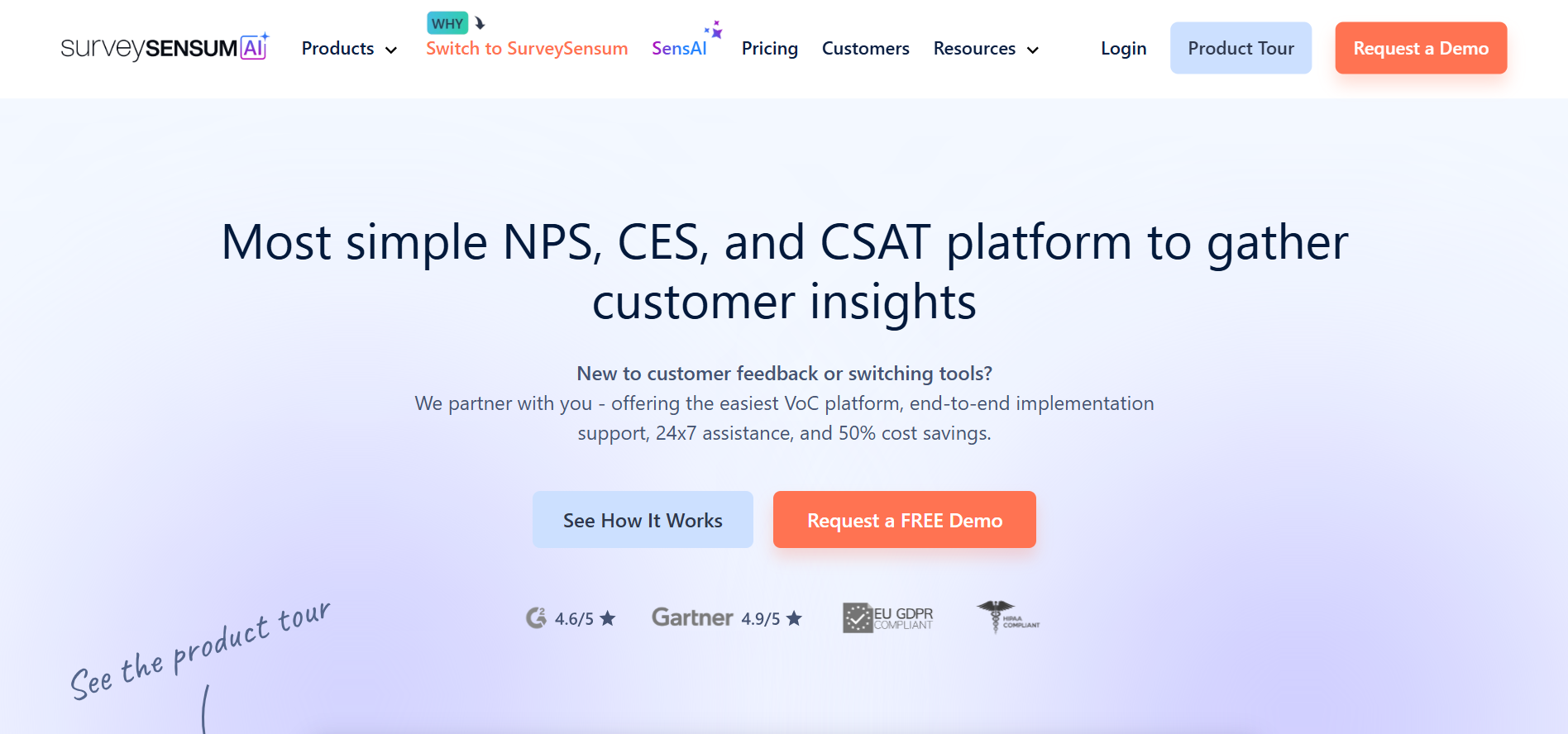
SurveySensum is one of the best customer feedback tools in Indonesia for organizations that want to go beyond collecting survey responses and actually act on customer feedback. Indonesian CX teams often receive feedback in Bahasa Indonesia and English, and traditional survey tools struggle to analyze this mixed-language feedback accurately.
SurveySensum solves this with AI-powered multilingual text analytics, closed-loop ticketing, and role-based dashboards that help teams understand feedback and assign issues quickly. Instead of exporting responses to spreadsheets, Indonesian CX teams can analyze feedback, identify root causes, and track resolution directly within the platform.
Why SurveySensum stands out in Indonesia
- DIY setup for surveys, dashboards, and workflows so teams can launch CX programs quickly without heavy configuration.
- Suited for Bahasa Indonesia and English feedback analysis with contextual AI text analytics that understands mixed-language responses.
- Built-in closed-loop workflows for ownership and follow-up that convert negative feedback into trackable tickets.
- Better fit for WhatsApp-led customer engagement designed for messaging-first CX environments.
- SensAI chat-based engine for CX insights to give you instant answers without digging into dashboards.
- Role-based dashboards for teams and branches so each team can access and manage the feedback they own.
- AI summaries for qualitative feedback that convert large volumes of open-text responses into clear insights.
- Quick deployment for faster CX rollout so teams can start collecting and acting on feedback quickly.
- 24×7 local customer support with fast response times for operational teams.
- Root cause and key driver analysis by SensAI to identify what is driving customer dissatisfaction.
Verdict: SurveySensum is one of the most relevant VOC tools for Indonesia because it matches the market’s real need: faster action, better text understanding, and less operational friction. It works especially well for teams that want outcomes, not just reports.
Explore SurveySensum to see how Indonesian CX teams can move from survey collection to faster action, stronger follow-up, and better customer closure. View SurveySensum pricing
Free Forever • No Feature Limitation • No Credit Card Required • Sign Up For Free 
2. Qualtrics: Best for large, complex CX ecosystems
Best for: large enterprises in banking, aviation, telecom, insurance, and multinational environments with mature CX or research teams.
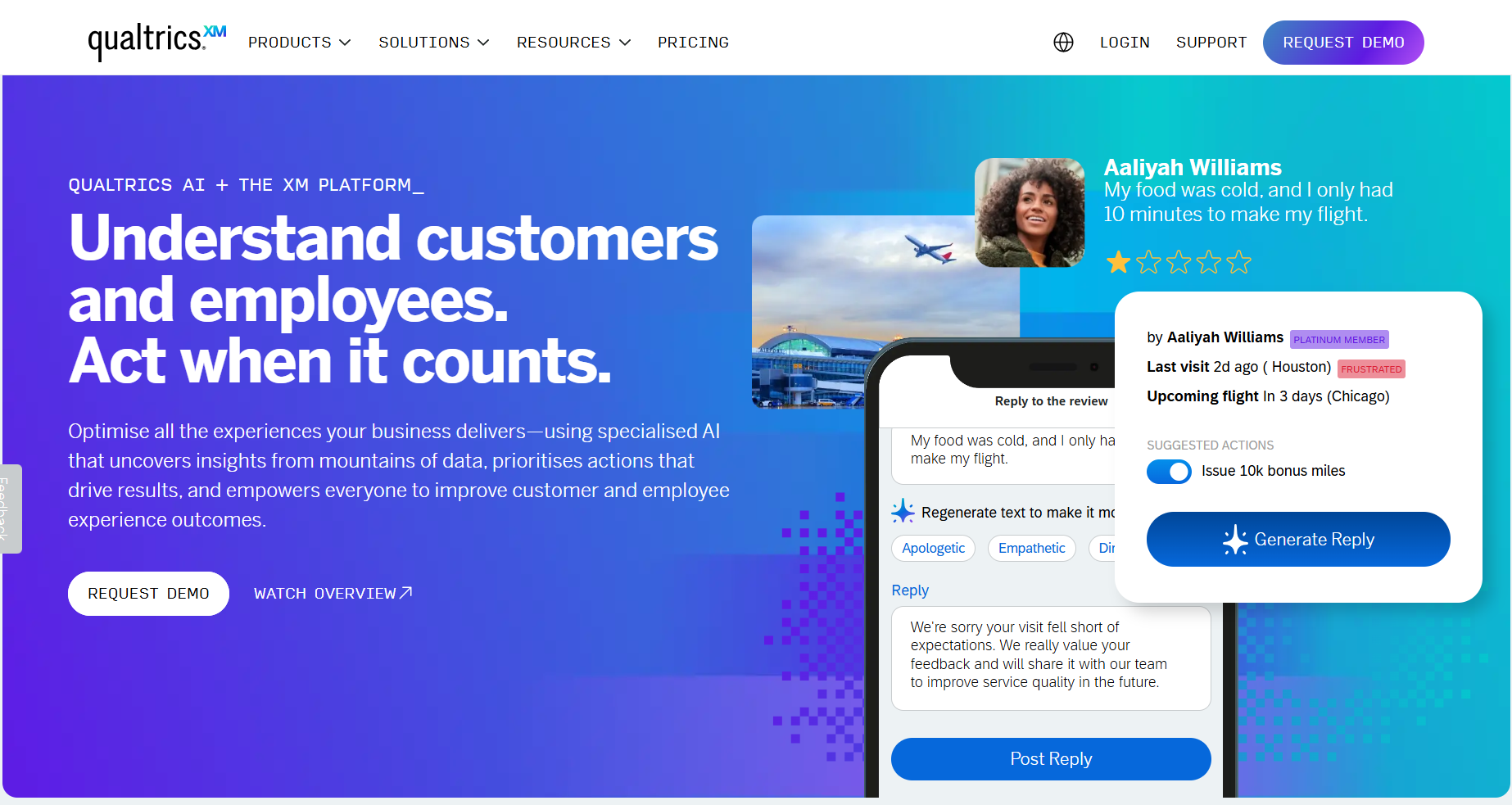
Qualtrics is designed for organizations that need depth, scale, and structure. It offers broad experience management capabilities across customer, employee, and research programs, making it suitable for enterprises managing multiple business units, journeys, and use cases.
Why Qualtrics stands out in Indonesia
- Strong enterprise-grade CX and research capabilities
- Suitable for large multi-team programs
- Advanced survey logic and reporting flexibility
- Well-established global market presence
- Useful for organizations wanting a broader experience management stack
Limitations as per Indonesian CX teams
- Complex and heavy for day-to-day use
- Higher cost can be difficult for leaner teams
Verdict: Qualtrics is powerful, but it is best for organizations that are ready for complexity and scale. For many Indonesian CX teams, the challenge is not capability but usability at speed.
3. Medallia: Best for enterprise-wide experience management
Best for: hospitality, airlines, telecom, financial services, and large service businesses managing customer experience across many touchpoints.
Medallia is built for enterprises that want centralized visibility across journeys, channels, and service operations. It is often chosen by organizations running mature CX programs that need structured feedback management across multiple teams and locations.
Why Medallia stands out in Indonesia
- Good visibility across journeys and service touchpoints
- Suitable for multi-location or multi-business-unit operations
- Strong enterprise positioning for mature CX programs
- Useful for companies wanting centralized experience oversight
Limitations as per Indonesian CX teams
- Setup and rollout may take longer
- Cost can be high for businesses with narrower VOC needs
Verdict: Medallia is a serious enterprise platform for serious enterprise programs. It makes sense when scale is the priority, but not always when speed and simplicity matter more.
4. SurveyMonkey: Best for quick and simple surveys
Best for: startups, small businesses, and teams that only need basic CSAT, NPS, or feedback forms.
SurveyMonkey is popular because it makes survey creation easy. Teams can launch quickly, collect responses, and get started without much setup. But it becomes less suitable once CX teams need stronger analytics, issue ownership, or structured follow-up.
Why SurveyMonkey stands out in Indonesia
- Familiar interface with a low learning curve
- Good for simple CSAT and NPS use cases
- Useful for smaller teams with limited requirements
- Works well for straightforward response collection
Limitations as per Indonesian CX teams
- Limited support for closed-loop action after feedback is collected
- Not ideal for deeper regional-language open-text analysis
Verdict: SurveyMonkey is good for getting feedback in. It is less effective when the business needs to turn that feedback into coordinated action.
→ See SurveyMonkey alternatives in Indonesia designed to go beyond surveys and help teams turn feedback into real ownership, follow-ups, and closure.
5. Forsta: Best for research-led feedback programs
Best for: research teams, financial services, telecom, and enterprises running formal customer insights or experience measurement programs.
Forsta is better known in structured research and enterprise feedback environments than in lighter survey-led use cases. It is suited to organizations that value disciplined measurement, formalized programs, and deeper insights into operations.
Why Forsta stands out in Indonesia
- Strong fit for research-oriented feedback programs
- Useful for formal experience measurement environments
- Relevant for enterprises with dedicated insights teams
- Supports structured and disciplined data collection
- Better suited for organizations with higher research maturity
Limitations as per Indonesian CX teams
- Can feel less intuitive for operational CX teams
- Not the first choice for fast rollout and agility
Verdict: Forsta is better suited to structured research environments than everyday operational CX execution. It works best when rigor matters more than speed.
If your team is ready to move beyond basic surveys, explore SurveySensum, a VOC platform built for faster action, better feedback understanding, and stronger closure.
Free Forever • No Feature Limitation • No Credit Card Required • Sign Up For Free
6. Local CX tools in Indonesia: Best for teams that prefer local vendor familiarity
Some businesses in Indonesia prefer to evaluate local or regional CX tools before choosing a global platform. The appeal is simple: communication feels easier, support feels closer, and the vendor may better understand local business expectations.
This matters during onboarding, rollout, and day-to-day coordination. But the real decision still comes down to product depth, not location alone.
Why local CX tools stand out in Indonesia
- Easier communication during onboarding and rollout
- Better familiarity with the local market context
- More comfortable for teams that prefer closer vendor coordination
- Can feel more accessible during the buying process
- Often shortlisted by businesses exploring Indonesia-focused options
Limitations as per Indonesian CX teams
- Some local tools remain limited to basic surveys and reporting
- Analytics depth may be weaker for open-text feedback
- Workflow capabilities can be limited for follow-up and issue ownership
- Local presence does not always mean stronger product capability
Verdict: Local CX tools can be a reasonable starting point for teams that value familiarity. But Indonesian CX teams should still choose based on whether the platform can support real VOC execution, not just local presence.
How to Actually Choose the Right VOC Tool for Your Team
Before you book a demo or forward a shortlist to procurement, get honest answers to these five questions:
Can your team run it without the vendor? If every change needs a support ticket, you don’t own your CX program. The vendor does.
Does it understand how your customers actually communicate? Bahasa, code-switching, indirect feedback – if the NLP can’t handle these, your insights are already incomplete.
Is WhatsApp a core channel or a bolt-on? In Indonesia, the answer to this question alone eliminates most platforms.
Will it clear your legal and compliance team? For regulated industries, ask about data residency on day one, not after three months of evaluation.
Can your whole team use it? Not just the tech-savvy analyst. Everyone. If the interface and support aren’t in Bahasa, adoption will always be partial.
If a platform can’t answer all five convincingly, it’s not the right fit for this market, regardless of how impressive the global case studies look.
Conclusion
The best VOC tools in Indonesia are not just survey platforms. They help businesses collect feedback on the right channels, understand Bahasa Indonesia + English responses, and act faster on customer issues.
When CX platforms ignore:
- WhatsApp-first behavior
- Multilingual feedback
- Indirect complaint culture
- Local compliance needs
Programs become difficult to scale.
That is where SurveySensum stands out.
It gives Indonesian businesses what many traditional platforms still miss: DIY speed, contextual text analytics, closed-loop action, and a stronger fit for local customer behavior. Instead of stopping at survey collection, it helps teams move from feedback to resolution in a faster and more practical way.
So, if your business is looking for customer feedback software in Indonesia that can do more than collect responses, SurveySensum is a strong choice. It is built for CX teams that want to understand customers better, act faster, and improve experience continuously.
Want to see how SurveySensum works in a real CX workflow? Get a live walkthrough and explore how your team can collect feedback, understand it faster, and act on it with less friction.
Free Forever • No Feature Limitation • No Credit Card Required • Sign Up For Free
FAQs
What is a VOC tool and why do Indonesian businesses need one?
A VOC (Voice of Customer) tool collects, centralizes, and analyzes customer feedback across channels such as WhatsApp surveys, and support tickets. Indonesian businesses need VOC platforms because customer bases are scaling quickly and manual feedback processes cannot keep up. Leadership teams need clear insights into customer satisfaction, churn risk, and service issues rather than scattered feedback across multiple tools.
What should I look for in customer feedback software in Indonesia?
Look for platforms that support multichannel feedback collection, WhatsApp-friendly survey distribution, closed-loop workflows, and ease of use for CX teams. Infrastructure readiness and compliance capabilities are also important, especially for companies operating in regulated industries.
Why does WhatsApp matter for VOC programs in Indonesia?
Customer communication in Indonesia is strongly messaging-led, and WhatsApp is the dominant customer interaction channel. Many VOC platforms are built primarily for email surveys and treat WhatsApp as an add-on. Platforms that support WhatsApp as a primary feedback channel typically achieve higher response rates and faster customer issue resolution.
Can VOC tools analyze Bahasa Indonesia feedback?
Many global VOC platforms struggle with Bahasa Indonesia feedback because they rely on keyword-based analytics built for English. This often misreads mixed Bahasa–English responses and misses indirect sentiment. Platforms with native Bahasa NLP capabilities can better interpret context, code-switching, and subtle dissatisfaction signals in customer feedback.
Why do regulated industries in Indonesia care about data hosting and compliance?
Companies regulated by OJK must carefully review data governance, infrastructure location, and third-party risk. When customer data is hosted outside Indonesia, it can trigger additional compliance reviews and security assessments. This makes infrastructure and data residency an important factor during VOC platform procurement.
Why do Indonesian CX teams struggle with global VOC platforms?
Many global VOC tools are designed for English-first markets and large enterprise implementations. Indonesian CX teams often face challenges such as lack of Bahasa support, heavy vendor dependency for configuration changes, and tools that are not optimized for messaging-first customer communication.
What is the best customer feedback software in Indonesia?
SurveySensum is widely considered a strong fit for Indonesian CX teams because it supports native Bahasa Indonesia NLP, WhatsApp as a primary feedback channel, compliance readiness for regulated industries, and a self-serve interface for CX teams.
How long does it take to implement a VOC platform in Indonesia?
Implementation timelines depend on the platform and integrations required. Some enterprise VOC tools take months to deploy. Platforms designed for faster onboarding can allow teams to start collecting and analyzing feedback within days or weeks rather than months.
See what a more practical VOC platform looks like for Indonesia. Explore SurveySensum and see how it fits WhatsApp-first, action-led CX programs.
Free Forever • No Feature Limitation • No Credit Card Required • Sign Up For Free

New to NPS?
List of Features

Looking for NPS Alternative?
Here's the Comparison

Increase ROI by 3x with targeted feedback & analysis
Boost Customer Satisfaction by up to 20%
Reduce Churn by identifying pain points in real time
See it in Action
Contents
How much did you enjoy this article?